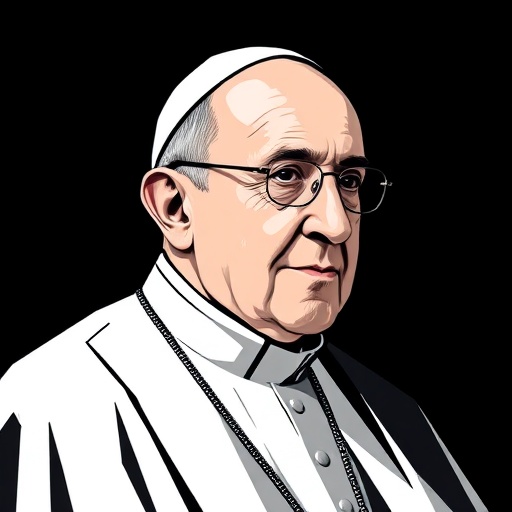
Pope Francis — "Corruption is the gangrene of a people."
Corruption is the gangrene of a people.
Corruption is the gangrene of a people.
Click any product to generate a realistic preview. Up to 3 at a time.
* Initial load can take up to 90 seconds — revising the preview in another color is nearly instant.
"I am a sinner, and I need the mercy of God."
"The world is tired of hypocritical Christians."
"Who am I to judge a gay person seeking the Lord with good will?"
"Sometimes, when I see a very young priest, who is very rigid, I think: ‘Something is not right with this one.’"
"The death penalty is inadmissible because it is an attack on the inviolability and dignity of the person."
First Latin American and Jesuit pope (2013-), who has steered the Catholic Church toward pastoral inclusion on LGBTQ pastoral care, divorced Catholics, and climate. Closely associated with Pope John XXIII (the Vatican II reformer pope) and Cardinal Walter Kasper (his theological ally on pastoral reform). For an intellectual contrast, see Cardinal Raymond Burke, American traditionalist cardinal, former head of the Vatican Apostolic Signatura — Burke is the public face of Catholic traditionalism that views Francis's pastoral approach as doctrinally dangerous — he has formally challenged Amoris Laetitia and other Francis reforms.
Found in 1 providers: deepseek
1 source checked
Corruption isn't merely dishonesty or greed — it is tissue death spreading through a society's body. Like gangrene, it starts locally, kills what it touches, and spreads outward until the whole organism is threatened. The metaphor insists corruption cannot be tolerated or managed in small doses; it must be cut out entirely, because left alone it destroys institutions, trust, and ultimately the collective health of any community or nation.
Jorge Mario Bergoglio grew up in Argentina, a nation ravaged by cycles of political corruption and economic collapse. As Archbishop of Buenos Aires he lived amid poverty deepened by corrupt governance. As Pope he launched aggressive Vatican Bank reforms, prosecuted financial crimes within the Curia, and repeatedly refused to shield institutions from accountability. This quote is autobiographical — Francis has fought corruption inside the Church itself, not just condemned it from a pulpit.
Francis became Pope in 2013 as the Panama Papers, Lava Jato scandal in Brazil, and systemic abuse cover-ups inside the Church were exposing elite corruption at historic scale. Populist anger globally was fueled by perception that institutions protected insiders. Simultaneously the Church faced its own credibility crisis over financial opacity and abuse. His corruption rhetoric landed in a world already radicalized by seeing exactly what institutional rot produces when left untreated.
AI-generated insights based on extensive research and information for context. Factual errors? Email [email protected].
Your cart is empty