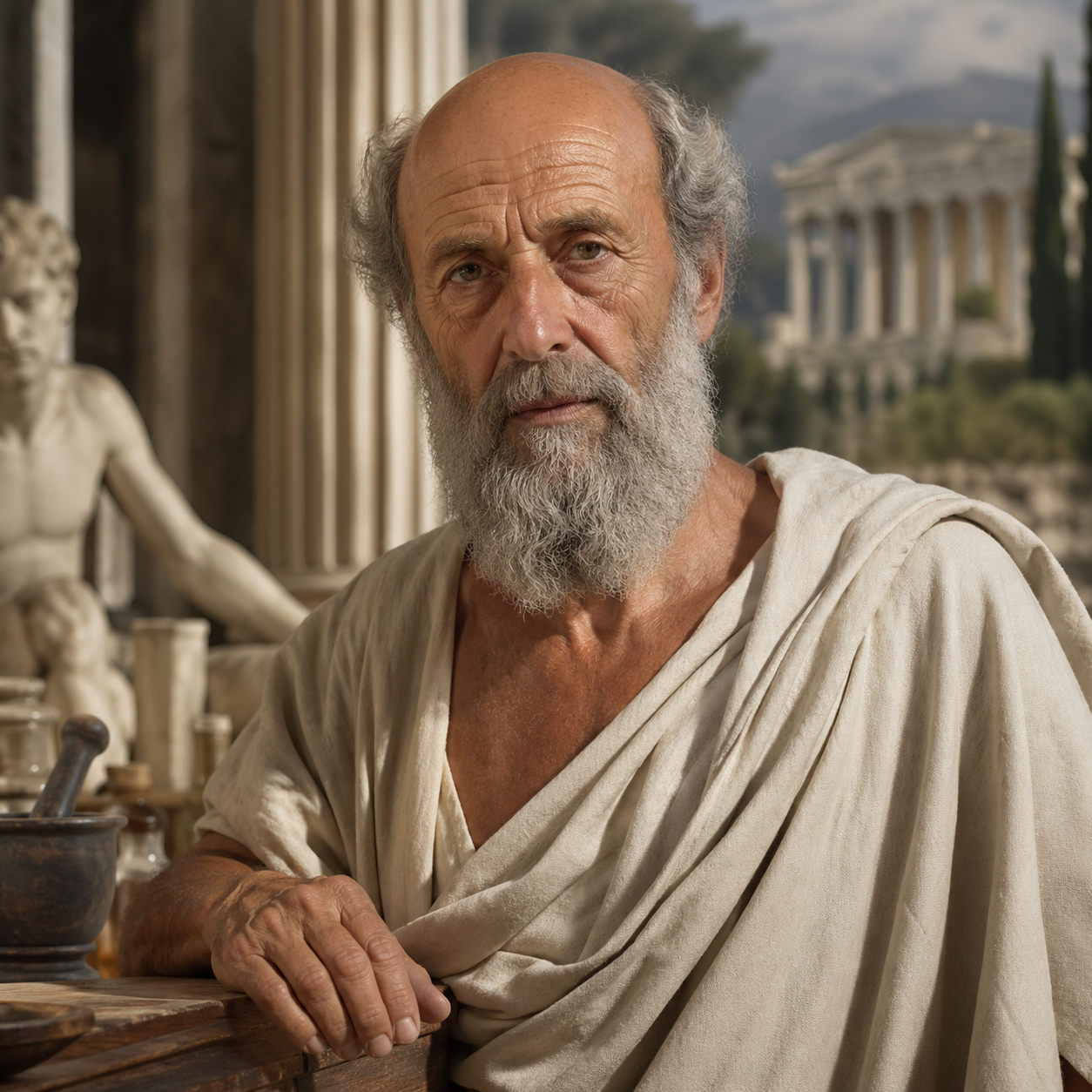
Hippocrates — "Desperate diseases require desperate remedies."
Desperate diseases require desperate remedies.
Desperate diseases require desperate remedies.
Click any product to generate a realistic preview. Up to 3 at a time.
* Initial load can take up to 90 seconds — revising the preview in another color is nearly instant.
"Sleep, when disturbed, is a sign of disease."
"Life is short, the art long, opportunity fleeting, experience treacherous, judgment difficult."
"Those by nature overweight, die earlier than the slim."
"The physician should be able to tell the antecedents, know the present, and foretell the future - must explain the things experienced and things not experienced, and must communicate to the sick the t…"
"It is more important to know what sort of person has a disease than to know what sort of disease a person has."
A pragmatic view on the necessity of strong interventions for severe illnesses.
Date: c. 460-370 BCE
WisdomFound in 2 providers: gemini,grok
2 sources checked
When a condition is severe and life-threatening, only an equally forceful intervention can address it effectively. Mild or cautious treatments fail against extreme problems — the response must match the scale of the threat. Don't treat a crisis with half-measures. The gravity of a situation justifies and demands a proportionally bold, even risky course of action that a routine case would never warrant.
Hippocrates built medicine on observation and proportional reasoning — match the treatment to the disease, not to custom or comfort. As a practicing physician who catalogued serious conditions like epilepsy, head wounds, and epidemic fevers, he understood that timid remedies killed patients with severe illnesses. This quote embodies his empirical, outcomes-driven philosophy: a physician's duty is effectiveness, even when the cure itself carries considerable risk.
In 5th-century BCE Greece, illness was widely attributed to divine punishment, treated through prayer and ritual at Asclepion temples. The devastating Plague of Athens (430 BCE) killed tens of thousands, exposing the limits of traditional religious healing. Hippocrates championed natural, rational explanations over superstition. His saying validated bold, unconventional treatments when standard methods failed — a striking intellectual challenge to an era that still trusted gods over physicians.
AI-generated insights based on extensive research and information for context. Factual errors? Email [email protected].
Your cart is empty