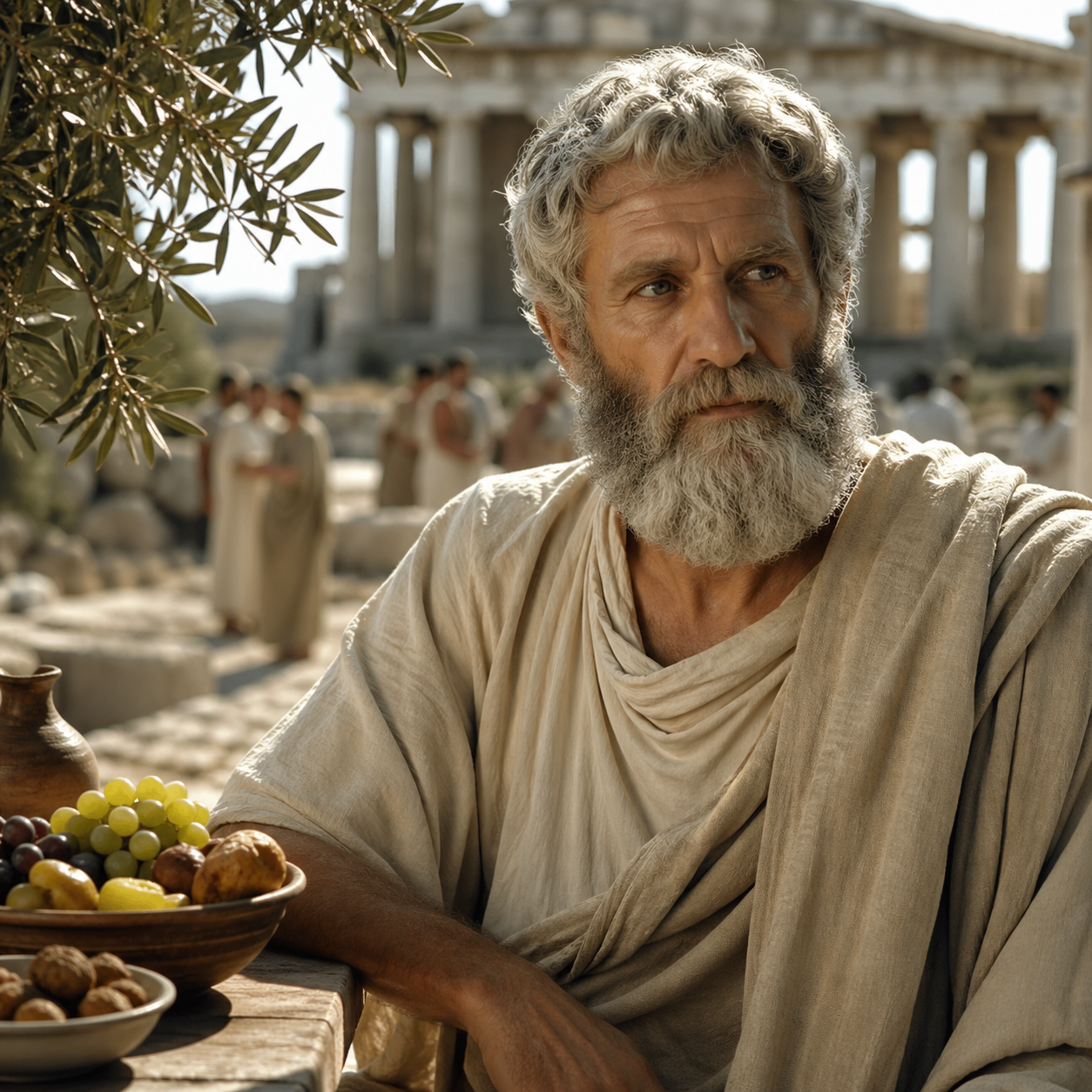
Epicurus — "Do not spoil what you have by desiring what you have not; remember that what you…"
Do not spoil what you have by desiring what you have not; remember that what you now have was once among the things you only hoped for.
Do not spoil what you have by desiring what you have not; remember that what you now have was once among the things you only hoped for.
Click any product to generate a realistic preview. Up to 3 at a time.
* Initial load can take up to 90 seconds — revising the preview in another color is nearly instant.
"The end of all our actions is to be free from pain and fear."
"We are born once and cannot be born twice, but for all eternity must be no more. But you, who are not master of tomorrow, postpone your happiness. Life is wasted by delaying, and each one of us dies w…"
"Pleasure is the beginning and the end of the blessed life."
"Limit yourself to the present, and your fears will be gone."
"Justice is a contract of utility entered into to prevent men from harming or being harmed by one another."
Greek philosopher who founded the Garden school in Athens, whose materialist atomism and pleasure-as-tranquility ethics shaped Hellenistic thought. Closely associated with Lucretius (Roman successor whose De Rerum Natura preserved Epicurean physics). For an intellectual contrast, see the Stoics (Zeno, Epictetus, Marcus Aurelius), the Hellenistic ethical school of discipline-of-acceptance — Stoic 'live according to nature' and Epicurean 'pleasure and absence of pain' framed every ancient ethical decision — every Roman of Cicero's era was implicitly choosing one path or the other. The Stoic-Epicurean rivalry was the central philosophical debate of the Hellenistic and Roman world for 400 years.
The standard scholarly entry points to Epicurus's work: A.A. Long (UC Berkeley, Classics) — Hellenistic Philosophy: Stoics, Epicureans, Sceptics (1974); Tim O'Keefe (Georgia State University, ancient philosophy) — Epicureanism (2010); David Sedley (Cambridge, Classics) — Lucretius and the Transformation of Greek Wisdom (1998). These are the works graduate seminars cite when teaching Epicurus.
Your cart is empty