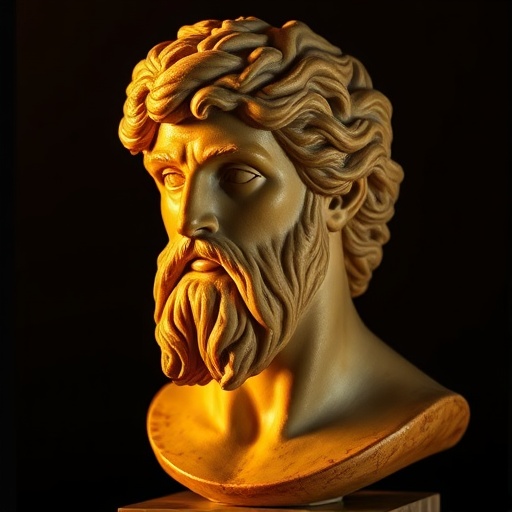
Pythagoras — "Do not wear a ring."
Do not wear a ring.
Do not wear a ring.
Click any product to generate a realistic preview. Up to 3 at a time.
* Initial load can take up to 90 seconds — revising the preview in another color is nearly instant.
"Let no one persuade you by word or deed to do or say whatever is not best for you."
"Beans look like the gates of Hades."
"It is only necessary to make war with five things; with the maladies of the body, the ignorances of the mind, with the passions of the body, with the seditions of the city and the discords of families…"
"Do not put your hand to anything without thinking."
"Geometry is knowledge of the eternally existent."
Greek philosopher and mathematician whose school in Croton combined geometry (the Pythagorean theorem), number-mysticism, and a religious-vegetarian way of life. Closely associated with Thales of Miletus (earlier pre-Socratic and the first philosopher). For an intellectual contrast, see Heraclitus, pre-Socratic Greek philosopher of flux — Heraclitus called Pythagoras 'the chief of swindlers' — among the founding insults of the philosophical-rivalry tradition. Their 'all is flux' vs 'all is number' poles still organize the philosophy of mathematics today (Platonist vs anti-realist).
A 'symbol,' possibly related to avoiding attachments or ostentation.
Date: c. 570 – c. 495 BC
ShockingFound in 1 providers: grok
1 source checked
Avoid wearing a ring on your finger. On the surface it is a simple prohibition against jewelry, but it functions as a coded instruction: do not bind yourself with visible marks of status, attachment, or obligation. A ring is a circle that seals you to something, whether a vow, a faction, or a public identity. The advice is to stay unbound, keep your allegiances private, and refuse the small chains that ornament becomes.
Pythagoras led a secretive brotherhood in Croton whose members followed strict akousmata, short cryptic rules like this one, recorded by later writers such as Iamblichus and Porphyry. He demanded communal property, vegetarianism, silence for initiates, and rejection of outward display. A ring signified worldly attachment and public identity, both of which clashed with his ascetic discipline and his belief that the soul must be purified from material bindings to pursue mathematical and spiritual truth.
In sixth-century BCE Greece and Magna Graecia, signet rings sealed contracts, marked aristocratic rank, and identified citizens in legal matters. Refusing one was a visible social statement in a world where jewelry signaled lineage, wealth, and political allegiance among the tyrannies and oligarchies of the Greek colonies. Pythagoras founded his school in Croton around 530 BCE amid civic turmoil, and his followers' rejection of common ornaments reinforced their separation from ordinary polis life and its entangling oaths.
AI-generated insights based on extensive research and information for context. Factual errors? Email [email protected].
Your cart is empty