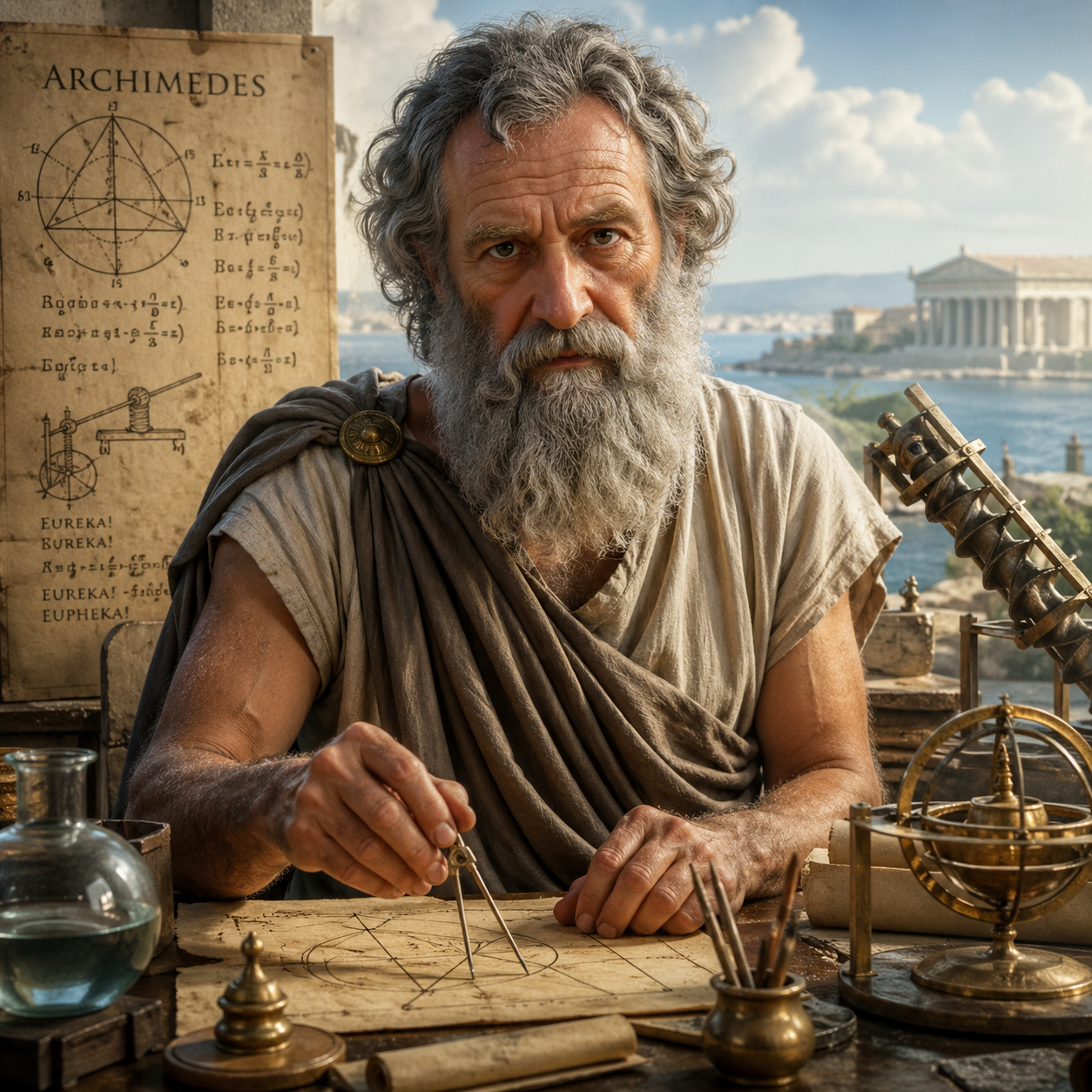
Archimedes — "Eureka!"
Eureka!
Eureka!
Click any product to generate a realistic preview. Up to 3 at a time.
* Initial load can take up to 90 seconds — revising the preview in another color is nearly instant.
"Any solid lighter than a fluid will, if placed in the fluid, be immersed in it to such an extent that the weight of the solid will be equal to the weight of the fluid displaced."
"I will show you how to calculate the number of grains of sand that would fit into the universe."
"If I had a place to stand on, I could move the whole world."
"It is easier to make a thousand discoveries than to invent a single new method."
"It is not possible to find a number greater than the number of grains of sand which could be contained in a sphere of the size of the universe."
Exclaimed upon discovering the principle of buoyancy, running naked through the streets of Syracuse.
Date: c. 250 BCE (approximate, story relayed by Vitruvius Pollio in 1st century BCE)
GeneralFound in 1 providers: gemini
1 source checked
The spontaneous cry 'I have found it!' captures the electric moment when a solution clicks after sustained effort. It describes the sudden clarity that follows deep thinking—when an answer that seemed out of reach becomes obvious all at once. Today it's shorthand for any breakthrough insight, large or small. The word itself has become a universal symbol of discovery, instantly recognized across science, business, and everyday life.
Legend holds that Archimedes shouted this while stepping into his bath and watching water overflow, realizing he could measure a crown's volume through displacement and detect fraud for King Hiero II. It perfectly mirrors his character: a mind so consumed by problems that a mundane moment became a laboratory. His work on buoyancy, levers, pi, and centers of gravity all share this same restless drive to find hidden order in the physical world.
Third-century BC Syracuse sat at the intersection of Greek intellectual tradition and Hellenistic practical politics. Thinkers were pushing beyond pure geometry toward applied natural philosophy—measuring, weighing, testing real materials. King Hiero II needed empirical answers, not abstractions. Archimedes's moment embodied a cultural shift: knowledge existed not only for contemplation but to solve concrete problems for rulers and engineers. It predated the formal scientific method yet demonstrated its core instinct perfectly.
AI-generated insights based on extensive research and information for context. Factual errors? Email [email protected].
Your cart is empty