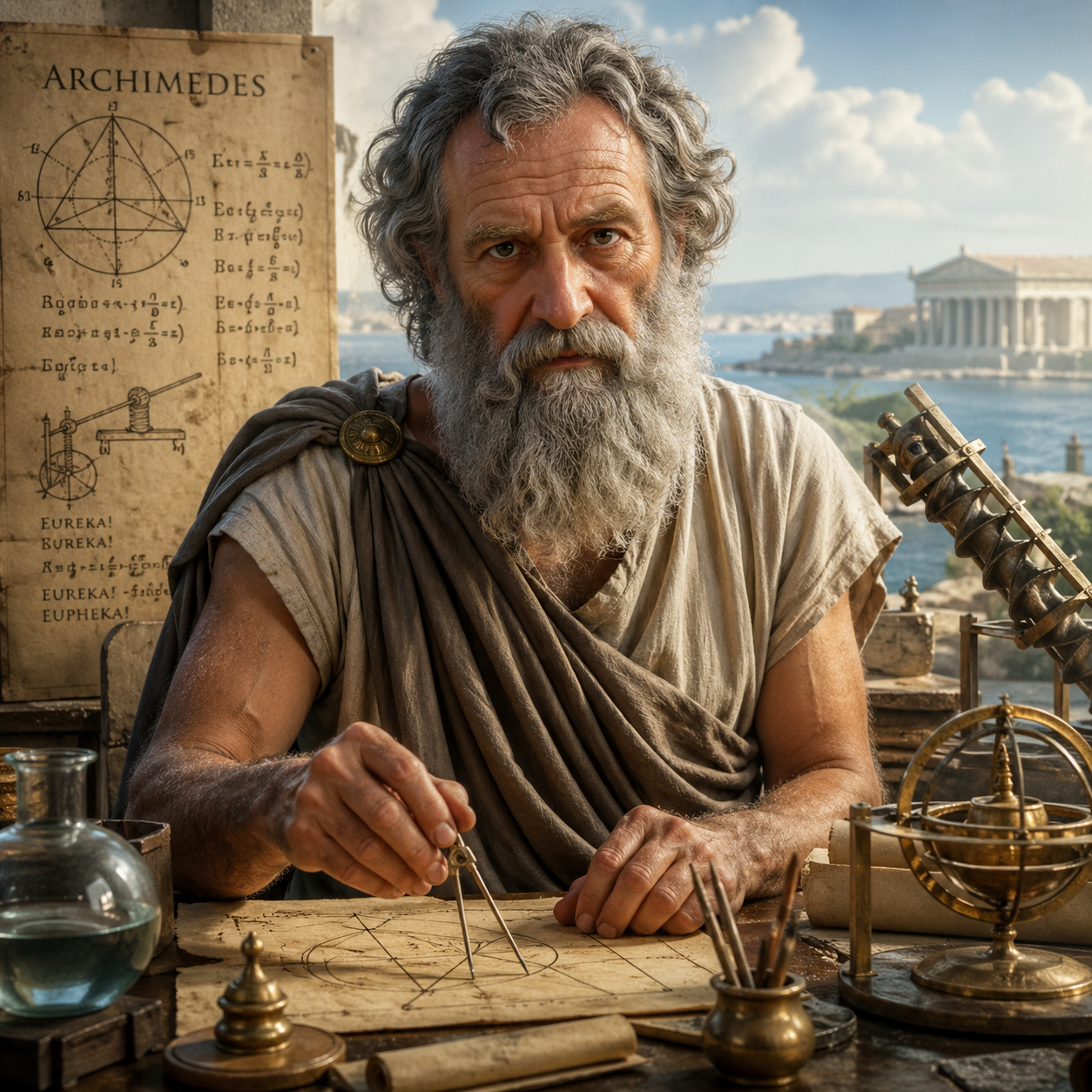
Archimedes — "Eureka! Eureka!"
Eureka! Eureka!
Eureka! Eureka!
Click any product to generate a realistic preview. Up to 3 at a time.
* Initial load can take up to 90 seconds — revising the preview in another color is nearly instant.
"It is a property of the circle that the ratio of its circumference to its diameter is the same for all circles."
"Any solid lighter than a fluid will, if placed in the fluid, be immersed in it to such an extent that the weight of the solid will be equal to the weight of the fluid displaced."
"The most important thing in life is to learn."
"Equal weights at equal distances are in equilibrium, and equal weights at unequal distances are not in equilibrium, but incline towards the weight which is at the greater distance."
"The sphere is the most perfect of all solids."
Famously exclaimed upon discovering the principle of buoyancy while bathing. As told by Vitruvius.
Date: c. 250 BCE
GeneralFound in 1 providers: grok
1 source checked
The sudden, electric feeling of discovering something you've been searching hard for. That moment when confusion breaks open into clarity — when the answer you couldn't see suddenly becomes undeniable. It captures the raw joy of intellectual breakthrough: not a calm realization but an overwhelming, physical rush of certainty. The word itself means 'I have found it' in Greek, and it has become humanity's universal shorthand for that moment of revelation.
According to Vitruvius, Archimedes shouted this while leaping from his bath, having realized water displacement could measure the volume of an irregular object — solving King Hiero II's gold-crown fraud problem. This perfectly encapsulates Archimedes: a man so consumed by mathematical and physical problems that insight struck him mid-bath, so overcome with joy he reportedly ran naked through Syracuse. His life was defined by relentless problem-solving and passionate discovery.
In 3rd-century BC Syracuse, natural philosophy had no institutional laboratories or peer review — discovery was personal, lonely, and hard-won. Greek thinkers worked without algebra, calculus, or modern notation, relying on geometric reasoning alone. Kings commissioned mathematicians to solve practical state problems, like detecting fraudulent goldsmiths. A breakthrough in this environment represented not just intellectual achievement but often political consequence, making genuine discovery genuinely momentous and worth shouting about.
AI-generated insights based on extensive research and information for context. Factual errors? Email [email protected].
Your cart is empty