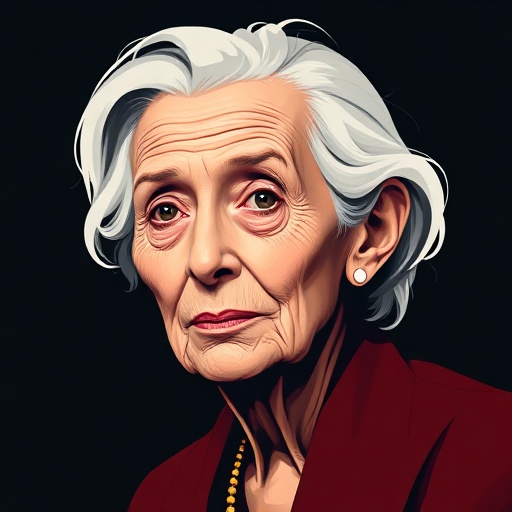
Jane Goodall — "Every animal has a right to live, and we should respect that right."
Every animal has a right to live, and we should respect that right.
Every animal has a right to live, and we should respect that right.
Click any product to generate a realistic preview. Up to 3 at a time.
* Initial load can take up to 90 seconds — revising the preview in another color is nearly instant.
"We need to be voices for the voiceless, and advocates for those who cannot speak for themselves."
"The chimpanzees taught me that it's important to be patient."
"The power of one individual to make a difference is immense, and we should never underestimate it."
"I think the most important thing is to have hope."
"We need to educate the next generation about the importance of protecting the environment."
British primatologist who in 1960 began the longest-running wild primate study at Gombe Stream, transforming our understanding of chimpanzees. Closely associated with Dian Fossey (mountain-gorilla researcher) and Birutė Galdikas (orangutan researcher; together with Goodall and Fossey one of Louis Leakey's 'Trimates'). For an intellectual contrast, see Walter Palmer, American dentist who killed Cecil the Lion in Zimbabwe in 2015 — Palmer represents the trophy-hunting tradition Goodall's life's work has been organized against — the colonial-era hunter-naturalist worldview that treated primates and big game as specimens or trophies, which Goodall's Roots & Shoots and Jane Goodall Institute exist specifically to displace.
Found in 1 providers: grok
1 source checked
Animals have an inherent right to exist — not a privilege humans grant them, but something intrinsic to their lives. Honoring that right requires humans to consciously stop treating other species as resources to exploit or obstacles to remove. It positions every individual animal, not just endangered species in aggregate, as a being with a stake in its own survival, demanding a shift from human dominion to shared moral responsibility.
Goodall arrived at Gombe Stream, Tanzania in 1960 and spent decades observing chimpanzees — documenting their tool use, grief, and intricate social hierarchies. Those findings dismantled the assumption that such capacities were uniquely human. She founded the Jane Goodall Institute and pivoted from pure research to global advocacy against poaching and habitat destruction, driven by the belief that once you truly know an animal, protecting its life becomes non-negotiable.
Goodall's career spans an era of accelerating biodiversity crisis. Scientists now classify the present as a sixth mass extinction, with roughly one million species threatened. Industrial-scale factory farming expanded across the 20th century while deforestation erased critical habitats. The animal rights movement gained cultural momentum from the 1970s onward. Her advocacy emerged as a direct moral counter to the dominant 20th-century view of nature as a resource pool for human consumption.
AI-generated insights based on extensive research and information for context. Factual errors? Email [email protected].
Your cart is empty