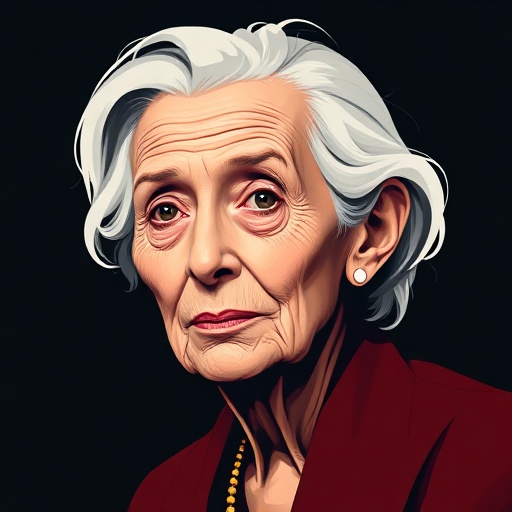
Jane Goodall — "Every single one of us can make a difference, and we should never forget that."
Every single one of us can make a difference, and we should never forget that.
Every single one of us can make a difference, and we should never forget that.
Click any product to generate a realistic preview. Up to 3 at a time.
* Initial load can take up to 90 seconds — revising the preview in another color is nearly instant.
"We have to be the change we want to see in the world, and that starts with each of us."
"It's not just about saving animals, it's about saving ourselves."
"I believe in a spiritual power, but I don't necessarily identify with any particular religion."
"I believe that there is hope for the future, as long as we don't give up."
"What you do makes a difference, and you have to decide what kind of difference you want to make."
British primatologist who in 1960 began the longest-running wild primate study at Gombe Stream, transforming our understanding of chimpanzees. Closely associated with Dian Fossey (mountain-gorilla researcher) and Birutė Galdikas (orangutan researcher; together with Goodall and Fossey one of Louis Leakey's 'Trimates'). For an intellectual contrast, see Walter Palmer, American dentist who killed Cecil the Lion in Zimbabwe in 2015 — Palmer represents the trophy-hunting tradition Goodall's life's work has been organized against — the colonial-era hunter-naturalist worldview that treated primates and big game as specimens or trophies, which Goodall's Roots & Shoots and Jane Goodall Institute exist specifically to displace.
Found in 1 providers: grok
1 source checked
Individual action matters more than most people believe. This quote pushes back against the feeling of helplessness—the idea that problems are too big for one person to affect. It insists that collective change is built from individual choices, and that forgetting your own power is itself a form of giving up. Every person's decisions, habits, and voice contribute to outcomes larger than themselves.
Goodall embodied this belief personally. With no university degree when she arrived at Gombe, Tanzania in 1960, she was dismissed by peers who doubted her methods. Her decades of patient observation rewrote what science understood about chimpanzees and human uniqueness. Later, she founded Roots & Shoots, a global youth program built on the explicit premise that young people in any community can drive real environmental and humanitarian change.
Goodall's career spans the environmental awakening of the 1960s through today's climate crisis. As industrial deforestation accelerated, biodiversity collapsed, and carbon emissions destabilized global climate systems, widespread eco-anxiety took hold—a sense that catastrophe is inevitable and individual action meaningless. Goodall's message directly counters that despair. Her work emerged alongside the first Earth Day in 1970 and into a generation grappling with whether collective will can still reverse planetary harm.
AI-generated insights based on extensive research and information for context. Factual errors? Email [email protected].
Your cart is empty