Archimedes — "Every solid body immersed in a fluid is buoyed up by a force equal to the weight…"
Every solid body immersed in a fluid is buoyed up by a force equal to the weight of the fluid displaced by the body.
Every solid body immersed in a fluid is buoyed up by a force equal to the weight of the fluid displaced by the body.
Click any product to generate a realistic preview. Up to 3 at a time.
* Initial load can take up to 90 seconds — revising the preview in another color is nearly instant.
"The properties of bodies depend on their figures."
"Every magnitude is comparable with every other magnitude of the same kind."
"The shortest distance between two points is a straight line."
"I have discovered a way to measure the circumference of the Earth."
"It is not possible to find a number greater than the number of grains of sand which could be contained in a sphere of the size of the universe."
Found in 1 providers: grok
1 source checked
When an object is submerged in a liquid, the liquid pushes back up with a force exactly equal to the weight of the liquid the object displaces. This explains why a steel ship floats while a steel bolt sinks — shape determines how much water is displaced. Objects feel lighter underwater for the same reason. The principle is precise and measurable: buoyancy equals displaced fluid weight, no more, no less.
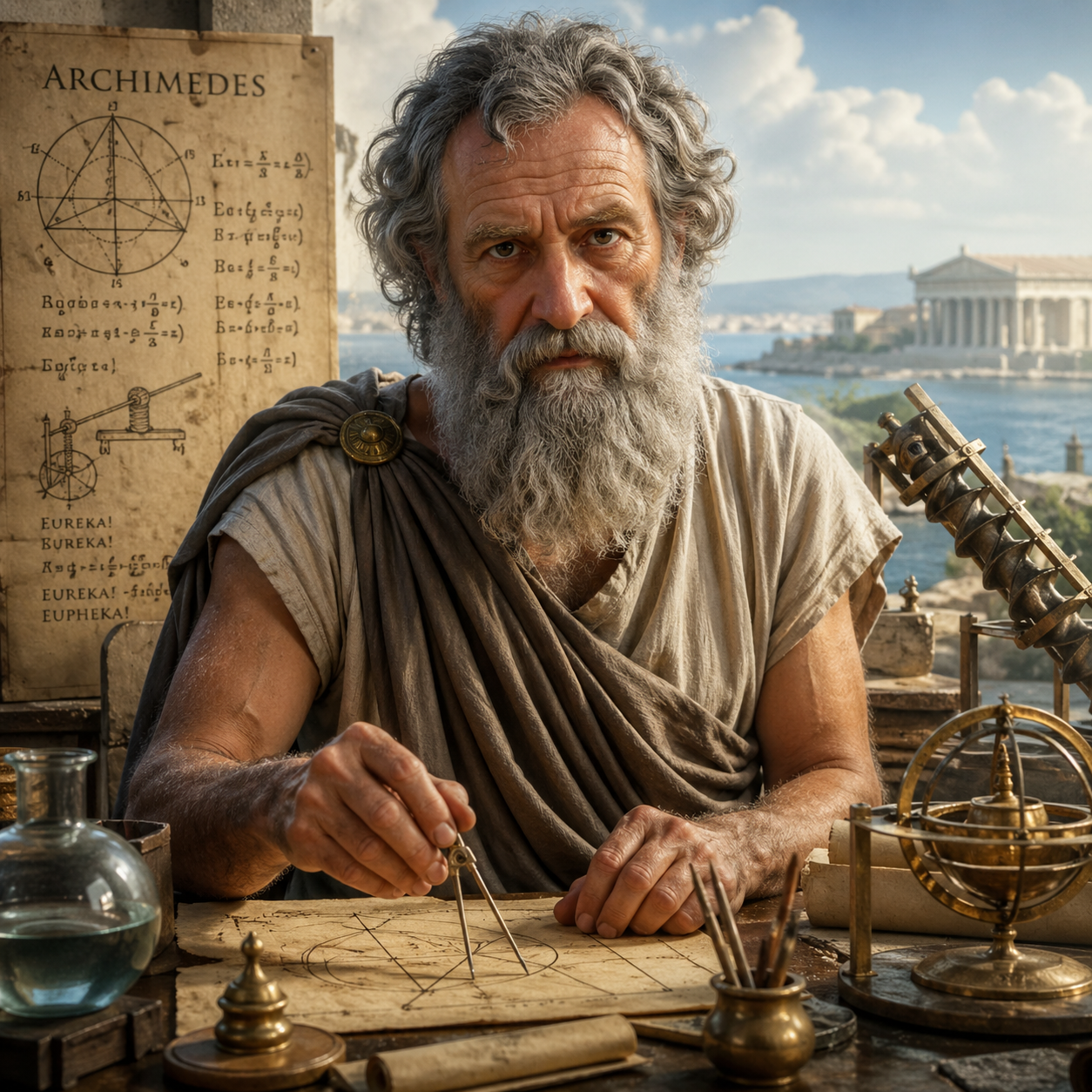
Legend holds Archimedes discovered this principle in his bath, leaping out shouting 'Eureka!' He applied it practically: King Hiero II suspected his golden crown was diluted with silver, and Archimedes used displaced water to measure its density without melting it, exposing the fraud. This reflects his defining genius — converting abstract mathematical insight into precise engineering solutions — a pattern seen throughout his work on levers, pulleys, and the war machines he built to defend Syracuse.
In 3rd-century BC Syracuse, a Greek colony in Sicily, Mediterranean naval power and trade depended on shipbuilding. Understanding buoyancy had real strategic stakes. The Hellenistic era saw Greek scholarship flourish across Alexandria and Syracuse, merging pure mathematics with practical engineering. Archimedes himself lived through Rome's devastating siege of his city in 212 BC, designing war machines to defend it. His extraction of universal physical laws from careful observation marked a turning point toward what we now call empirical science.
AI-generated insights based on extensive research and information for context. Factual errors? Email [email protected].
Your cart is empty