Max Planck — "Experiment is the only means of knowledge at our disposal. Everything else is po…"
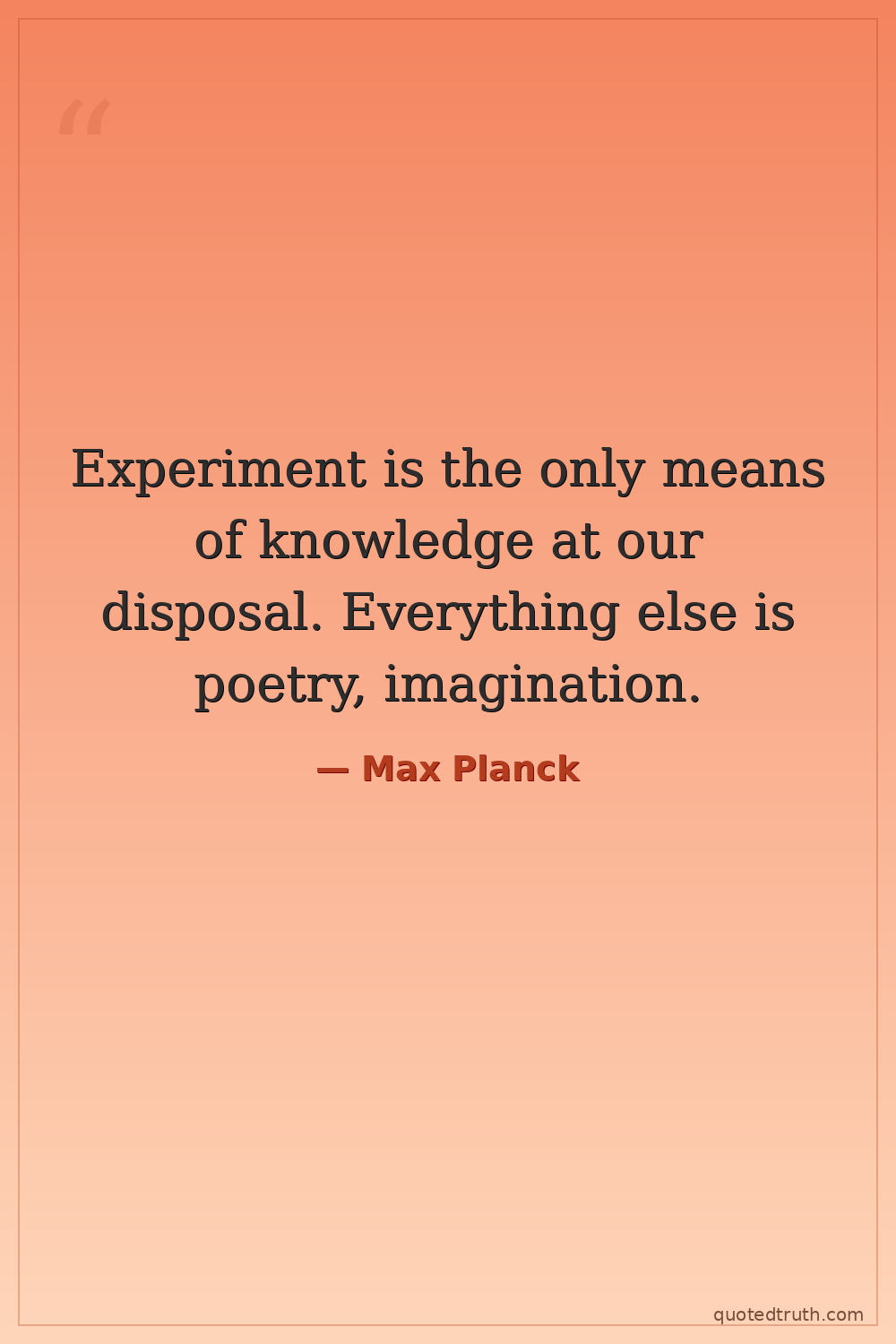
Experiment is the only means of knowledge at our disposal. Everything else is poetry, imagination.
Experiment is the only means of knowledge at our disposal. Everything else is poetry, imagination.
Click any product to generate a realistic preview. Up to 3 at a time.
* Initial load can take up to 90 seconds — revising the preview in another color is nearly instant.
"The freedom of thought and speech must be preserved in all circumstances."
"The greatest obstacle to discovery is not ignorance, but the illusion of knowledge."
"Religion and natural science are fighting a joint battle in an incessant, never-ending crusade against skepticism and against dogmatism, against unbelief and against superstition, and as the motto for…"
"The greatest discovery of all time is that man can change his future by merely changing his attitude."
"The man who has had a spiritual awakening is a man of courage."
Found in 2 providers: gemini,grok
2 sources checked
Real knowledge comes only from testing ideas against reality through controlled experiments. Anything else—however elegant or convincing it sounds—is just speculation, creativity, or storytelling dressed up as truth. Planck is drawing a sharp line between verified evidence and imaginative thinking, arguing that no matter how beautiful a theory is, it holds no claim to being knowledge until experiment backs it up. Everything untested is art, not science.
Planck revolutionized physics in 1900 by proposing energy quanta, a radical idea he initially resisted himself and only accepted because experimental data on blackbody radiation forced him to. A deeply rigorous German theorist trained under Kirchhoff and Helmholtz, he distrusted unsupported speculation and prized measurable results. His Nobel-winning quantum hypothesis was born from fitting equations to stubborn experimental curves, embodying his conviction that evidence, not elegance, dictates scientific truth.
Planck worked during physics's most turbulent era (late 1800s-1940s), when classical Newtonian mechanics was collapsing under new experimental findings about radiation, atoms, and relativity. Rival schools of philosophical speculation—positivism, idealism, Machian empiricism—fought over science's foundations. Meanwhile, radioactivity, X-rays, and spectral lines demanded explanation. In this climate of theoretical chaos, Planck's insistence on experimental grounding defended physics as a discipline distinct from metaphysics, anchoring the emerging quantum revolution in measurable reality.
AI-generated insights based on extensive research and information for context. Factual errors? Email [email protected].
Your cart is empty