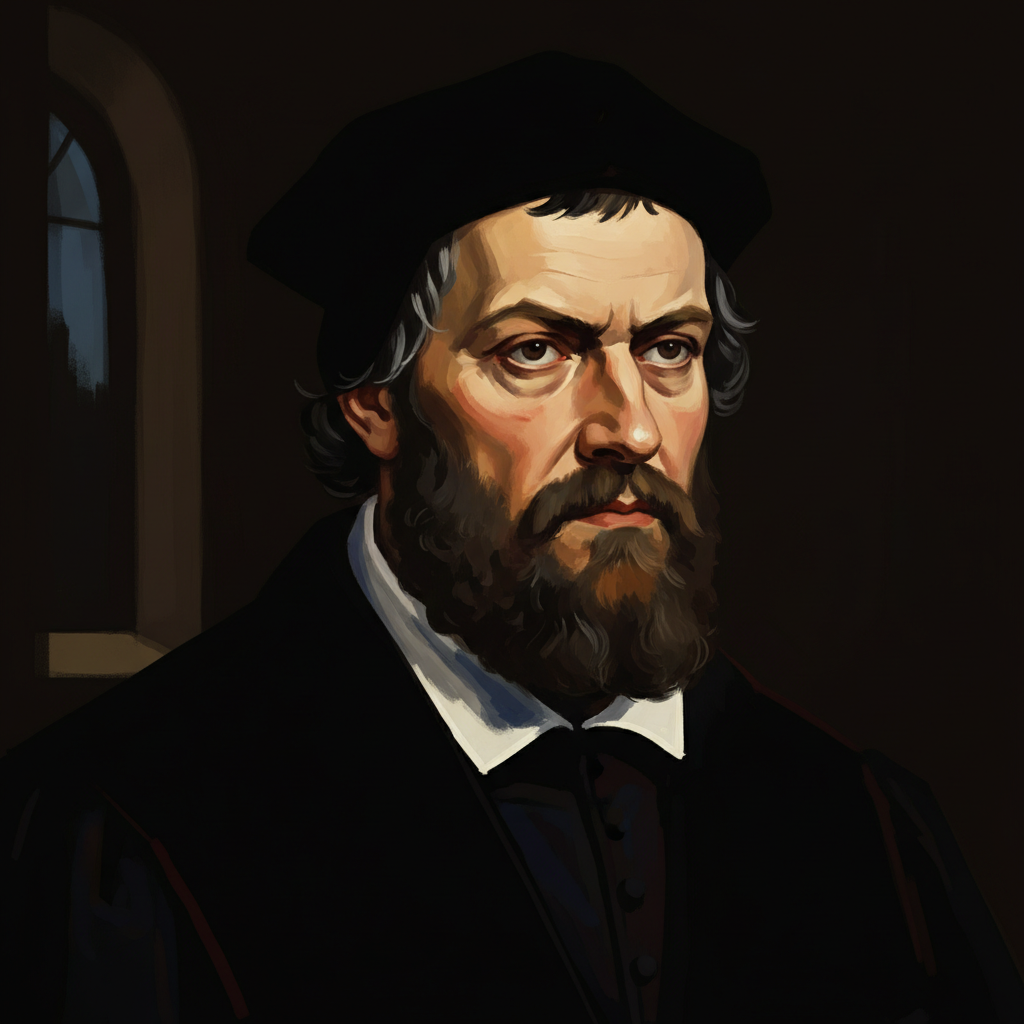
Martin Luther — "Faith is a living, daring confidence in God's grace, so sure and certain that a …"
Faith is a living, daring confidence in God's grace, so sure and certain that a man could stake his life on it a thousand times.
Faith is a living, daring confidence in God's grace, so sure and certain that a man could stake his life on it a thousand times.
Click any product to generate a realistic preview. Up to 3 at a time.
* Initial load can take up to 90 seconds — revising the preview in another color is nearly instant.
"Faith is permitting ourselves to be seized by the things we do not see."
"I have so much to do today, I'll need to spend another hour on my knees."
"The inner man cannot be forced to do out of his own free will, what he should do, except the grace of God change the heart and make it willing."
"I am rough, boorish, stormy, and warlike. I am born to fight innately with innumerable monsters and devils."
"Christianity is nothing but a continual exercise in feeling that you have no sin although you sin, but that your sins are thrown on Christ."
German theologian whose 95 Theses (1517) launched the Protestant Reformation and broke the Catholic Church's monopoly on Western Christianity. Closely associated with Philipp Melanchthon (Lutheran systematizer) and John Calvin (later Reformer who built on Luther's break). For an intellectual contrast, see Pope Leo X, Renaissance pope (1513-1521) — Leo X's indulgence sales triggered Luther's break and Leo excommunicated him in 1521 — Luther's entire Reformation is structured as a direct answer to the indulgence-funded Vatican Leo represented.
Found in 2 providers: grok,gemini
2 sources checked
Real faith is not a cautious opinion or polite agreement with religious ideas. It is an active, risk-taking trust in God's unearned favor so solid that you would bet everything you have on it, over and over, without hesitation. Faith here is not feeling or performance but a settled confidence that shows itself in courage, willing to face loss, danger, or death because the trust underneath it is unshakable.
Luther staked his actual life on this conviction. When summoned before Emperor Charles V at the Diet of Worms in 1521, he refused to recant and was declared an outlaw any subject could kill. A former Augustinian monk crushed by guilt until he seized Romans 1:17, he rebuilt Christianity around justification by faith alone. His definition of faith as daring confidence mirrors his own defiance of pope, emperor, and execution threats.
Early sixteenth-century Europe ran on the medieval Catholic system of works, indulgences, pilgrimages, and priestly mediation, where salvation felt transactional and uncertain. Luther's 1517 Ninety-Five Theses, spread by Gutenberg's press, detonated that framework. Peasants revolted, princes chose sides, and Christendom fractured. In that climate, calling faith a life-staking confidence in grace alone was not abstract theology but a direct assault on Rome's authority and a rallying cry for the Reformation.
AI-generated insights based on extensive research and information for context. Factual errors? Email [email protected].
Your cart is empty