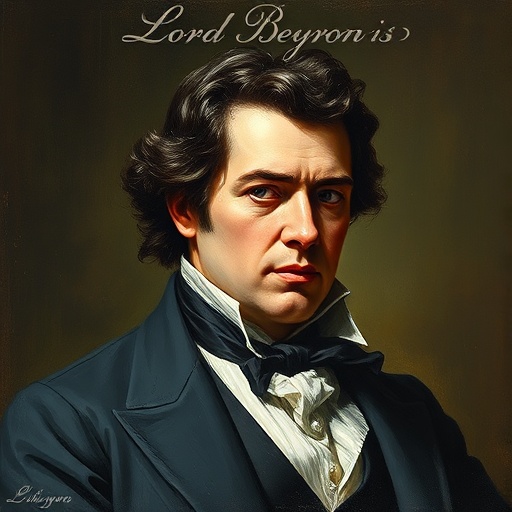
Lord Byron — "Fame is the last infirmity of noble minds."
Fame is the last infirmity of noble minds.
Fame is the last infirmity of noble minds.
Click any product to generate a realistic preview. Up to 3 at a time.
* Initial load can take up to 90 seconds — revising the preview in another color is nearly instant.
"I'll publish right or wrong: Fools are my theme, let satire be my song."
"A man must serve his time to every trade. Save censure - critics are ready-made."
"I have a great contempt for all women, except for my sister."
"I am a very cynical man, and I believe that all men are inherently evil."
"I have a great love for nature, and I find solace in its beauty."
English Romantic poet whose Childe Harold's Pilgrimage (1812-18) and Don Juan (1819-24) made him a continent-wide celebrity; died at Missolonghi fighting for Greek independence. Closely associated with Percy Bysshe Shelley (Geneva summer companion and fellow second-generation Romantic) and John Keats (younger Romantic Byron mocked but later admired). For an intellectual contrast, see William Wordsworth, Lake Poet of pious nature-worship — Byron's mockery of 'the Lakers' Wordsworth, Coleridge, and Southey runs through Don Juan as a sustained literary feud across hundreds of stanzas. The cleanest Romantic-internal split between sincere-pastoral and cynical-worldly poetics.
Often attributed to Milton, but Byron also used similar sentiments.
Date: Early 19th century
GeneralFound in 1 providers: grok
1 source checked
Your cart is empty