Nicolaus Copernicus — "First of all, the world is spherical. This is because the sphere is the most per…"
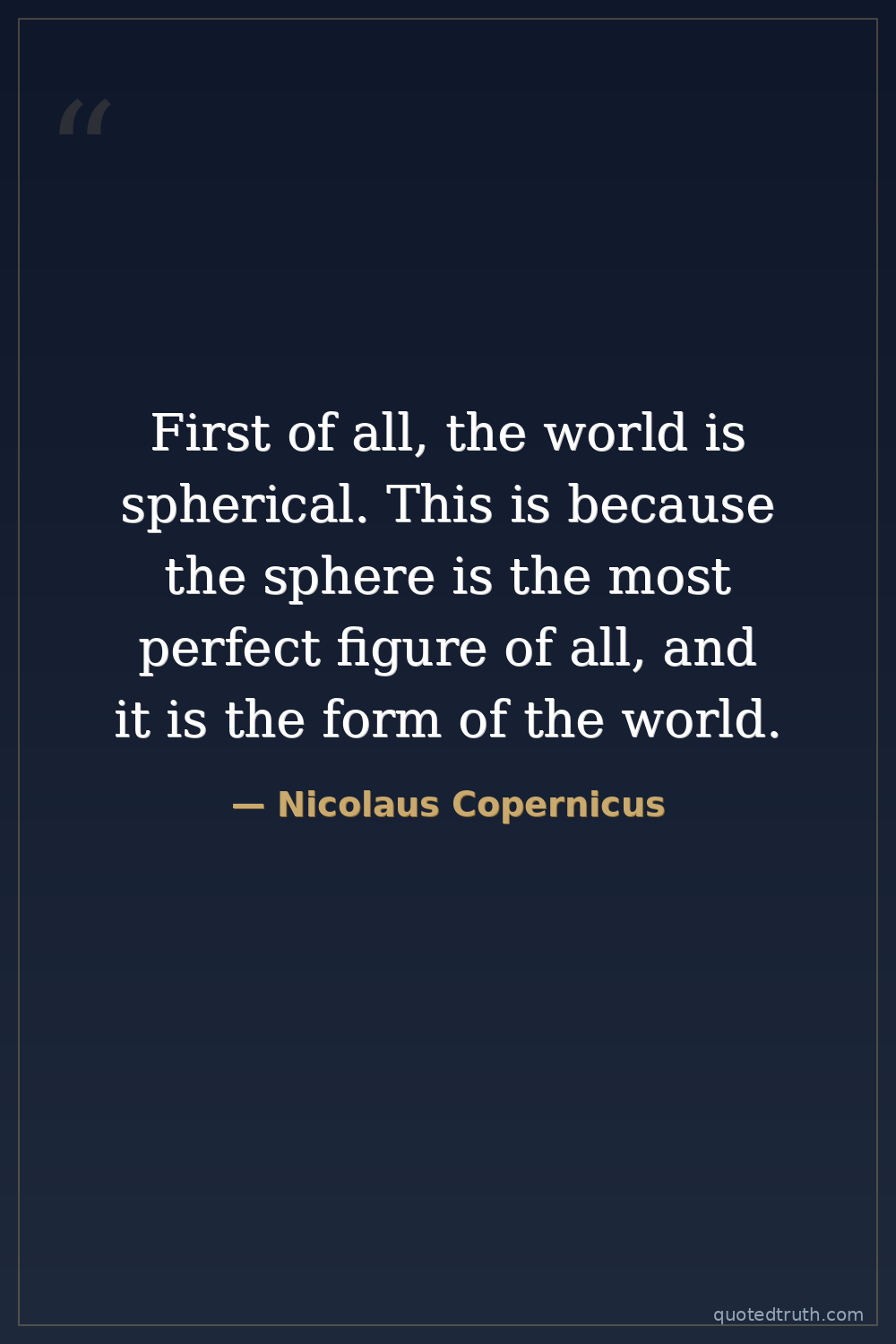
First of all, the world is spherical. This is because the sphere is the most perfect figure of all, and it is the form of the world.
First of all, the world is spherical. This is because the sphere is the most perfect figure of all, and it is the form of the world.
Click any product to generate a realistic preview. Up to 3 at a time.
* Initial load can take up to 90 seconds — revising the preview in another color is nearly instant.
"For, when a ship is floating calmly on a smooth sea, and the mariners are thinking of nothing but the voyage, if a sudden storm should strike it, and the ship should be driven by the wind, it is not t…"
"The celestial sphere is finite and spherical."
"The earth, too, has other motions than that of the daily rotation."
"Those things which I am saying now may be obscure, yet they will be made clearer in their proper place."
"I have been so long in preparing this work that I have almost despaired of publishing it."
Found in 1 providers: grok
1 source checked
Copernicus asserts that Earth and the cosmos are spherical, not merely as observation but as logical necessity — the sphere being geometrically perfect, enclosing maximum volume with minimum surface. He blends empirical reasoning with philosophical idealism: because nature tends toward perfection, the universe must be built on spherical forms. This reflects his belief that mathematical beauty and physical reality are inseparable, that understanding the world's shape reveals something fundamental about its design.
Copernicus was steeped in Neoplatonic philosophy, which held that mathematical perfection mirrors divine order. His entire heliocentric model depended on spheres and circular orbits — he couldn't abandon circles even when observations strained them. As a Catholic canon trained in mathematics and medicine in Renaissance Italy, he absorbed Greek traditions equating spheres with celestial perfection. This quote reveals his method: anchoring revolutionary astronomy in classical philosophical ideals of geometric beauty rather than pure empirical measurement.
In Copernicus's time, Aristotelian cosmology and Ptolemaic astronomy dominated European thought, placing Earth at the universe's center within nested crystalline spheres. Renaissance Neoplatonism revived Platonic ideas about mathematical perfection as evidence of divine creation. The spherical Earth was accepted by scholars, but the deeper question — what moves and why — remained fiercely contested. Declaring the sphere cosmically fundamental was both a classical argument and the geometric foundation for his radical heliocentric reorganization of those same celestial spheres.
AI-generated insights based on extensive research and information for context. Factual errors? Email [email protected].
Your cart is empty