Machiavelli — "For a man who wishes to make a profession of good in everything must necessarily…"
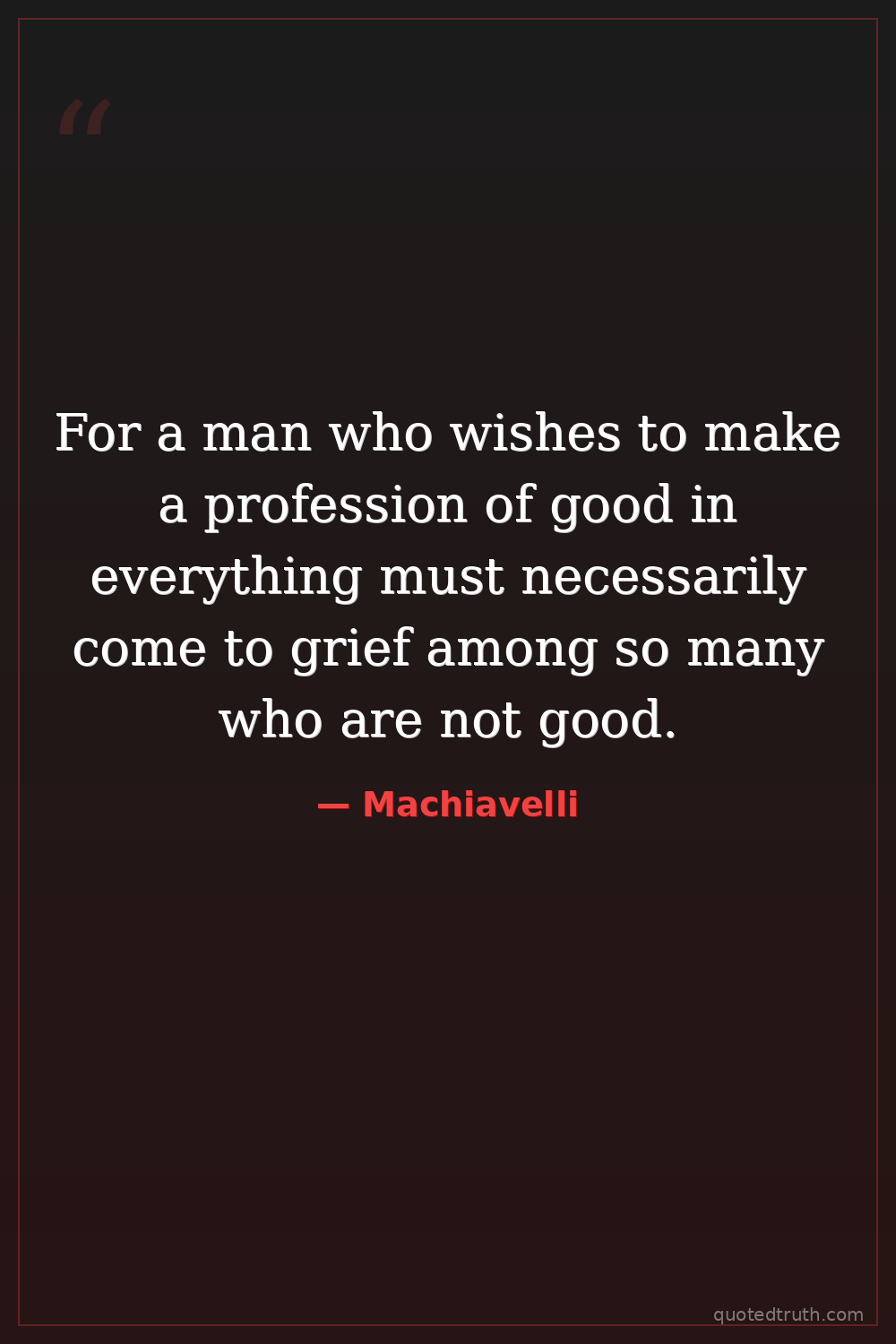
For a man who wishes to make a profession of good in everything must necessarily come to grief among so many who are not good.
For a man who wishes to make a profession of good in everything must necessarily come to grief among so many who are not good.
Click any product to generate a realistic preview. Up to 3 at a time.
* Initial load can take up to 90 seconds — revising the preview in another color is nearly instant.
"A wise prince, therefore, ought to find a means by which his subjects will always in every sort and kind of circumstance have need of the state and of him, and then they will always be faithful to him…"
"It is necessary for a prince, if he wishes to maintain himself, to learn how not to be good, and to use this knowledge and not use it, according to the necessity of the case."
"He who is the cause of another becoming powerful is ruined; because that power has been effected either by industry or by force, and both of these are suspicious to the one who has been raised to powe…"
"It is better to be a good prophet than a good poet."
"Any man who tries to be good all the time is bound to come to ruin among the great number of men who are not good."
Florentine diplomat and political theorist whose The Prince (written 1513) became the founding text of political realism and gave us the adjective 'Machiavellian.' Closely associated with Francesco Guicciardini (fellow Florentine political analyst and historian). For an intellectual contrast, see Erasmus of Rotterdam, Dutch humanist and The Education of a Christian Prince author (1516) — Erasmus's princely-instruction manual was published three years after Machiavelli's, for the same European audience, and is the explicit Christian-virtue alternative to Machiavellian power-realism. The cleanest 'realism vs idealism' founding pairing in modern political theory.
Your cart is empty