Saint Paul — "For I would that all men were even as I myself. But every man hath his proper gi…"
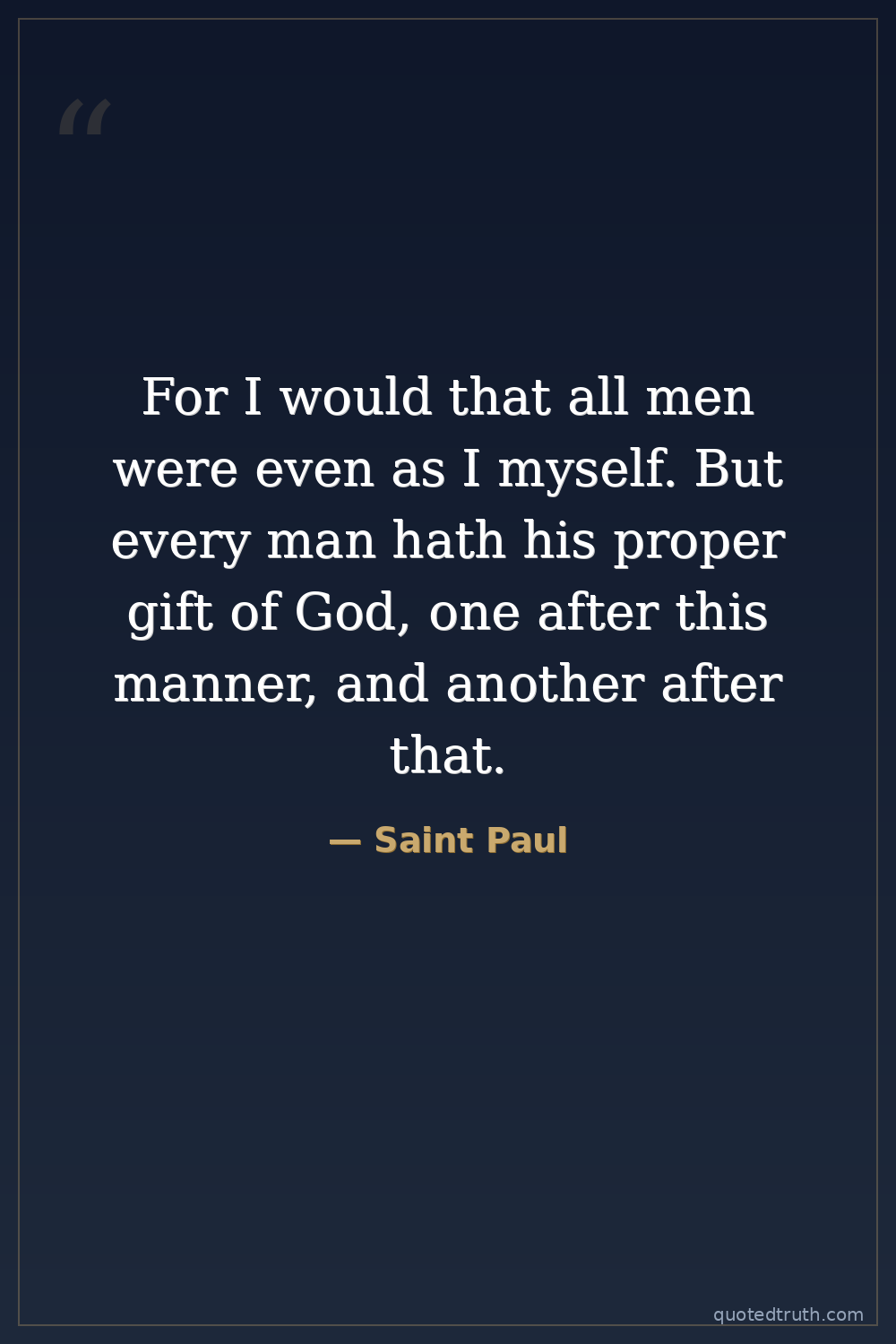
For I would that all men were even as I myself. But every man hath his proper gift of God, one after this manner, and another after that.
For I would that all men were even as I myself. But every man hath his proper gift of God, one after this manner, and another after that.
Click any product to generate a realistic preview. Up to 3 at a time.
* Initial load can take up to 90 seconds — revising the preview in another color is nearly instant.
"Let your women keep silence in the churches: for it is not permitted unto them to speak; but they are commanded to be under obedience, as also saith the law."
"Do not be deceived: ‘Bad company ruins good morals.’"
"If any man love not the Lord Jesus Christ, let him be Anathema Maranatha."
"But when completeness comes, what is in part disappears."
"If anyone thinks that he is something when he is nothing, he deceives himself."
Found in 1 providers: gemini
1 source checked
Paul wishes everyone could live as he does—celibate and fully devoted to spiritual work—but recognizes that isn't realistic or right for everyone. Each person receives a different gift from God, and those gifts take different forms. Some are suited for single life, others for marriage. The point is that diverse callings are legitimate, and people shouldn't feel pressured to copy someone else's path when their own strengths lie elsewhere.
Paul wrote this in 1 Corinthians 7 while unmarried and traveling constantly to plant churches across the Roman Empire. His itinerant missionary life—shipwrecks, prisons, beatings—would have been nearly impossible with a family. Yet as a former Pharisee trained under Gamaliel, he understood Jewish tradition valuing marriage. His willingness to affirm others' different callings reflects his pastoral flexibility toward the messy, mixed congregations he founded in places like Corinth.
In first-century Corinth, a bustling Roman port notorious for sexual license and temple prostitution, new Christians were wrestling with how to handle marriage, celibacy, and sexuality. Greco-Roman culture prized marriage for civic duty and heirs, while some ascetic philosophical schools praised celibacy. Paul was writing to a fractured church asking him practical questions amid this tension, and expectations of Christ's imminent return also shaped his counsel that present arrangements mattered less than devotion.
AI-generated insights based on extensive research and information for context. Factual errors? Email [email protected].
Your cart is empty