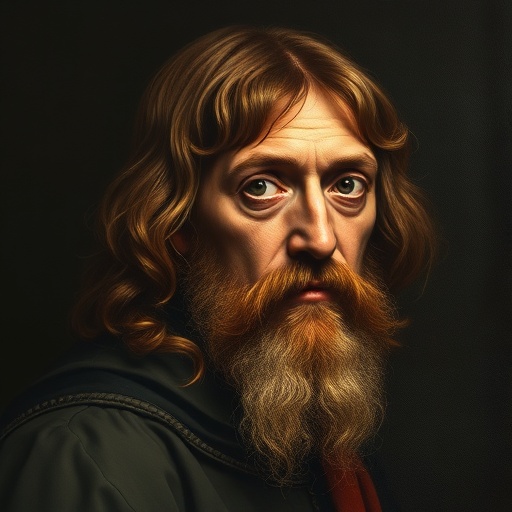
Nicolaus Copernicus — "For it is not the magnitude of the stars, but the magnitude of their distance fr…"
For it is not the magnitude of the stars, but the magnitude of their distance from us, that causes them to appear small.
For it is not the magnitude of the stars, but the magnitude of their distance from us, that causes them to appear small.
Click any product to generate a realistic preview. Up to 3 at a time.
* Initial load can take up to 90 seconds — revising the preview in another color is nearly instant.
"The Sun, as if seated on a royal throne, governs the family of stars which wheel around it."
"First of all, the world is spherical. This is because the sphere is the most perfect figure of all, and it is the form of the world."
"For it is the duty of an astronomer to compose the history of the celestial motions through careful and expert study."
"But if anyone desires to judge these things not ignorantly but with skill and knowledge, he will find that what I have undertaken is in harmony with the best authorities, and that it is in no way oppo…"
"The celestial sphere is finite and spherical."
Found in 1 providers: grok
1 source checked
Stars look tiny not because they are tiny, but because they sit at staggering distances from Earth. Our perception shrinks them relative to nearby objects, not because of any actual diminishment. The lesson is epistemic: appearances mislead when we ignore the role distance plays in shaping what we see. Scale and position matter enormously when interpreting observations — a principle that extends far beyond astronomy into how we judge anything from a limited vantage point.
Copernicus spent his career proving that appearances deceive: Earth seems stationary, yet it orbits the Sun. He recognized that stars showed no observable parallax during Earth's annual orbit and concluded they must be vastly more distant than previously imagined — a necessary implication of heliocentrism. His 1543 work De Revolutionibus repositioned humanity from cosmic center to one small point in an enormous universe, making this quote a direct expression of his astronomical reasoning and intellectual humility.
In Copernicus's time, the Ptolemaic geocentric model placed Earth at the universe's center, with stars fixed on a relatively nearby celestial sphere. Medieval and Renaissance thinkers believed the cosmos was finite and comprehensible. Suggesting stars were unimaginably far away implied a universe of terrifying scale, threatening both Aristotelian physics and theological cosmology. The Protestant Reformation made intellectual heterodoxy dangerous. Copernicus withheld De Revolutionibus until his deathbed, aware that reframing cosmic distances meant reframing humanity's place in creation.
AI-generated insights based on extensive research and information for context. Factual errors? Email [email protected].
Your cart is empty