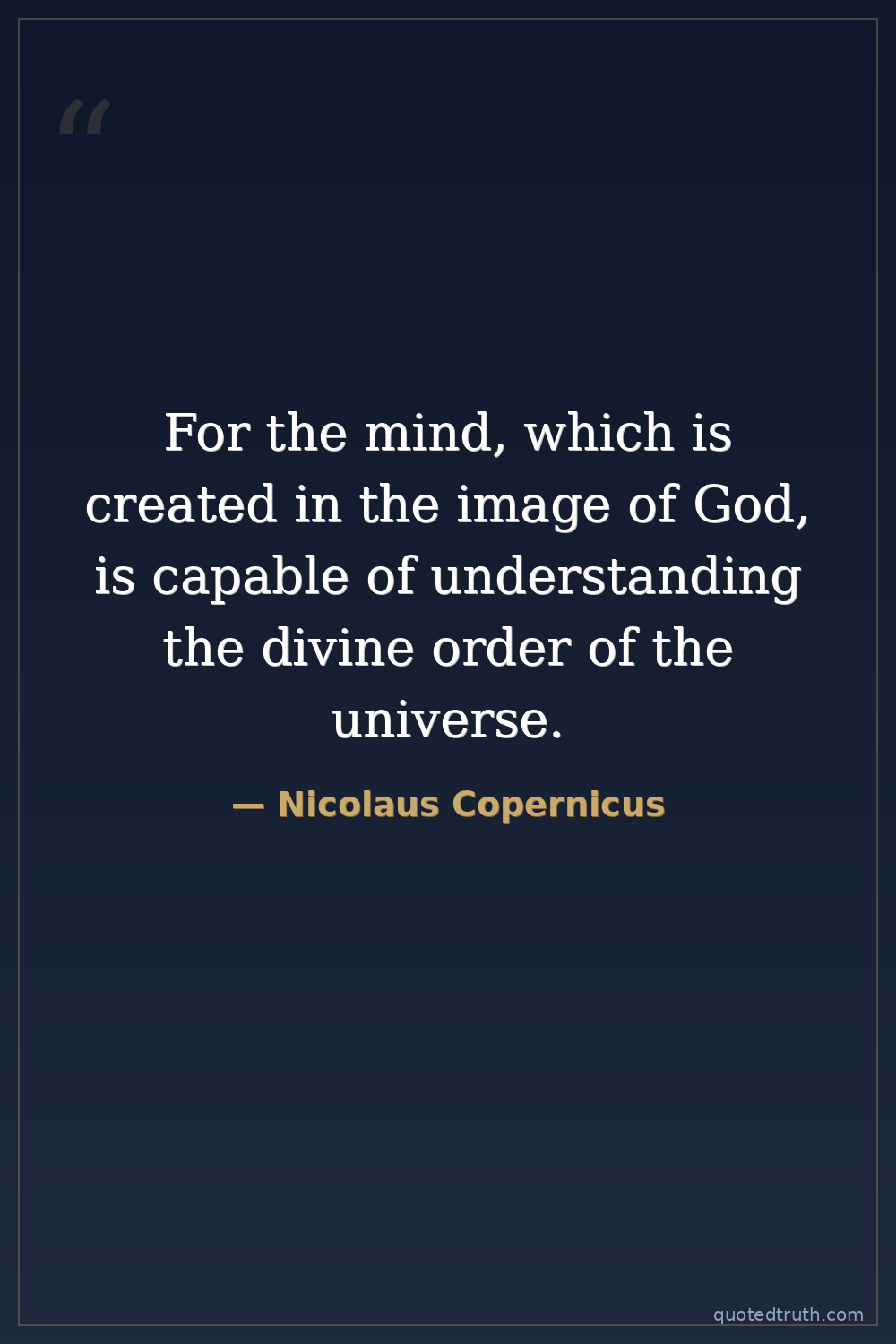
Nicolaus Copernicus — "For the mind, which is created in the image of God, is capable of understanding …"
For the mind, which is created in the image of God, is capable of understanding the divine order of the universe.
For the mind, which is created in the image of God, is capable of understanding the divine order of the universe.
Click any product to generate a realistic preview. Up to 3 at a time.
* Initial load can take up to 90 seconds — revising the preview in another color is nearly instant.
"The world is spherical; whether it is finite or infinite is an open question."
"We are thus brought to a standstill by the realization that our previous theories were not only complicated but also inconsistent."
"For the motion of the earth is a fact, and the apparent change of position of the fixed stars is due to the earth's motion and not to any motion of the stars themselves."
"I am not ignorant that there are some who, having heard that in my treatises on the ordering of the spheres of the universe, I attribute certain motions to the terrestrial globe, will immediately shou…"
"The Sun, the Moon, and the Earth, are all parts of one great system."
Attributed, general sentiment but not a direct quote from his major work.
Date: 16th Century (approx.)
BiblicalFound in 1 providers: grok
1 source checked
Human intellect, divinely created, has the power to grasp the mathematical and structural order underlying the cosmos. Reason and faith are not opposed — God built humans capable of understanding His creation. Studying the universe is therefore both an intellectual and a spiritual act. True comprehension of nature is achievable, and pursuing it honors the intelligence God placed within us.
Copernicus was a Catholic canon who balanced Church duties with decades of private astronomical research. He framed heliocentrism as uncovering God's elegant design, dedicating De Revolutionibus to Pope Paul III. He believed mathematical truth honored the Creator rather than challenged Him. This reflects his core approach: scientific inquiry as a spiritual act, which helped justify his radical repositioning of Earth within the cosmos.
In early 16th-century Europe, the Catholic Church shaped all intellectual life, and natural philosophy was expected to reflect divine order. The Renaissance had revived ancient Greek astronomy while reinforcing creation as a mirror of God's wisdom. The Protestant Reformation was simultaneously fracturing Christendom. Copernicus published De Revolutionibus in 1543, framing heliocentrism in theological language to preempt condemnation — making this statement both genuine belief and calculated defense.
AI-generated insights based on extensive research and information for context. Factual errors? Email [email protected].
Your cart is empty