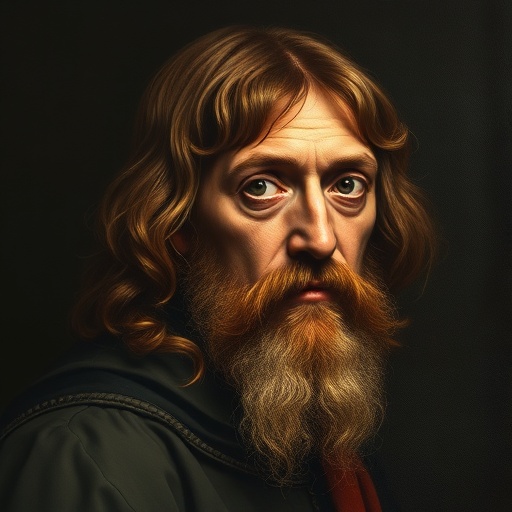
Nicolaus Copernicus — "For the motion which appears to us in the heavens is not in the heavens themselv…"
For the motion which appears to us in the heavens is not in the heavens themselves, but in the earth.
For the motion which appears to us in the heavens is not in the heavens themselves, but in the earth.
Click any product to generate a realistic preview. Up to 3 at a time.
* Initial load can take up to 90 seconds — revising the preview in another color is nearly instant.
"The earth also is spherical, since it presses upon its center from every direction."
"For it is the duty of an astronomer to compose the history of the celestial motions through careful and expert study."
"Thus, the Sun, remaining in one place, illuminates all the planets equally, as if it were a candle placed in the middle of a room."
"To know the mighty works of God, to comprehend His wisdom and majesty and power; to appreciate, in degree, the wonderful workings of His laws, surely all this must be a pleasing and acceptable mode of…"
"Finally we shall place the Sun himself at the center of the Universe."
Found in 1 providers: grok
1 source checked
What we observe as the movement of stars and planets across the sky is not caused by the heavens physically moving around us. Instead, it is Earth itself that moves, creating the illusion of celestial motion. Our perception deceives us: we feel stationary, but we are the ones in motion. Apparent movement is a product of our own position and movement, not the universe revolving around us.
Copernicus spent decades at Frombork Cathedral quietly developing his heliocentric theory while serving as a canon. This statement is the philosophical core of De Revolutionibus Orbium Coelestium, his life's work published just before his death in 1543. His willingness to relocate Earth from the cosmos's center reflected deep mathematical conviction over comfortable tradition, a radical intellectual courage that defined his entire scholarly identity.
In the early 16th century, Ptolemaic geocentrism dominated European astronomy, backed by Aristotelian philosophy and Catholic Church doctrine. Earth's centrality was theological fact, not mere hypothesis. Challenging it risked intellectual ridicule and ecclesiastical censure. Copernicus operated during the Renaissance's flowering of empirical inquiry, when humanist scholars increasingly trusted observation over inherited authority, making his heliocentric reframing both dangerous and historically catalytic.
AI-generated insights based on extensive research and information for context. Factual errors? Email [email protected].
Your cart is empty