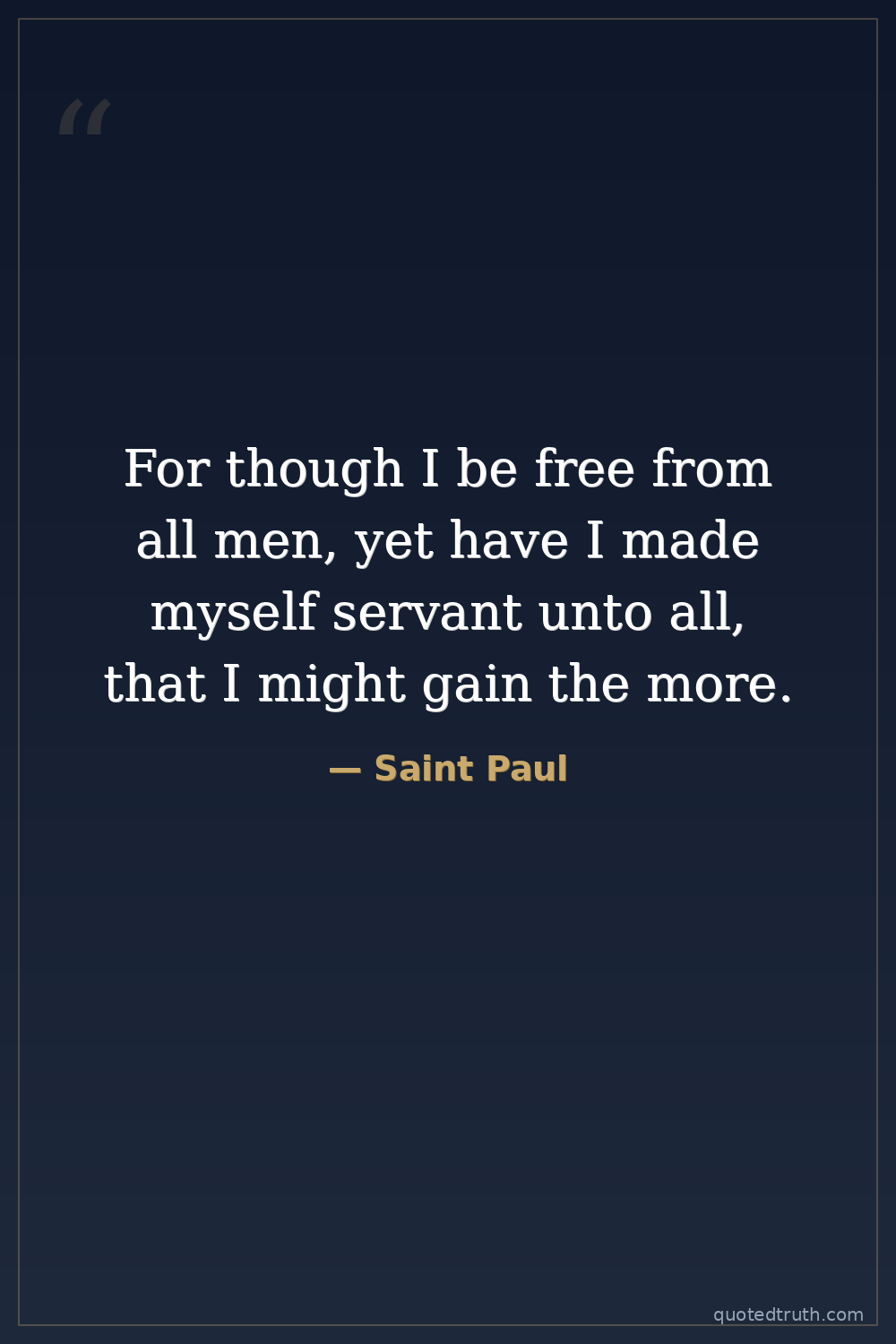
Saint Paul — "For though I be free from all men, yet have I made myself servant unto all, that…"
For though I be free from all men, yet have I made myself servant unto all, that I might gain the more.
For though I be free from all men, yet have I made myself servant unto all, that I might gain the more.
Click any product to generate a realistic preview. Up to 3 at a time.
* Initial load can take up to 90 seconds — revising the preview in another color is nearly instant.
"For ye suffer fools gladly, seeing ye yourselves are wise."
"For I could wish that I myself were accursed from Christ for my brethren, my kinsmen according to the flesh."
"For I am jealous over you with godly jealousy: for I have espoused you to one husband, that I may present you as a chaste virgin to Christ."
"But though we, or an angel from heaven, preach any other gospel unto you than that which we have preached unto you, let him be accursed."
"For Adam was first formed, then Eve. And Adam was not deceived, but the woman being deceived was in the transgression."
Found in 2 providers: gemini,grok
2 sources checked
Even though nobody has authority over me and I owe nothing to anyone, I deliberately put myself at everyone's service. I adapt to their needs, set aside my own preferences, and take on the role of a helper rather than a boss. I do this strategically, because meeting people where they are is the most effective way to win them over and bring more of them along with me.
Paul was a Roman citizen and trained Pharisee who could have leveraged significant social standing, yet he worked as a tentmaker to avoid burdening converts and famously became 'all things to all people'—keeping kosher among Jews, eating freely among Gentiles. This voluntary servanthood defined his missionary method across the Mediterranean and reflects his conviction that the gospel's advance mattered more than personal rights or status.
In the first-century Roman world, rigid hierarchies defined everything: citizen over non-citizen, free over slave, patron over client. Voluntarily lowering one's status was culturally shocking and often shameful. Paul wrote this around 55 CE to Corinth, a status-obsessed port city, while navigating tensions between Jewish and Gentile converts whose dietary and ritual practices clashed, making cross-cultural accommodation a practical survival skill for the young church.
AI-generated insights based on extensive research and information for context. Factual errors? Email [email protected].
Your cart is empty