Richard Feynman — "God was invented to explain mystery. God is always invented to explain those thi…"
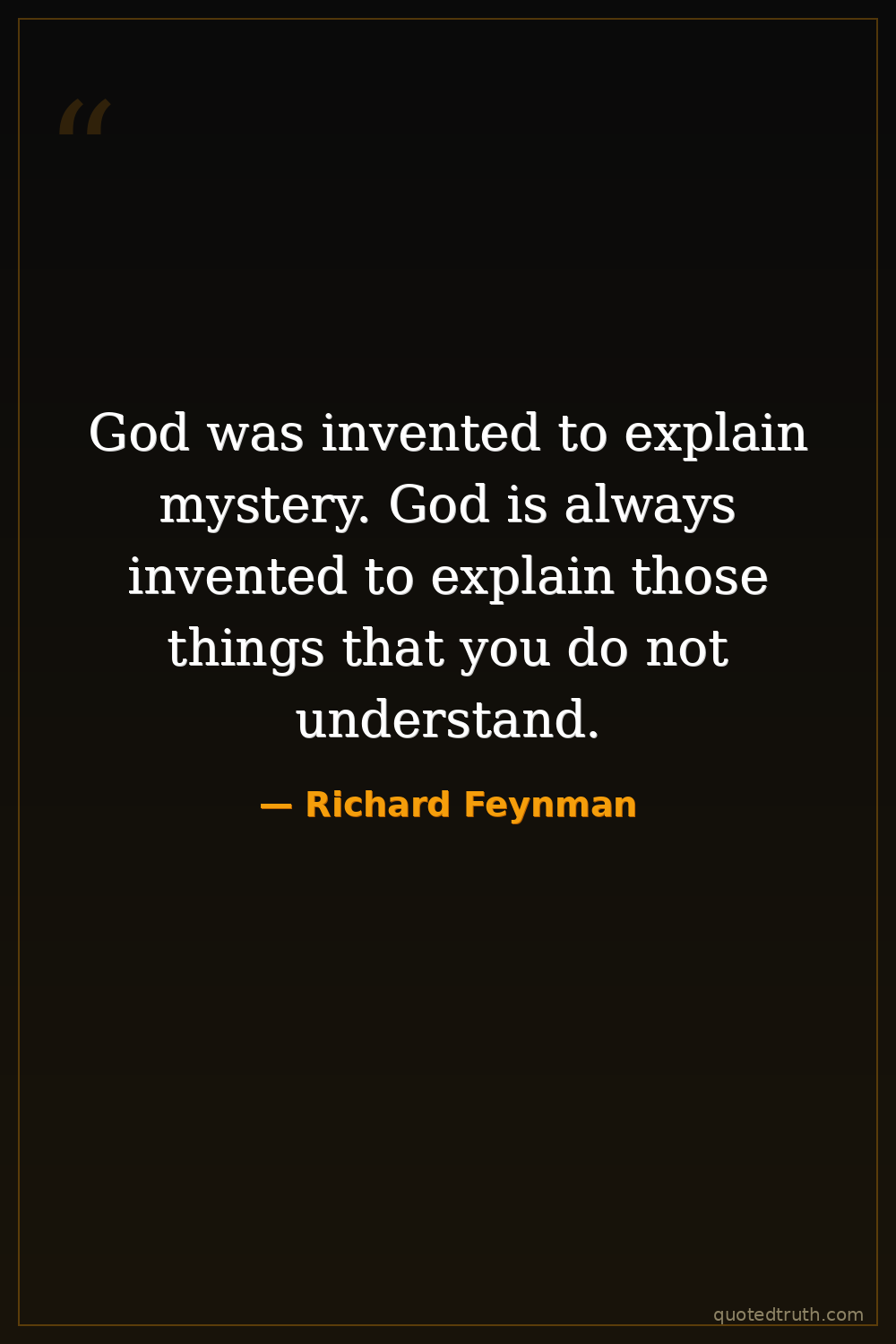
God was invented to explain mystery. God is always invented to explain those things that you do not understand.
God was invented to explain mystery. God is always invented to explain those things that you do not understand.
Click any product to generate a realistic preview. Up to 3 at a time.
* Initial load can take up to 90 seconds — revising the preview in another color is nearly instant.
"I'm smart enough to know that I'm dumb."
"The easiest way to fool yourself is to believe something because you want it to be true."
"Our imagination is stretched to the utmost, not, as in fiction, to imagine things which are not really there, but just to comprehend those things which are there."
"I was also a little bit of a clown."
"The thing that bothered me about it was that I was doing work for the military, and I didn't like that."
American theoretical physicist who shared the 1965 Nobel for QED, developed Feynman diagrams, and wrote the Feynman Lectures on Physics. Closely associated with Julian Schwinger (co-Nobelist for QED) and Murray Gell-Mann (Caltech rival and Eightfold-Way physicist). For an intellectual contrast, see Deepak Chopra, physician and quantum-mysticism author — Feynman's Caltech 'cargo cult science' commencement address is the precise template for what he saw as misuse of physics terminology — Chopra-style appropriation of quantum vocabulary for metaphysical claims is the canonical example of what Feynman called 'fooling yourself'.
From the book 'Superstrings: A Theory of Everything?' edited by Paul C. W. Davies and Julian R. Brown.
Date: 1988
ShockingFound in 1 providers: gemini
1 source checked
When humans encounter something they cannot explain, they attribute it to a divine being rather than admitting ignorance. God serves as a placeholder answer for the unknown. Once science explains a mystery, God gets pushed back to the next frontier of ignorance. This is not an argument against God's existence, but a critique of using divinity as a lazy substitute for genuine understanding and inquiry.
Feynman spent his career at Caltech dismantling mystery through rigorous physics, winning the 1965 Nobel Prize for quantum electrodynamics. He was famously atheistic and intellectually combative, celebrating uncertainty rather than papering over it. His Feynman Lectures emphasized that saying 'I don't know' is the beginning of science, not a failure. He saw intellectual honesty as sacred and God-of-the-gaps reasoning as its antithesis.
Feynman worked during the Cold War scientific boom, when nuclear physics, space exploration, and computing rapidly eroded previously 'inexplicable' phenomena. The 1950s-80s saw fierce tension between religious tradition and accelerating science. Creationism versus evolution debates intensified in American culture. Scientists increasingly had to defend empiricism publicly, making Feynman's blunt critique of divine-placeholder thinking both timely and culturally provocative.
AI-generated insights based on extensive research and information for context. Factual errors? Email [email protected].
Your cart is empty