Erwin Schrodinger — "God's existence or non-existence, and the validity of moral laws, are not matter…"
God's existence or non-existence, and the validity of moral laws, are not matters for scientific inquiry.
God's existence or non-existence, and the validity of moral laws, are not matters for scientific inquiry.
Click any product to generate a realistic preview. Up to 3 at a time.
* Initial load can take up to 90 seconds — revising the preview in another color is nearly instant.
"The only real valuable thing is intuition."
"The scientific method is the best way to get at the truth, but it is not the only way."
"The greatest obstacle to discovery is not ignorance, but the illusion of knowledge."
"There is no quantum jump. There is no such thing as a quantum jump. It is all balderdash."
"What is life? The answer to this question is not what one expects."
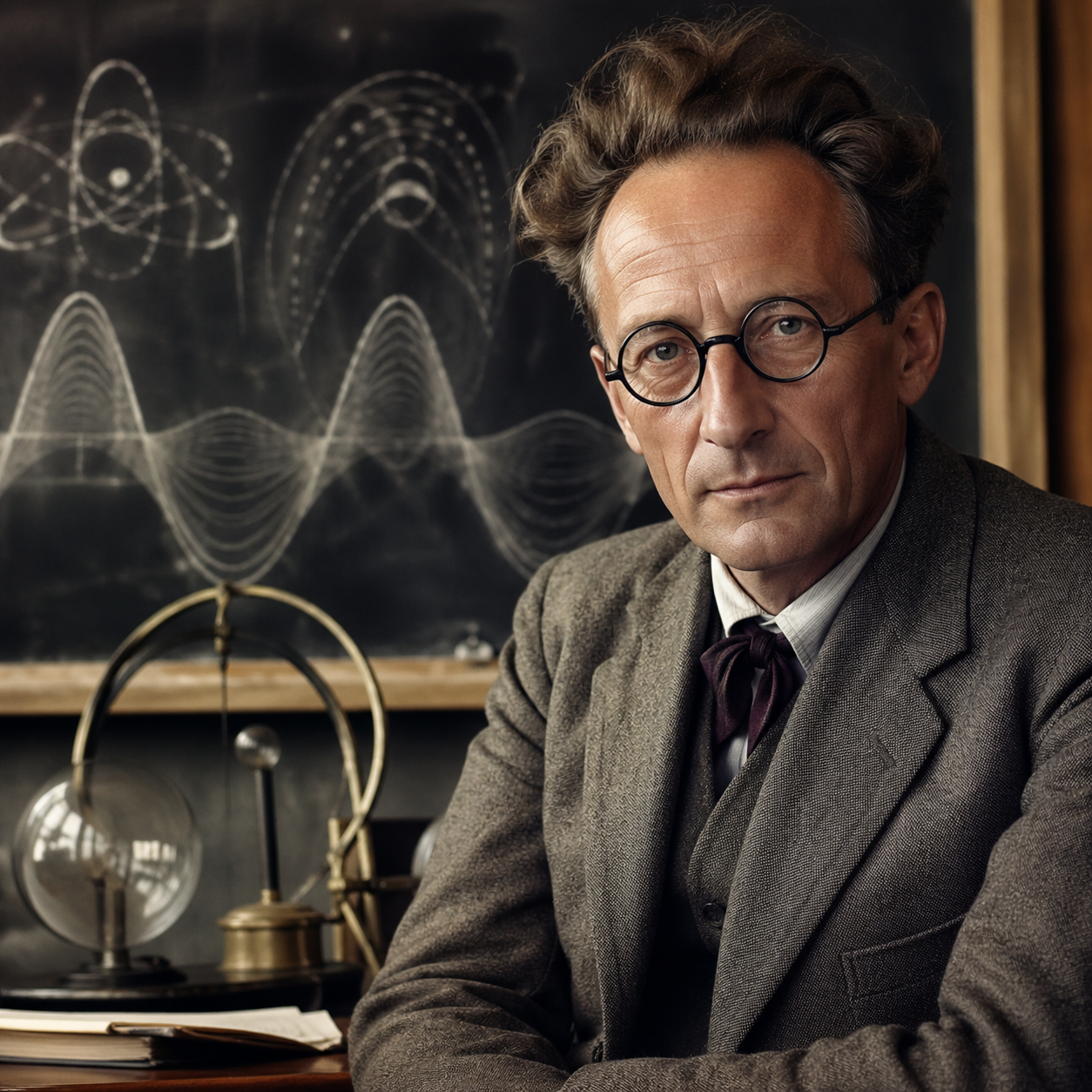
Austrian physicist who shared the 1933 Nobel for the wave equation that bears his name and the famous cat thought-experiment. Closely associated with Werner Heisenberg (matrix-mechanics rival who reached the same physics by different math) and Albert Einstein (his pen-pal on quantum interpretation). For an intellectual contrast, see Niels Bohr, Danish physicist and architect of the Copenhagen interpretation — Schrödinger's cat thought-experiment was specifically designed to ridicule Bohr's 'observer-dependent reality' reading of quantum mechanics — Schrödinger thought the Copenhagen interpretation was absurd; the cat was meant as reductio ad absurdum.
Attributed, but specific source is elusive. Reflects common scientific stance.
Date: Unknown
GeneralFound in 1 providers: grok
1 source checked
Science operates within defined limits — it investigates measurable, testable phenomena but cannot resolve whether God exists or establish the ultimate basis of morality. These belong to metaphysics, philosophy, and theology. The scientific method requires falsifiable hypotheses; questions of divine existence and moral foundations are not falsifiable. Science describes how the world works, but cannot determine what we should value or whether something beyond the physical exists.
Schrodinger, creator of wave mechanics and the famous cat thought experiment, was paradoxically one of science's most philosophical practitioners. He authored 'What is Life?' and 'Mind and Matter,' exploring consciousness through Hindu Vedanta philosophy. He personally rejected the idea that science exhausted all meaningful knowledge, drawing on Eastern mysticism alongside quantum theory. This quote reflects his lifelong conviction that the deepest questions about existence transcend the laboratory's reach.
Schrodinger's era (1887–1961) saw rising scientism — the belief that science could answer every meaningful question. The Vienna Circle's logical positivism declared metaphysical statements meaningless. Meanwhile, Darwinian evolution continued challenging religious authority, and totalitarian regimes weaponized pseudo-scientific ideologies. Quantum mechanics itself upended determinism, opening philosophical debates about reality's nature. Schrodinger's insistence on science's boundaries was a measured defense of philosophy and theology in an age threatening to dissolve them into data.
AI-generated insights based on extensive research and information for context. Factual errors? Email [email protected].
Your cart is empty