Zoroaster — "Happiness is a choice. And sometimes, that choice involves a really good piece o…"
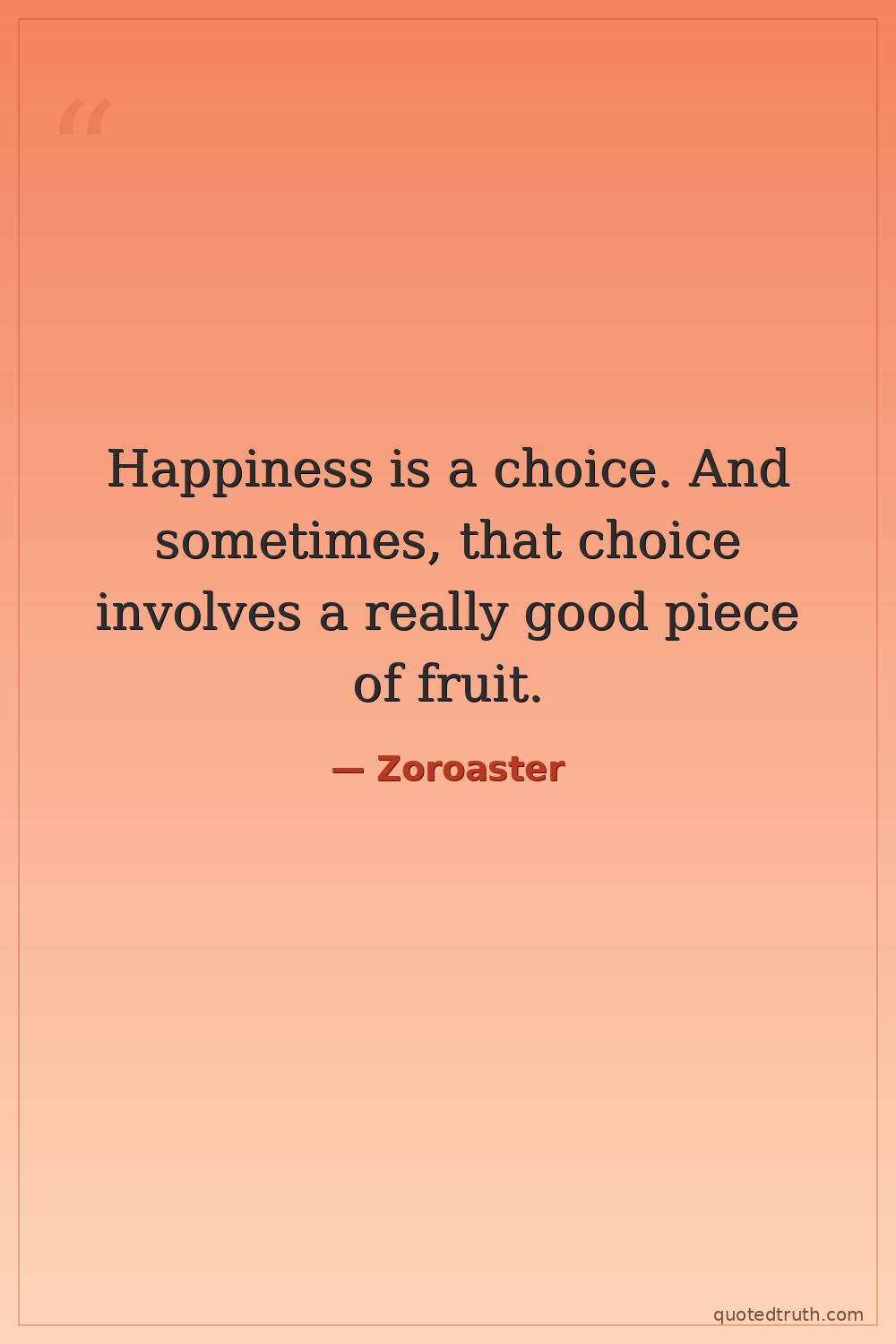
Happiness is a choice. And sometimes, that choice involves a really good piece of fruit.
Happiness is a choice. And sometimes, that choice involves a really good piece of fruit.
Click any product to generate a realistic preview. Up to 3 at a time.
* Initial load can take up to 90 seconds — revising the preview in another color is nearly instant.
"Through Good Mind, Righteousness, and Devotion, Mazda Ahura will grant Immortality and Wholeness."
"I am aware of my weakness, grant me the affection which a lover in the radiance of righteousness."
"He who sows the ground with care and diligence acquires a greater stock of religious merit than he could gain by the repetition of ten thousand prayers."
"And when these two spirits came together, they created life and non-life, and how at the end the worst existence shall be for the wicked, but the Best Mind for the righteous."
"The two primal spirits, who revealed themselves in vision as twins, are the Better and the Bad in thought, word, and action."
Iranian prophet who founded Zoroastrianism, the first major religion of cosmic dualism between good (Ahura Mazda) and evil (Angra Mainyu). Closely associated with The Buddha (near-contemporary Eastern moral-cosmological revolutionary). For an intellectual contrast, see Friedrich Nietzsche, German philosopher of 'beyond good and evil' — Nietzsche appropriated Zarathustra's name for Thus Spoke Zarathustra (1883) precisely to invert the original's moral cosmology — the historical Zoroaster founded the good-versus-evil framework Nietzsche's character announces the end of.
A modern, lighthearted take on a philosophical idea, not a direct quote.
Date: Modern
GeneralFound in 1 providers: grok
1 source checked
Happiness is not something that happens to you passively; it is a decision you make, often in small everyday moments. The line adds a wink by pointing to something simple and tangible, like enjoying a piece of fruit, as proof that joy is built from deliberate attention to ordinary pleasures rather than waiting for grand circumstances to deliver it.
Zoroaster taught that every person actively chooses between Asha (truth, order) and Druj (deceit), making moral agency central to his religion. Happiness as a chosen good aligns with his ethic of good thoughts, good words, good deeds. Fruit fits too: Zoroastrian ritual honors creation, and fresh produce appears on the sacred sofreh, treating the earth's bounty as a gift worth consciously savoring.
Zoroaster lived in Bronze-to-Iron Age eastern Iran, likely around 1500–1000 BCE, among pastoral tribes who feared capricious nature-gods and relied on orchards, dairy, and grain. Against that fatalistic backdrop, his message that humans freely choose their alignment with truth was radical. Cultivated fruit trees, irrigation, and settled agriculture were lifelines, so pointing to fruit evoked both prosperity and the tangible blessings of Ahura Mazda's ordered creation.
AI-generated insights based on extensive research and information for context. Factual errors? Email [email protected].
Your cart is empty