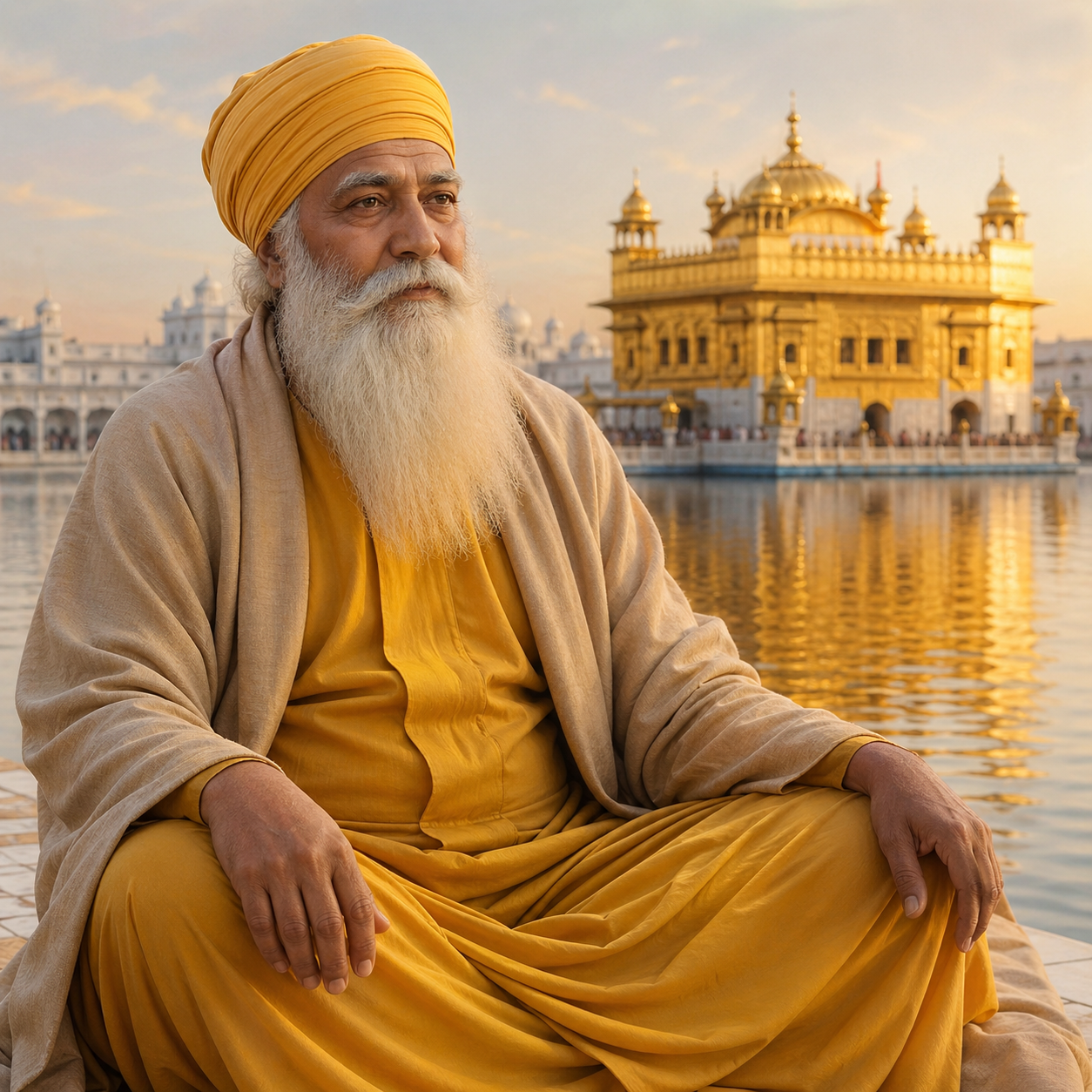
Guru Nanak — "He alone is a Brahmin who knows God."
He alone is a Brahmin who knows God.
He alone is a Brahmin who knows God.
Click any product to generate a realistic preview. Up to 3 at a time.
* Initial load can take up to 90 seconds — revising the preview in another color is nearly instant.
"Those who call themselves kings are butchers of the people."
"The one who eats what he earns through hard labor and shares it, he alone knows the path."
"The ignorant person is blind, even though he has eyes."
"There is but one God. And sometimes, He has a very subtle sense of humor."
"Realization of Truth is higher than all else. Higher still is truthful living."
Founder of Sikhism and the first of the Ten Sikh Gurus, whose teachings of one universal God and rejection of caste shaped Punjab. Closely associated with Kabir (mystical poet whose verses appear in the Sikh Guru Granth Sahib). For an intellectual contrast, see Brahmanical orthodoxy, the Hindu caste-and-ritual establishment of his era — Sikhism was founded as a deliberate alternative to both Hindu ritual hierarchy and Islamic exclusivism — Nanak's universalism was a structural rejection of caste and priestly mediation.
From a Shabad, challenging caste hierarchy by redefining Brahminhood spiritually.
Date: circa 1500
BiblicalFound in 1 providers: deepseek
1 source checked
True spiritual status comes from direct knowledge of the divine, not from birth, caste, rituals, or inherited titles. Being a priest in name means nothing if you lack real understanding of God. The quote redefines a sacred label by its substance: anyone who genuinely realizes the divine qualifies, and anyone who doesn't, regardless of lineage or ceremony, simply doesn't. Merit replaces heredity as the measure of holiness.
Guru Nanak founded Sikhism explicitly rejecting caste hierarchy and ritual formalism. Born into a Hindu Khatri family in 1469 Punjab, he famously declared 'there is no Hindu, no Muslim,' traveled across South Asia debating priests and mullahs, and established langar, the communal meal where all castes eat together. This saying distills his core teaching: access to God is universal, earned through inner realization, not monopolized by the Brahmin class he directly challenged.
Nanak lived 1469-1539 in Punjab under the Delhi Sultanate and early Mughal conquest, amid entrenched Hindu caste stratification and Islamic rule. Brahmins controlled Hindu ritual life while Muslim clerics held political favor, and ordinary people were taxed spiritually and materially by both. The Bhakti and Sufi movements were already questioning orthodoxy. Nanak's redefinition of 'Brahmin' was a radical social leveling in a moment when birth determined worth and religious identity was weaponized by competing elites.
AI-generated insights based on extensive research and information for context. Factual errors? Email [email protected].
Your cart is empty