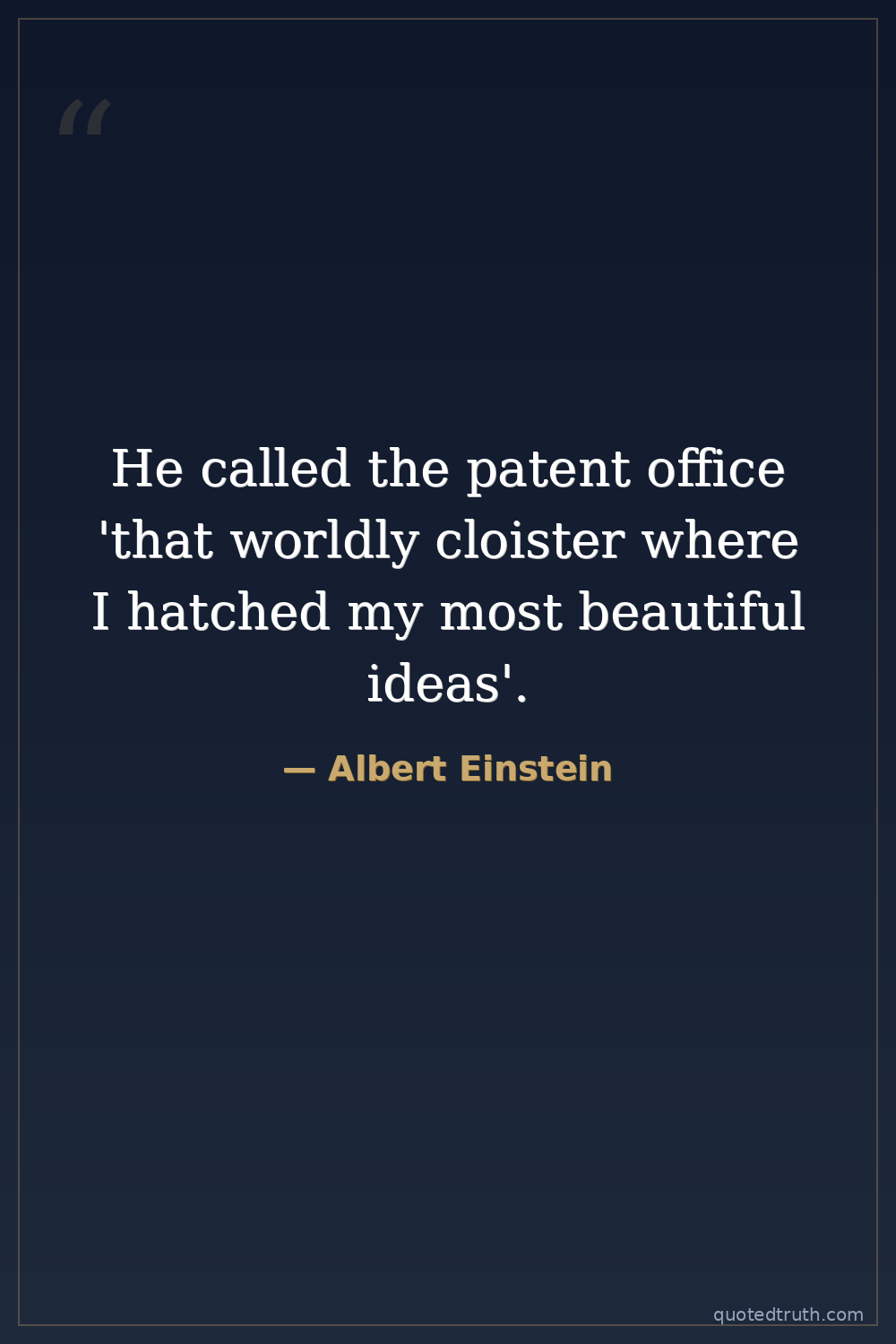
Albert Einstein — "He called the patent office 'that worldly cloister where I hatched my most beaut…"
He called the patent office 'that worldly cloister where I hatched my most beautiful ideas'.
He called the patent office 'that worldly cloister where I hatched my most beautiful ideas'.
Click any product to generate a realistic preview. Up to 3 at a time.
* Initial load can take up to 90 seconds — revising the preview in another color is nearly instant.
"I am by heritage a Jew, by citizenship a Swiss, and by temperament a human being, and only a human being, without any special attachment to any state or national entity whatsoever."
"The Negroes are certainly more primitive than us, but not in a negative sense."
"Only two things are infinite, the universe and human stupidity, and I'm not sure about the former."
"Great spirits have always encountered violent opposition from mediocre minds."
"I am almost ashamed to be living in such peace while all the rest struggle and suffer."
Describing his time working at the Swiss Patent Office.
Date: Referring to period 1902-1909
WisdomFound in 1 providers: gemini
1 source checked
The patent office, a mundane government job, became Einstein's most fertile intellectual refuge. "Worldly cloister" is a deliberate paradox — monasteries isolate monks from the world, but Einstein's isolation was different: embedded in commerce yet mentally withdrawn from it. Reviewing patent applications paid his bills without academic politics, giving him structured days and mental breathing room to pursue the deepest questions in physics on his own terms.
Einstein worked at the Swiss Patent Office in Bern from 1902 to 1909 — exactly when he published his four landmark 1905 papers, including special relativity and the photoelectric effect. Reviewing electromagnetic device patents refined his intuitions about light and motion. Twice rejected for academic posts, he found freedom from institutional constraints at a bureaucrat's desk, where an outsider's unorthodox thinking reshaped the foundations of modern physics.
The early 1900s were the height of the Second Industrial Revolution — electricity, radio, and internal combustion were flooding patent offices with inventions. Meanwhile, physics faced a deep crisis: Maxwell's electromagnetism conflicted irreconcilably with Newtonian mechanics. European academia was hierarchical and credentialist, hostile to outsiders without credentials. An unconventional thinker with no professorship had no institutional platform, yet that exclusion accidentally gave Einstein the isolated mental space needed to resolve physics' greatest contradiction.
AI-generated insights based on extensive research and information for context. Factual errors? Email [email protected].
Your cart is empty