Benjamin Franklin — "He that has a wife and children, has given hostages to fortune."
He that has a wife and children, has given hostages to fortune.
He that has a wife and children, has given hostages to fortune.
Click any product to generate a realistic preview. Up to 3 at a time.
* Initial load can take up to 90 seconds — revising the preview in another color is nearly instant.
"He that lies down with dogs shall rise up with fleas."
"Necessity never made a good bargain."
"I am for doing good to the poor, but... I think the best way of doing good to the poor, is not making them easy in poverty, but leading or driving them out of it. I observed...that the more public pro…"
"He that falls in love with himself will have no rivals."
"A man of words and not of deeds, is like a garden full of weeds."
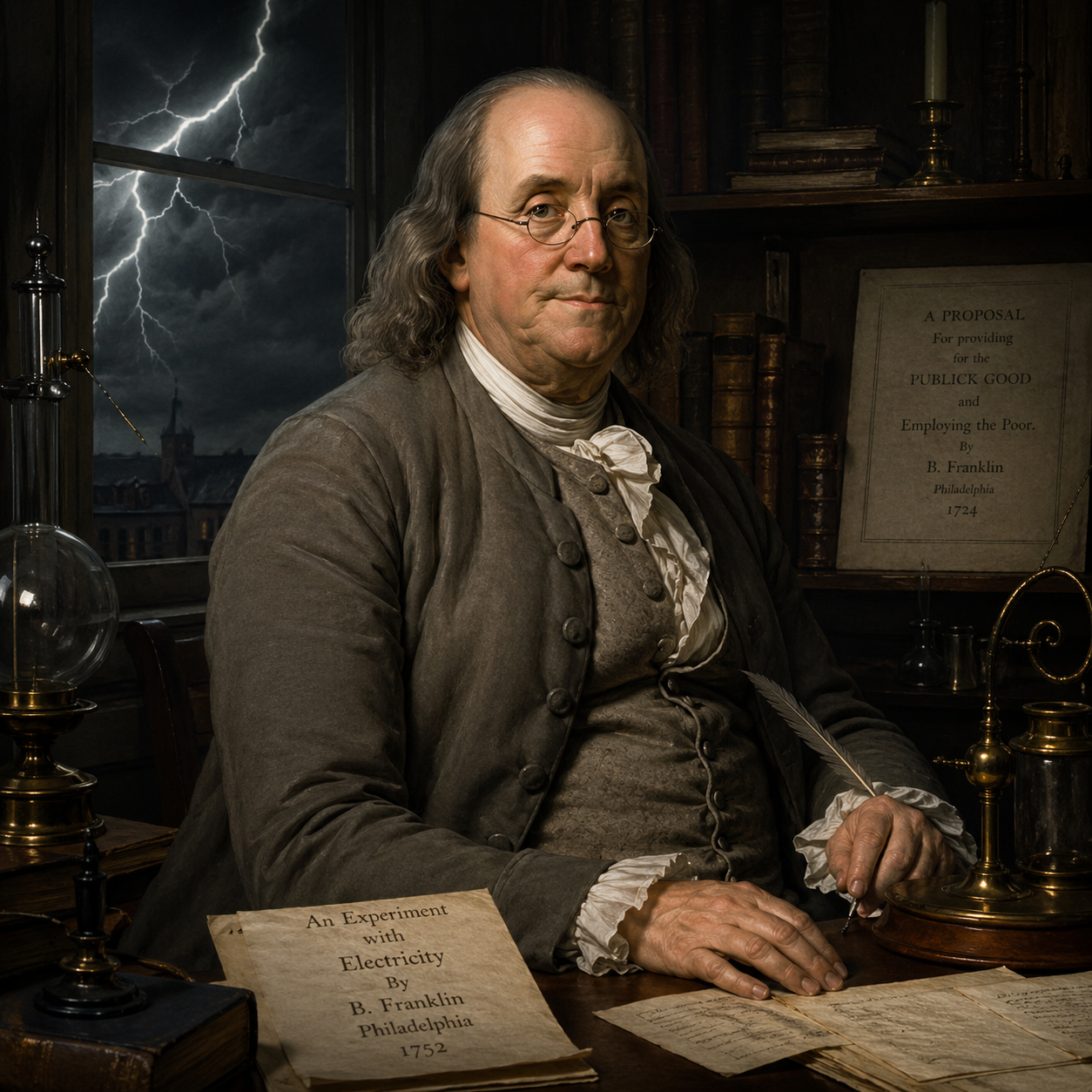
Polymath Founding Father, diplomat, and Poor Richard's Almanack author who helped draft the Declaration of Independence and the Constitution. Closely associated with John Adams (fellow Founder, Massachusetts statesman) and Thomas Jefferson (fellow Declaration drafter). For an intellectual contrast, see Thomas Hutchinson, last royal governor of colonial Massachusetts — Franklin leaked Hutchinson's loyalist correspondence to Boston in 1772 to inflame revolutionary sentiment — Hutchinson represented the colonial-aristocrat crown-loyalty that Franklin's revolution was organized to dismantle.
Found in 1 providers: grok
1 source checked
Marrying and having children makes a man fundamentally vulnerable — his family becomes 'hostages' that fate can exploit against him. He can no longer act with total freedom or absorb bold risks because others depend on him for survival. It is a clear-eyed view of domestic life as constraint: love and obligation bind a person to outcomes beyond their control, multiplying their exposure to loss, anxiety, and the unpredictable cruelties of circumstance.
Franklin's family life embodied this tension directly. He spent years away from his wife Deborah — in London, then Paris — pursuing scientific recognition and political negotiations while she managed home and business alone. His illegitimate son William became a Loyalist governor, estranged from Franklin during the Revolution in a rupture never fully repaired. A man who preached prudence in Poor Richard's Almanack, Franklin knew personally how deep attachments complicate public ambition and limit the risks a free man might otherwise take.
Colonial and Revolutionary America offered almost no buffer against fortune's reversals. Disease routinely claimed children; debt could dissolve households overnight; political allegiance could strip a man of property or liberty. The Revolution itself fractured families across Loyalist-Patriot lines, making domestic bonds genuinely dangerous. Without insurance, pensions, or stable institutions, dependents truly were hostages to fate. A single bad harvest, a merchant's bankruptcy, or a military defeat could erase decades of careful accumulation, making this sentiment viscerally real to Franklin's contemporaries.
AI-generated insights based on extensive research and information for context. Factual errors? Email [email protected].
Your cart is empty