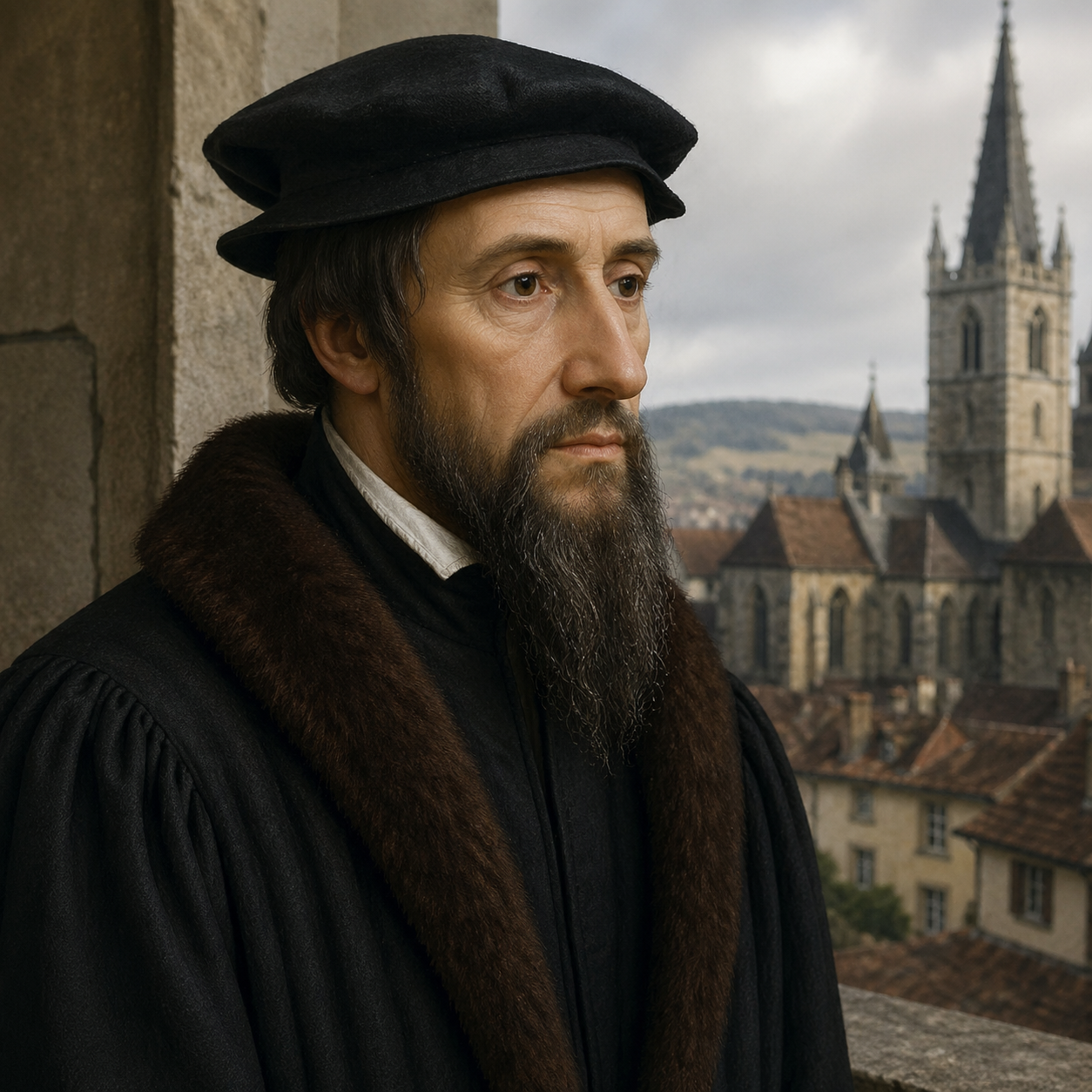
John Calvin — "He who has God for his father has the church for his mother."
He who has God for his father has the church for his mother.
He who has God for his father has the church for his mother.
Click any product to generate a realistic preview. Up to 3 at a time.
* Initial load can take up to 90 seconds — revising the preview in another color is nearly instant.
"For I stay not to consider the extravagance of those who say that grace is offered equally and promiscuously to all."
"The most perfect way of worshiping God is to live a holy life."
"The whole life of a Christian should be a perpetual exercise of repentance."
"The natural gifts were corrupted in man through sin, but his supernatural gifts were stripped from him."
"The reprobate are like hardened clay, which, the more it is baked, the harder it becomes."
French theologian whose Institutes of the Christian Religion (1536) systematized Protestant Reformed doctrine, including predestination. Closely associated with Martin Luther (Reformation founder, Calvin's predecessor). For an intellectual contrast, see Jacobus Arminius, Dutch Reformed theologian (1560-1609) — Arminius's rejection of strict double-predestination founded Arminianism — the theological tradition modern Methodism, most evangelicalism, and Pentecostalism descend from. The Calvinist-Arminian debate has divided Protestantism for 400 years.
Found in 1 providers: grok
1 source checked
If God is your Father, then the church is your spiritual mother — you cannot claim one while rejecting the other. True faith means belonging to a community that teaches, nurtures, and disciplines believers. The church isn't optional for a Christian; it's the household where God's children are raised. Separating personal belief from communal church membership is, in Calvin's view, a contradiction and a spiritual impossibility.
Calvin spent his career building Geneva's Reformed church as a disciplined institution essential to salvation, not a voluntary association. His Institutes of the Christian Religion dedicates major sections to ecclesiology, arguing the visible church is where God's Word is properly preached and sacraments rightly administered. Having fled Catholic France and navigated religious exile, Calvin personally lived the conviction that belonging to a true reformed church was non-negotiable for the faithful.
The Protestant Reformation fragmented Western Christendom in the 1500s, raising a dangerous question: if Rome's church is corrupt, is any institutional church necessary? Radical reformers like the Anabaptists said no. Calvin said yes — emphatically. His quote anchors Protestants to visible, organized church life precisely when individualism threatened to dissolve Christian community entirely. It also countered Catholic charges that Protestants abandoned the church, asserting Reformed congregations were the true heirs of apostolic Christianity.
AI-generated insights based on extensive research and information for context. Factual errors? Email [email protected].
Your cart is empty