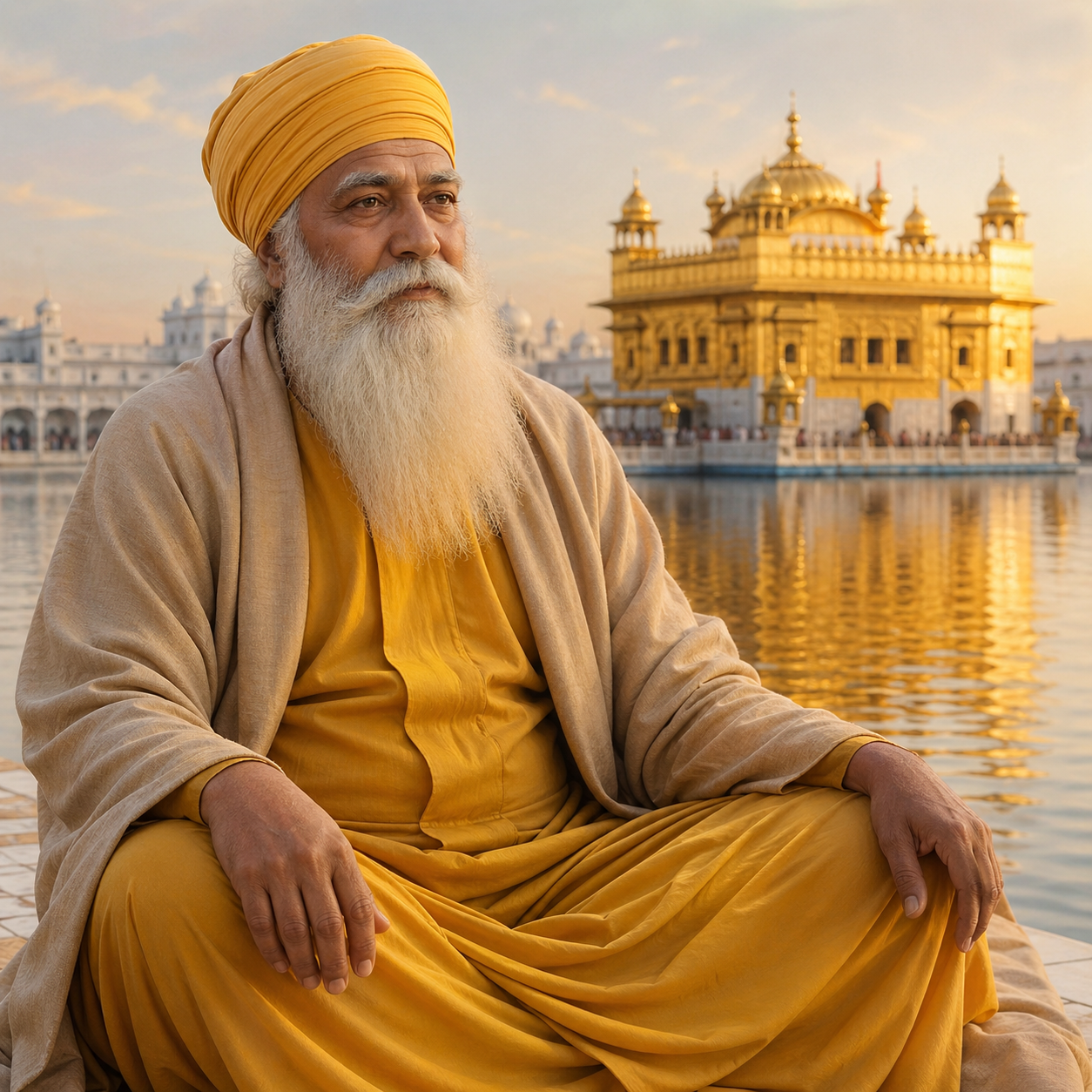
Guru Nanak — "He who is without sin, let him cast the first stone. Or, you know, just offer a …"
He who is without sin, let him cast the first stone. Or, you know, just offer a cup of chai.
He who is without sin, let him cast the first stone. Or, you know, just offer a cup of chai.
Click any product to generate a realistic preview. Up to 3 at a time.
* Initial load can take up to 90 seconds — revising the preview in another color is nearly instant.
"There is but one God. His name is Truth; He is the Creator. He fears none; He is without hate. He never dies; He is beyond the cycle of births and death. He is self-illuminated. He is realized by the …"
"Like the juggler, deceiving by his tricks, one is deluded by egotism, falsehood and illusion."
"Sing the praises of the Lord. And if you're out of tune, well, at least you're trying."
"I am neither a child, a young man, nor an ancient; nor am I of any caste."
"Death would not be called bad, O people, if one knew how to truly die."
Founder of Sikhism and the first of the Ten Sikh Gurus, whose teachings of one universal God and rejection of caste shaped Punjab. Closely associated with Kabir (mystical poet whose verses appear in the Sikh Guru Granth Sahib). For an intellectual contrast, see Brahmanical orthodoxy, the Hindu caste-and-ritual establishment of his era — Sikhism was founded as a deliberate alternative to both Hindu ritual hierarchy and Islamic exclusivism — Nanak's universalism was a structural rejection of caste and priestly mediation.
A humorous, anachronistic twist on a biblical saying, not a direct quote from Guru Nanak.
Date: Modern
GeneralFound in 1 providers: grok
1 source checked
Rather than judging others for their failures, respond with kindness and welcome. The quote reframes moral superiority as an invitation to connect — nobody is without fault, so instead of condemning, extend warmth. The chai twist turns a familiar rebuke into an act of hospitality, suggesting that shared humanity matters more than who is righteous enough to throw the first stone.
Guru Nanak (1469–1539) built Sikhism on radical hospitality — he instituted langar, the free community kitchen feeding people of every caste and faith without distinction. He traveled thousands of miles eating and sitting with outcasts, Muslims, and Hindus alike. A response of chai over condemnation is structurally identical to his core teaching: dissolve hierarchy, feed the stranger, judge no one.
In 15th-century Punjab, caste hierarchy, Brahminical purity laws, and Mughal religious authority all enforced rigid social judgment — who was clean, who was sinful, who deserved punishment. Guru Nanak's era was marked by intense Hindu-Muslim conflict after the Lodhi sultanate and early Mughal expansion. Replacing stone-throwing with shared nourishment was a direct, radical counter to every institution demanding exclusion and punishment.
AI-generated insights based on extensive research and information for context. Factual errors? Email [email protected].
Your cart is empty