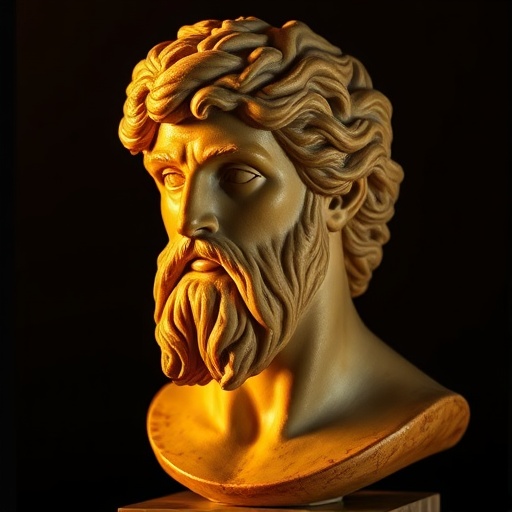
Pythagoras — "He who sows virtue reaps honor."
He who sows virtue reaps honor.
He who sows virtue reaps honor.
Click any product to generate a realistic preview. Up to 3 at a time.
* Initial load can take up to 90 seconds — revising the preview in another color is nearly instant.
"Choose rather to be strong of soul than strong of body."
"Know thyself and thou wilt know the universe."
"If you're asked: What is the silence? Respond: It is the first stone of the Wisdom's temple."
"A thought is an idea in transit."
"A man is never free unless he is master of himself."
Greek philosopher and mathematician whose school in Croton combined geometry (the Pythagorean theorem), number-mysticism, and a religious-vegetarian way of life. Closely associated with Thales of Miletus (earlier pre-Socratic and the first philosopher). For an intellectual contrast, see Heraclitus, pre-Socratic Greek philosopher of flux — Heraclitus called Pythagoras 'the chief of swindlers' — among the founding insults of the philosophical-rivalry tradition. Their 'all is flux' vs 'all is number' poles still organize the philosophy of mathematics today (Platonist vs anti-realist).
Found in 1 providers: grok
1 source checked
Consistent moral action produces lasting respect. If you put in the daily work of honesty, discipline, courage, and fairness, recognition and a good reputation follow naturally as the harvest. The image is agricultural: character is planted through small repeated choices, and honor grows from it over time. You cannot shortcut to being admired; you earn it by becoming the kind of person worth admiring.
Pythagoras ran a disciplined brotherhood in Croton where members followed strict ethical rules, vegetarian diets, silence vows, and daily self-examination. He taught that mathematics and moral purification were inseparable paths to wisdom. For him, virtue was not abstract philosophy but trained habit, and a thinker's reputation rested on lived conduct. This farming metaphor matches his belief that the soul, like a field, yields exactly what you cultivate in it.
In 6th-century BCE Greece, honor (time) was the highest social currency, tied to bloodline, wealth, and public deeds in city-states like Croton and Samos. Pythagoras challenged that aristocratic model by arguing honor should be earned through cultivated virtue, not inherited. This was the pre-Socratic moment when Greek thinkers were shifting ethics from Homeric warrior glory toward inner character, laying groundwork later expanded by Socrates and the Stoics.
AI-generated insights based on extensive research and information for context. Factual errors? Email [email protected].
Your cart is empty