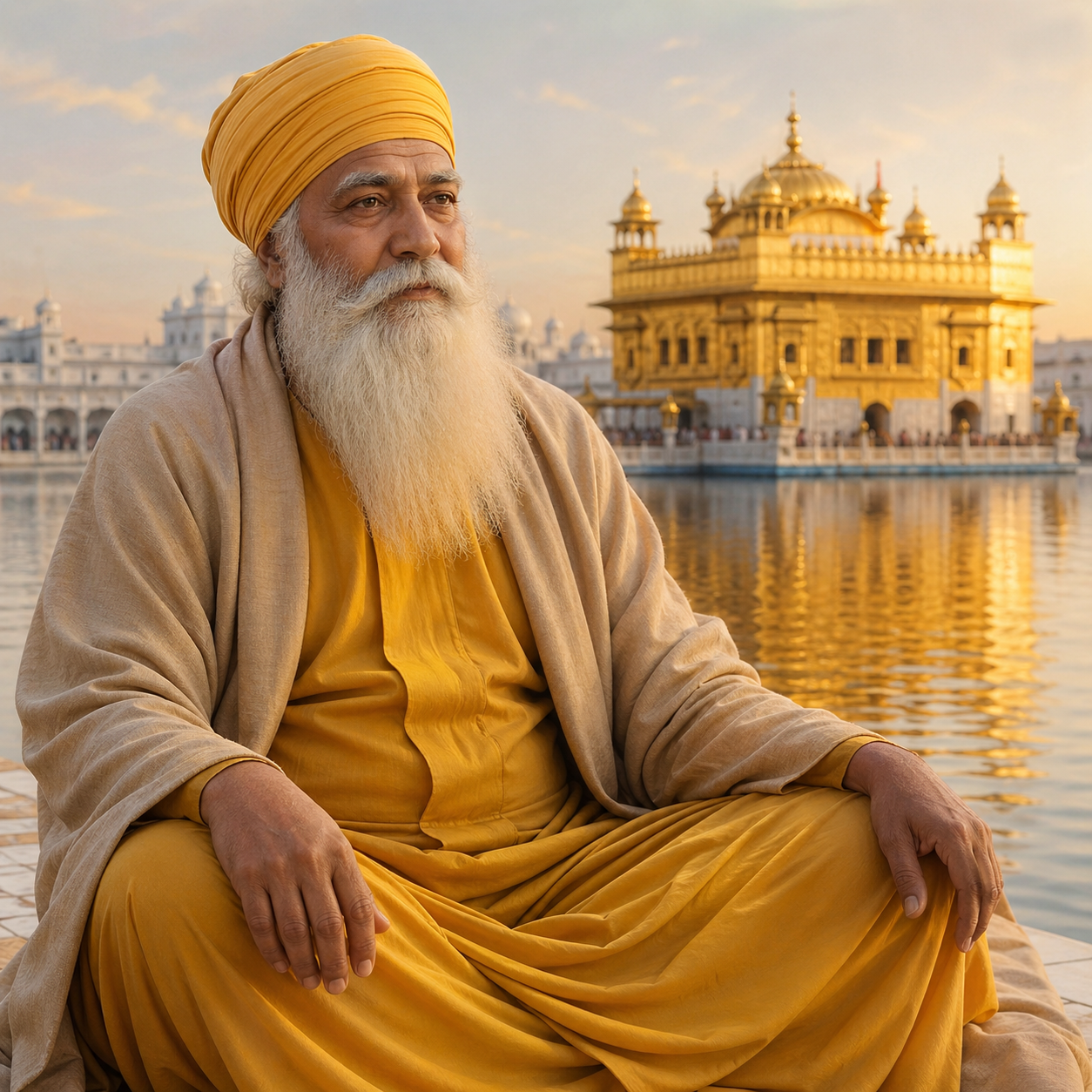
Guru Nanak — "He who speaks truth, lives truth, and meditates on truth, he alone is pure."
He who speaks truth, lives truth, and meditates on truth, he alone is pure.
He who speaks truth, lives truth, and meditates on truth, he alone is pure.
Click any product to generate a realistic preview. Up to 3 at a time.
* Initial load can take up to 90 seconds — revising the preview in another color is nearly instant.
"The world is burning in the fire of desire, greed, attachment, and ego."
"The greatest wealth is to be without desires."
"He alone is a true Yogi who knows the essence of the Self."
"Death would not be called bad, O people, if one knew how to truly die."
"Without virtues, there is no devotion."
Founder of Sikhism and the first of the Ten Sikh Gurus, whose teachings of one universal God and rejection of caste shaped Punjab. Closely associated with Kabir (mystical poet whose verses appear in the Sikh Guru Granth Sahib). For an intellectual contrast, see Brahmanical orthodoxy, the Hindu caste-and-ritual establishment of his era — Sikhism was founded as a deliberate alternative to both Hindu ritual hierarchy and Islamic exclusivism — Nanak's universalism was a structural rejection of caste and priestly mediation.
Found in 1 providers: grok
1 source checked
Purity is not achieved through rituals, caste, or outward appearances, but through honesty in three dimensions: what you say, how you live, and what you focus your mind on. A person whose words match their actions and whose inner reflection centers on truth becomes genuinely pure. Deception in speech, hypocrisy in behavior, or a mind absorbed in lies all contaminate a person regardless of religious performance or social status.
Guru Nanak (1469-1539) built Sikhism on the foundation of truthful living, making 'Sat' (truth) central to his teaching and placing 'Ik Onkar Satnam' at the opening of Sikh scripture. He rejected empty ritualism, caste purity codes, and the hypocrisy he saw in both Hindu priests and Muslim clerics, insisting instead that honest labor, honest speech, and remembrance of the Divine Name defined a true devotee.
In early-modern Punjab under the Lodi and early Mughal rulers, religious life was dominated by Brahminical ritual purity rules, Sufi orthodoxy, and sharp Hindu-Muslim tensions. Purity was measured by caste birth, pilgrimage, bathing rites, and dietary codes. Nanak traveled widely during this period (the udasis), witnessing Babur's 1521 invasion and widespread corruption among religious authorities, which sharpened his insistence that ethical truthfulness, not ceremonial observance, was the real measure of a clean life.
AI-generated insights based on extensive research and information for context. Factual errors? Email [email protected].
Your cart is empty