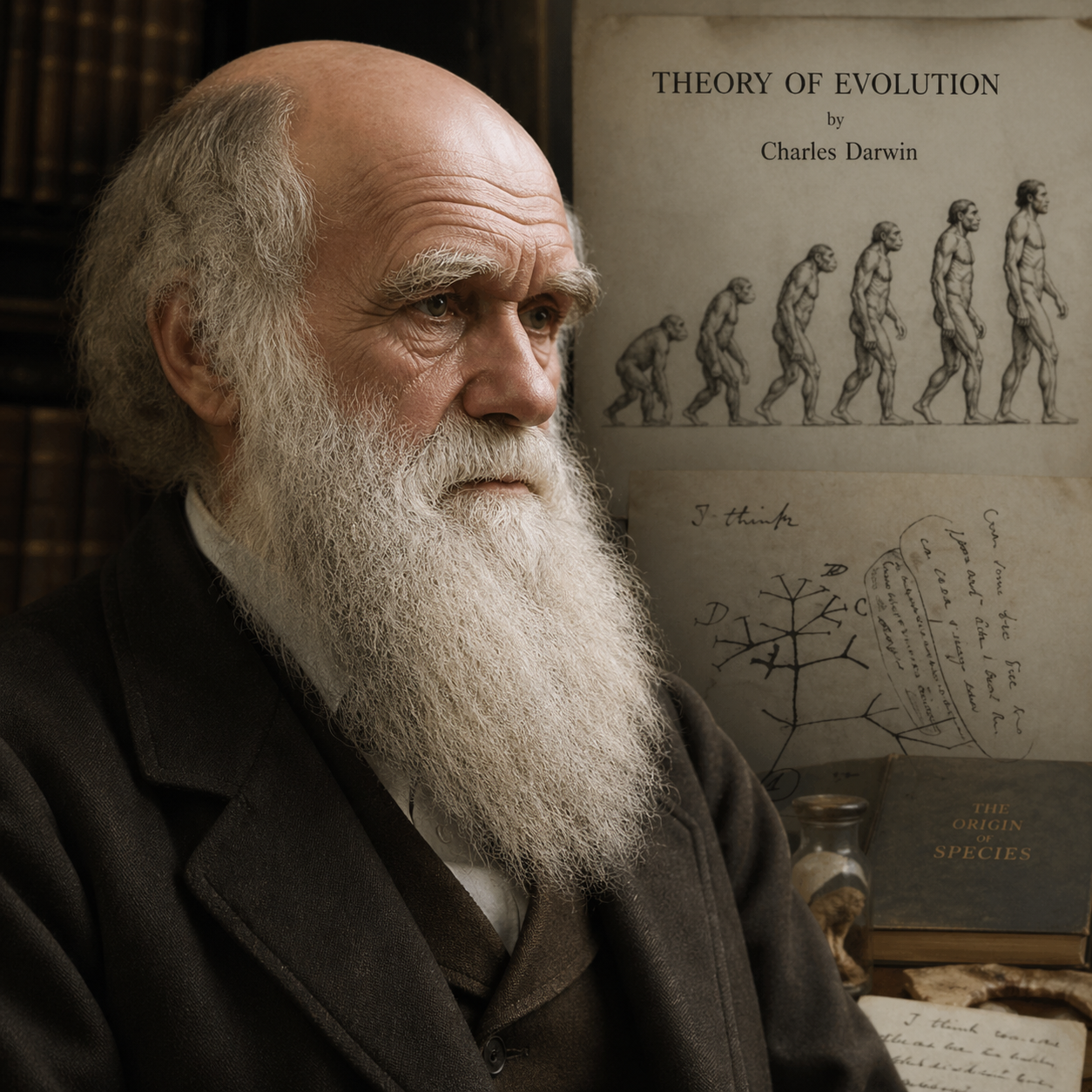
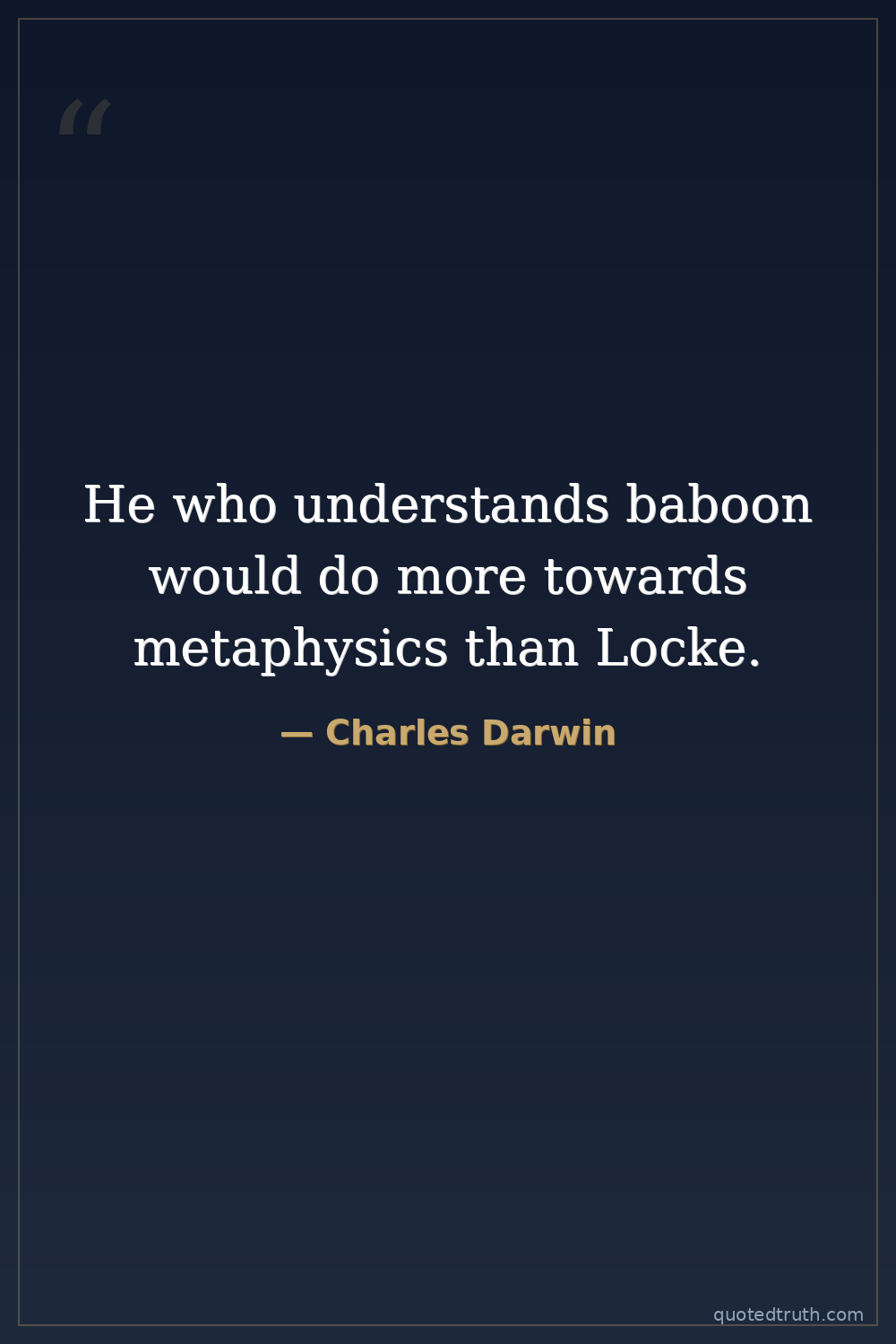
Charles Darwin — "He who understands baboon would do more towards metaphysics than Locke."
He who understands baboon would do more towards metaphysics than Locke.
He who understands baboon would do more towards metaphysics than Locke.
Click any product to generate a realistic preview. Up to 3 at a time.
* Initial load can take up to 90 seconds — revising the preview in another color is nearly instant.
"My mind seems to have become a kind of machine for grinding general laws out of large collections of facts."
"But I am very poorly today & very stupid & I hate everybody & everything. One lives only to make blunders."
"False facts are highly injurious to the progress of science, for they often endure long; but false views, if supported by some evidence, do little harm, for every one takes a salutary pleasure in prov…"
"The highest possible stage in moral culture is when we recognize that we ought to control our thoughts."
"Ignorance more frequently begets confidence than does knowledge."
British naturalist whose On the Origin of Species (1859) established evolution by natural selection — the unifying theory of modern biology. Closely associated with Thomas Henry Huxley (his 'bulldog' public defender) and Alfred Russel Wallace (independent co-discoverer of natural selection). For an intellectual contrast, see William Paley, Anglican theologian and Natural Theology author (1743-1805) — Origin of Species is structurally a 400-page reply to Paley — Darwin admired Paley's watchmaker-argument as an undergraduate at Cambridge and then spent 20 years building the empirical machinery to displace him. The cleanest 'design argument vs natural selection' founding rebuttal in science.
The standard scholarly entry points to Charles Darwin's work: Janet Browne (Harvard, history of science) — Charles Darwin: Voyaging (1995) and The Power of Place (2002); Adrian Desmond (UCL, biographer) — Darwin: The Life of a Tormented Evolutionist (1991, with James Moore). These are the works graduate seminars cite when teaching Charles Darwin.
Found in 1 providers: grok
1 source checked
Darwin argues that studying a baboon's behavior and psychology reveals more about the deepest questions of human nature, consciousness, and mind than abstract philosophical speculation ever could. Rather than theorizing from an armchair about what humans fundamentally are, observing our closest animal relatives yields direct truths about thought and emotion. Empirical animal study, he insists, unlocks metaphysical mysteries that even history's greatest philosophers, reasoning purely from human experience, cannot penetrate.
Darwin wrote this in his private notebooks around 1838, secretly developing evolutionary theory after his Beagle voyage. His core conviction—that humans share biological and mental continuity with animals—was still radical and unspoken publicly. He later devoted an entire book, The Expression of the Emotions in Man and Animals (1872), to exactly this idea. As a committed materialist, Darwin believed mind and behavior evolved, making primate observation a legitimate path to answering questions about human consciousness.
In the 1830s, metaphysics was dominated by idealist philosophy and natural theology, which treated the human mind as divinely unique and categorically separate from animal life. John Locke's empiricism, though foundational, still operated entirely within human experience. Darwin's suggestion that zoology could address philosophical questions challenged both religious orthodoxy and academic philosophy simultaneously. Natural history was just beginning its transformation into rigorous science, but linking primate behavior directly to questions of human consciousness remained deeply provocative.
AI-generated insights based on extensive research and information for context. Factual errors? Email [email protected].
Your cart is empty