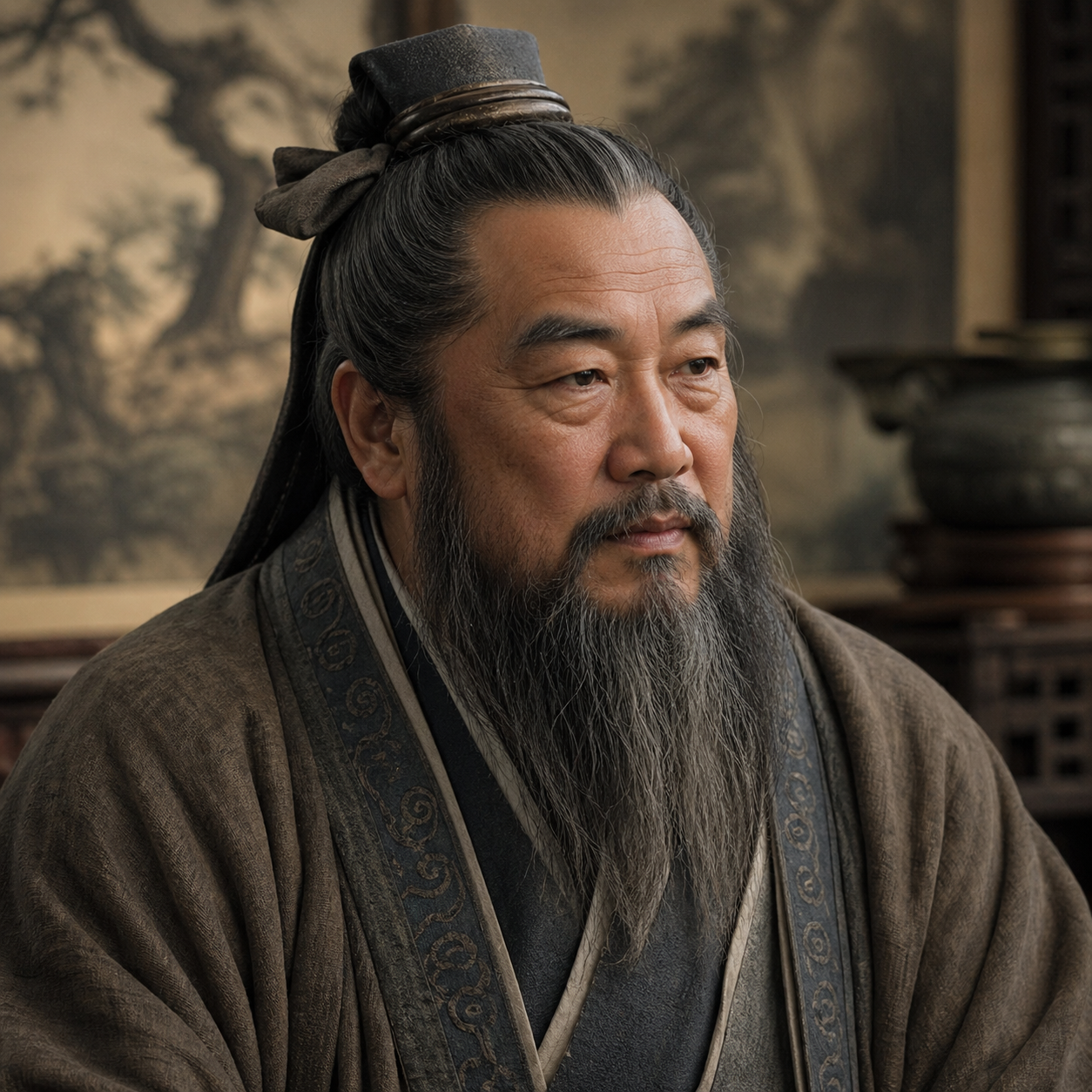
Confucius — "Hold faithfulness and sincerity as first principles."
Hold faithfulness and sincerity as first principles.
Hold faithfulness and sincerity as first principles.
Click any product to generate a realistic preview. Up to 3 at a time.
* Initial load can take up to 90 seconds — revising the preview in another color is nearly instant.
"I transmit but do not innovate; I am truthful in what I say and devoted to antiquity."
"It is not the failure of others to appreciate your abilities that should trouble you, but rather your own failure to appreciate theirs."
"The Master said, 'The wise man delights in water, the benevolent man delights in mountains. The wise man is active; the benevolent man is tranquil. The wise man is joyful; the benevolent man is long-l…"
"The Master said, 'I walk in the company of two other men, and I can always learn from them. I select their good qualities and follow them, and I correct their bad qualities and avoid them.'"
"Attack the evil that is within yourself, rather than attacking the evil that is in others."
Chinese philosopher and teacher whose teachings (compiled by his students in the Analects) became the foundational ethical framework of East Asian civilization for 2,500 years. Closely associated with Mencius (his most-influential follower a century later). For an intellectual contrast, see Laozi, near-contemporary Chinese sage and Tao Te Ching author — Confucius systematized social order through ritual and family hierarchy; Laozi's Taoist effortless-action philosophy argued such systems were the disease, not the cure. The two founding poles of Chinese moral philosophy — every East Asian moral tradition since has positioned itself between them.
The standard scholarly entry points to Confucius's work: Philip J. Ivanhoe (Georgetown, Chinese philosophy) — Confucian Moral Self Cultivation (2000); Edward Slingerland (UBC, Asian Studies) — Effortless Action: Wu-wei as Conceptual Metaphor (2003); Tu Weiming (Harvard, Confucian scholar) — Confucian Thought: Selfhood as Creative Transformation (1985). These are the works graduate seminars cite when teaching Confucius.
Found in 1 providers: grok
1 source checked
Make honesty and genuine commitment the foundation of everything you do. Before pursuing skills, achievements, or relationships, anchor yourself in being trustworthy and sincere in your words and actions. These two qualities should guide every decision rather than being afterthoughts. When you build character on reliability and authenticity, other virtues naturally follow, and people can depend on you in matters both small and consequential.
Confucius built his ethical system on ren (humaneness) and xin (trustworthiness), teaching that moral cultivation begins with personal integrity. As a traveling teacher advising rulers, he repeatedly emphasized that a leader without credibility cannot govern. He personally modeled sincerity, refusing positions under corrupt officials and walking away from lucrative posts rather than compromise his principles. This saying distills his lifelong conviction that character precedes competence.
Confucius lived during the Spring and Autumn period (551-479 BCE), an era of collapsing Zhou authority, warring states, political betrayal, and broken oaths between nobles. Rulers routinely violated treaties, ministers plotted coups, and social bonds frayed. Against this backdrop of rampant deceit, Confucius's insistence on faithfulness and sincerity was radical social medicine—a call to rebuild civilization from individual integrity upward when institutional trust had nearly vanished.
AI-generated insights based on extensive research and information for context. Factual errors? Email [email protected].
Your cart is empty