John Wesley — "Holy tempers are the very essence of religion."
Holy tempers are the very essence of religion.
Holy tempers are the very essence of religion.
Click any product to generate a realistic preview. Up to 3 at a time.
* Initial load can take up to 90 seconds — revising the preview in another color is nearly instant.
"I have often thought, that if I were to choose a companion to travel with, it should be one that would talk little."
"I am not afraid that the people called Methodists should ever cease to exist either in Europe or America. But I am afraid lest they should only exist as a dead sect, having the form of religion withou…"
"I have but one point in view, to promote, as far as I am able, vital, practical religion."
"I have often thought, that if I were to choose a profession, it should be that of a physician."
"I know no other book in the world, that contains so many strong and clear proofs of the being and perfections of God, and of the truth of our holy religion, as the Bible."
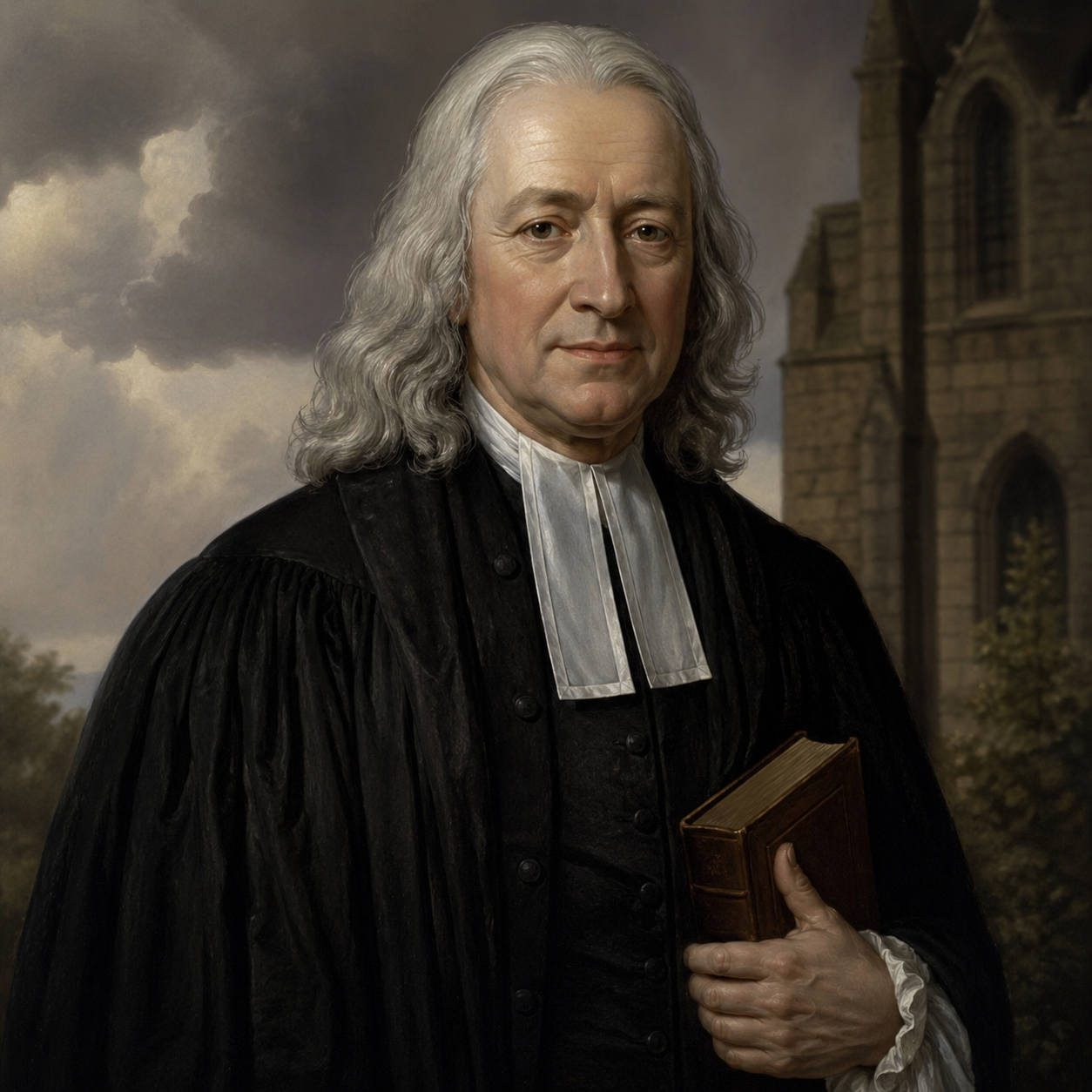
English Anglican cleric and founder of Methodism, whose open-air preaching and class-meeting structure created the largest 18th-century evangelical revival. Closely associated with Charles Wesley (his hymn-writing brother) and George Whitefield (early co-revivalist, later doctrinal opponent). For an intellectual contrast, see George Whitefield, Calvinist evangelical revivalist — Whitefield's predestinarian Calvinism vs Wesley's free-grace Arminian theology split the early Methodist movement permanently in the 1739-41 break. The founding evangelical Calvinist-Arminian schism — the two parallel evangelical traditions American Christianity descends from.
Found in 1 providers: grok
1 source checked
True religion isn't primarily about rituals, creeds, or outward behavior — it lives in the transformation of inner character. "Holy tempers" means the deep dispositions of the soul: love, patience, humility, compassion. Wesley argues these inward orientations are not byproducts of faith but its very core. A person can attend church faithfully and still miss religion entirely if their heart remains unchanged.
Wesley's doctrine of entire sanctification — the belief that God could purify a believer's heart completely — made "holy tempers" the destination of Christian life, not merely a side effect. He traveled 250,000 miles preaching this message, founded Methodist societies structured around mutual accountability for inner transformation, and wrote extensively on Christian perfection. For Wesley, God wasn't satisfied with compliant behavior; he wanted renovated desires.
In 18th-century England, the Church of England had grown institutionally rigid and spiritually cold — religion meant Sunday attendance, social conformity, and doctrinal assent. Meanwhile, the Industrial Revolution was uprooting communities and creating urban poverty and vice. Wesley's insistence that religion was fundamentally about inner character transformation challenged both nominal Christianity and Enlightenment rationalism, which treated morality as a matter of reason rather than transformed affection.
AI-generated insights based on extensive research and information for context. Factual errors? Email [email protected].
Your cart is empty