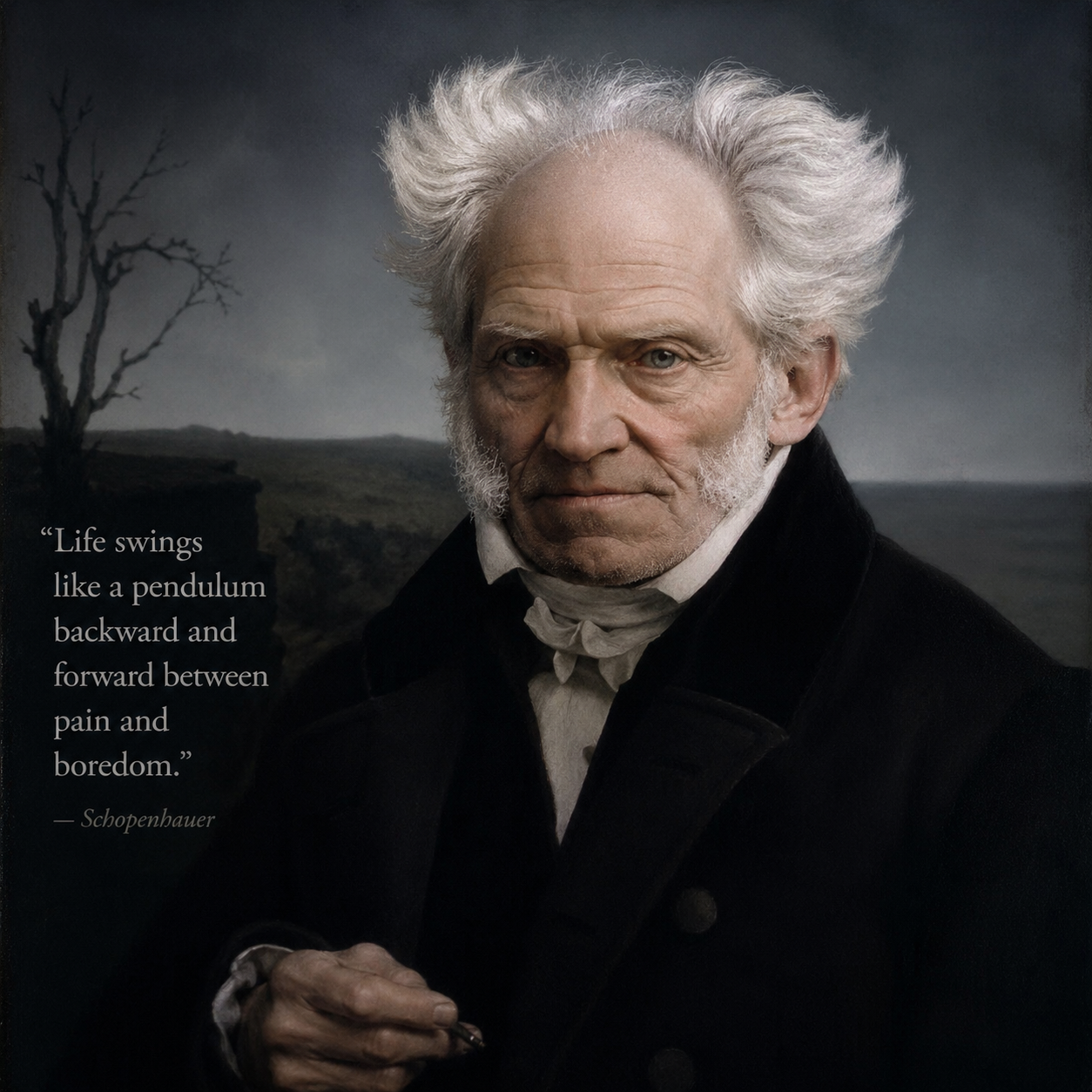
Arthur Schopenhauer — "Human life is a business that does not pay its expenses."
Human life is a business that does not pay its expenses.
Human life is a business that does not pay its expenses.
Click any product to generate a realistic preview. Up to 3 at a time.
* Initial load can take up to 90 seconds — revising the preview in another color is nearly instant.
"The greatest happiness for a man is to be free."
"The difficulty is to try and teach the multitude that something can be true and untrue at the same time."
"Women are the causa secondaria, the secondary cause, of the continuation of the species."
"The brain may be regarded as a kind of parasite of the organism, a pensioner, as it were, who dwells with the body."
"The greatest achievements of the human mind are generally received with distrust."
German philosopher of pessimism whose The World as Will and Representation (1819) defined the suffering-and-renunciation tradition. Closely associated with Immanuel Kant (the system Schopenhauer built on and revised). For an intellectual contrast, see G.W.F. Hegel, German Idealist of the rational unfolding of Spirit — Schopenhauer scheduled his Berlin lectures opposite Hegel's and spent decades attacking Hegel's optimistic system as deliberately mystifying nonsense — the foundational rivalry of 19th-century German philosophy.
The standard scholarly entry points to Arthur Schopenhauer's work: Bryan Magee (Oxford, populariser-philosopher) — The Philosophy of Schopenhauer (1983); Christopher Janaway (Southampton, Schopenhauer specialist) — Self and World in Schopenhauer's Philosophy (1989); David E. Cartwright (Wisconsin–Whitewater) — Schopenhauer: A Biography (2010). These are the works graduate seminars cite when teaching Arthur Schopenhauer.
Found in 1 providers: grok
1 source checked
Your cart is empty