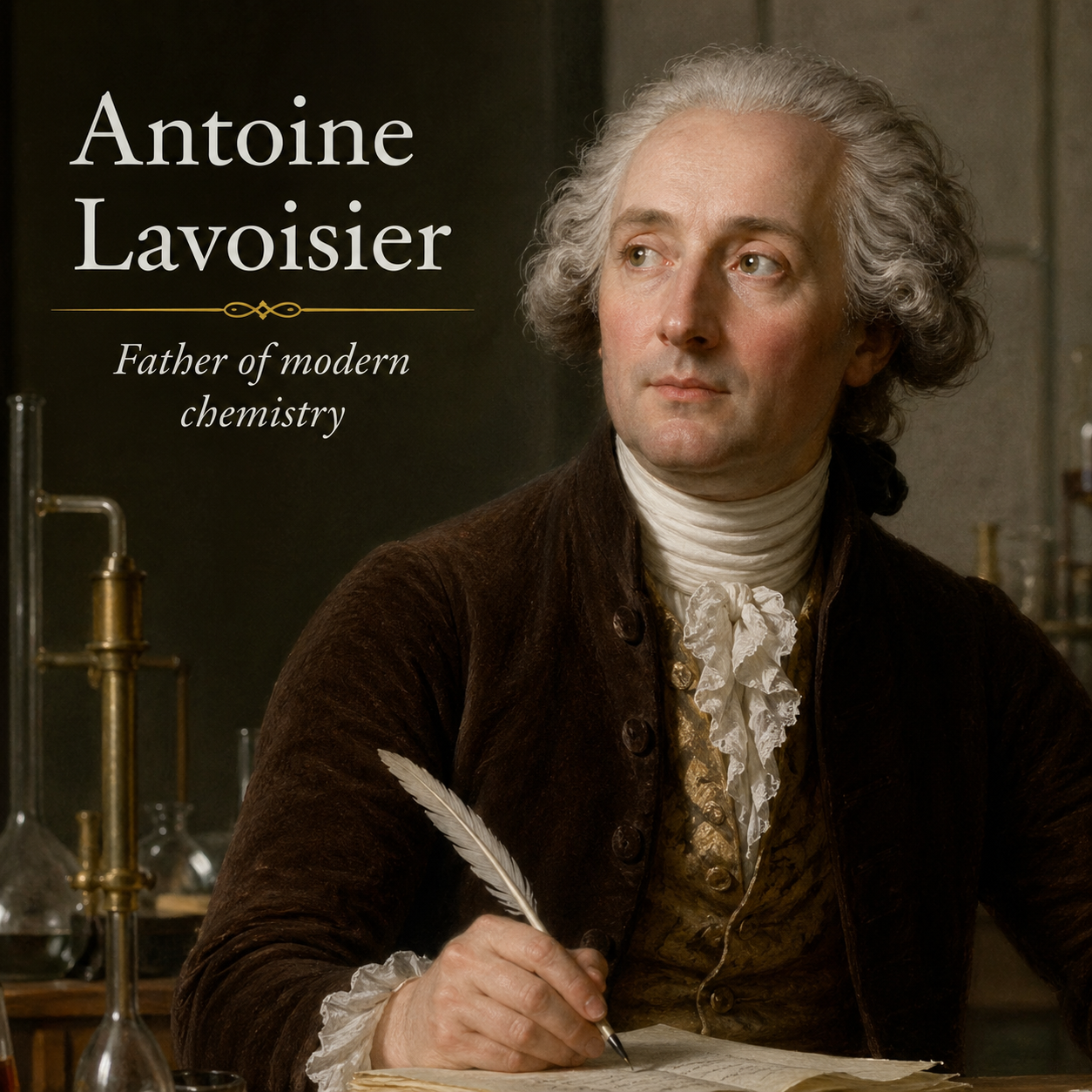
Antoine Lavoisier — "I am a chemist, not a politician."
I am a chemist, not a politician.
I am a chemist, not a politician.
Click any product to generate a realistic preview. Up to 3 at a time.
* Initial load can take up to 90 seconds — revising the preview in another color is nearly instant.
"The future of chemistry depends on the precision of its instruments and the accuracy of its observations."
"Chemistry is a science of facts and experiments, and not of opinions."
"I have never been able to believe in anything that I could not demonstrate by experiment."
"Science advances by correcting its errors."
"The greatest obstacle to discovery is not ignorance, but the illusion of knowledge."
Perhaps a lament during the French Revolution, though attributed, the exact context is difficult to pinpoint.
Date: c. 1790s
Self-DeprecatingFound in 1 providers: grok
1 source checked
The speaker is declaring their identity as a scientist, not a power-seeker or ideologue. They draw a hard line between empirical inquiry and political maneuvering, insisting their work belongs to evidence and reason, not governance or allegiance. It's a refusal to let external power struggles define or redirect them — a assertion that science and politics are separate callings demanding different minds and different loyalties.
Lavoisier revolutionized chemistry by naming oxygen, disproving phlogiston theory, and establishing conservation of mass — pure scientific work. Yet he also served as a fermier général, a royal tax collector, which made him politically toxic during the Revolution. Despite being one of history's greatest scientists, he was guillotined in 1794 for those financial-political ties. The quote captures his self-image exactly: a man of science, ultimately destroyed not for his chemistry but for his political entanglements.
The French Revolution's Reign of Terror (1793–1794) made political identity a matter of life and death. Enlightenment ideals had elevated reason and science, yet the Terror showed that intellectual achievement offered no protection from ideological violence. The old regime's collapse swept away scientists alongside aristocrats. When Lavoisier was executed, a judge reportedly declared 'the Republic has no need for scientists' — making any claim of political neutrality in that era not just idealistic, but genuinely fatal.
AI-generated insights based on extensive research and information for context. Factual errors? Email [email protected].
Your cart is empty