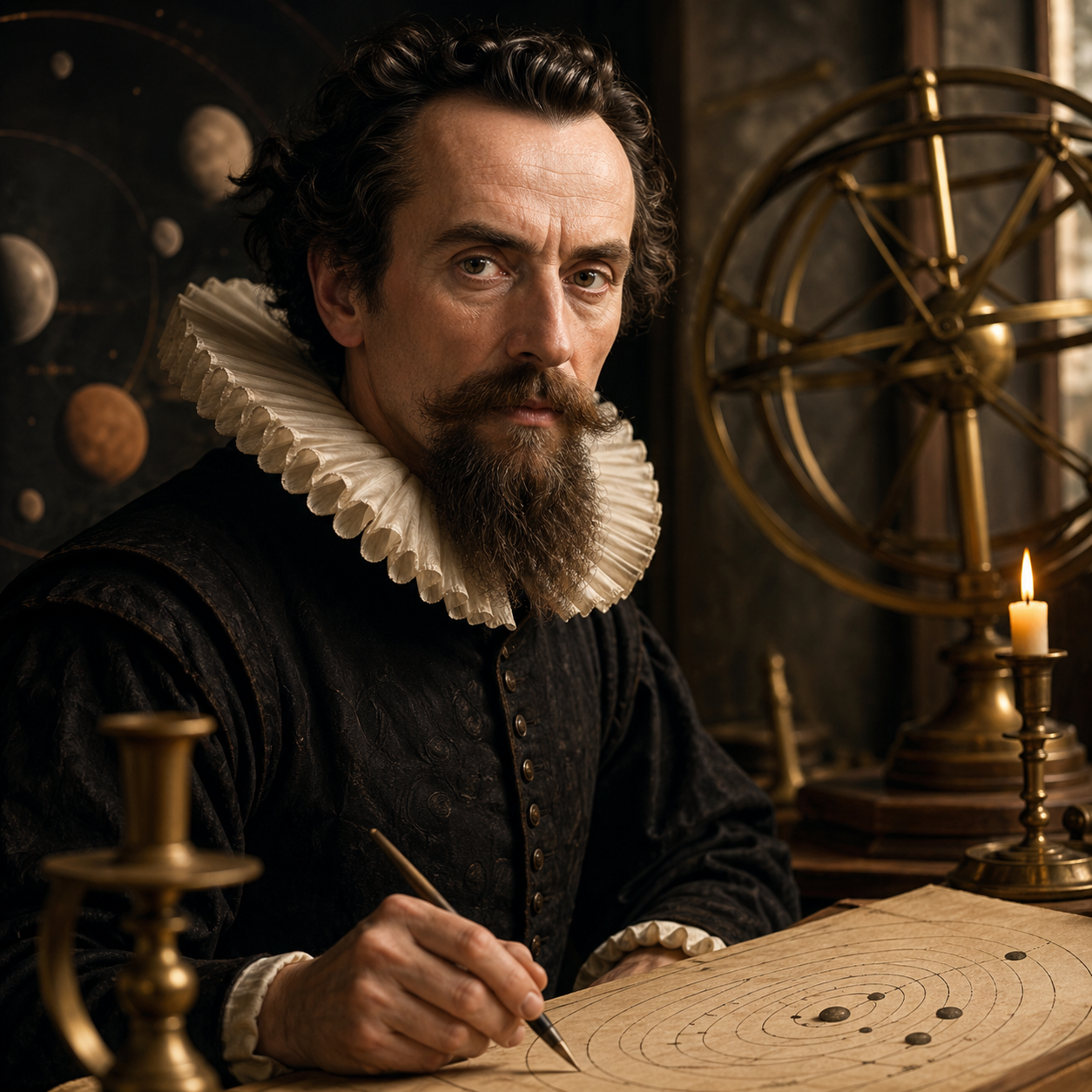
Johannes Kepler — "I am a Lutheran astrologer, I throw away the nonsense and keep the hard kernel."
I am a Lutheran astrologer, I throw away the nonsense and keep the hard kernel.
I am a Lutheran astrologer, I throw away the nonsense and keep the hard kernel.
Click any product to generate a realistic preview. Up to 3 at a time.
* Initial load can take up to 90 seconds — revising the preview in another color is nearly instant.
"The Earth has a soul, and it is sick with melancholy."
"I would rather be a good Christian than a good astronomer."
"God himself is the first and greatest geometrician."
"I have been a teacher, and I have learned much from my students."
"For a long time I was restless. Now, however, behold how through my effort God is being celebrated in astronomy."
Found in 1 providers: gemini
1 source checked
Kepler declares his approach to astrology: he takes the practice seriously enough to work within it, but refuses to swallow its superstitions whole. He sifts through what most treat as a unified tradition, discarding the mystical padding and preserving only what withstands scrutiny. It is a statement about intellectual honesty, a willingness to hold a contested craft to a higher standard rather than either embracing or rejecting it entirely.
Kepler earned income casting horoscopes for nobles like Rudolf II and Wallenstein, yet he also derived the three laws of planetary motion and insisted the heavens obeyed mathematical physics. A devout Lutheran barred from Catholic universities and exiled during the Counter-Reformation, he spent his life reconciling piety, paid astrology, and rigorous science. The quote captures his working compromise: keep the celestial geometry, jettison the fortune-telling folklore.
In the early seventeenth century astrology was a respectable court profession, funding astronomers who would otherwise starve. The Thirty Years War had just erupted, Galileo was under Church scrutiny, and Lutheran-Catholic tensions dictated where a scholar could teach or publish. Scientific revolution was underway but inseparable from patronage, prophecy, and religious identity. Drawing a line between empirical star-charts and occult prediction was a genuinely radical stance, not an obvious one.
AI-generated insights based on extensive research and information for context. Factual errors? Email [email protected].
Your cart is empty