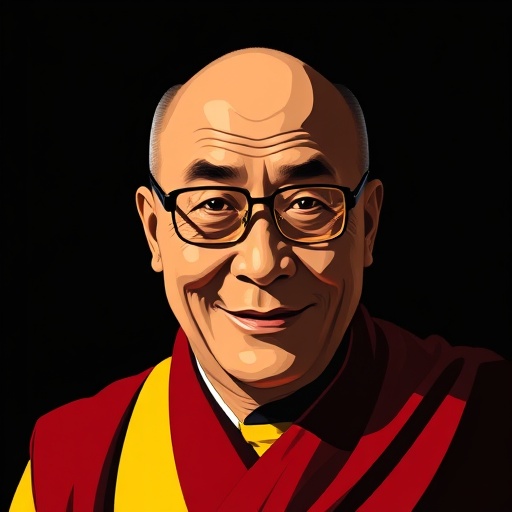
Dalai Lama (14th) — "I am a simple Buddhist monk."
I am a simple Buddhist monk.
I am a simple Buddhist monk.
Click any product to generate a realistic preview. Up to 3 at a time.
* Initial load can take up to 90 seconds — revising the preview in another color is nearly instant.
"My whole life has been dedicated to the cause of peace and non-violence."
"It is under the greatest adversity that there is the greatest potential for doing good, both for oneself and others."
"I am a very optimistic person. I believe that humanity has the potential to create a better world."
"My hope and prayer is that the Chinese Communist Party will change."
"Europe, I think, Europe is for Europeans."
Found in 1 providers: grok
1 source checked
Despite being one of the world's most recognized spiritual leaders, the Dalai Lama strips away all titles and roles to claim the most basic identity: a practitioner. It expresses Buddhism's core value of non-attachment to status, ego, and worldly position. Beneath the Nobel Prize, the global platform, and centuries of institutional tradition, his identity rests in daily practice and discipline, not rank, reverence, or the authority others project onto him.
Tenzin Gyatso was identified at age two as Tibet's 14th Dalai Lama, making him simultaneously a head of state and a living symbol of enlightenment. He has spent over 60 years in exile since China's 1959 invasion, addressed the UN, won the 1989 Nobel Peace Prize, and commands millions of followers worldwide. Yet he consistently resists divine framing, insisting his daily life is rooted in meditation, study, and monastic vows — the foundation of any ordinary Buddhist monk.
The contemporary era placed the Dalai Lama at the intersection of Cold War geopolitics, global human rights movements, and a Western spiritual hunger that elevated him to near-celebrity status. China's 1959 occupation of Tibet forced his Dharamsala exile, and Beijing persistently frames him as a political separatist. Against that backdrop, calling himself simply a monk rejects both the Chinese political accusation and the Western tendency to mythologize him into something beyond ordinary human practice and humility.
AI-generated insights based on extensive research and information for context. Factual errors? Email [email protected].
Your cart is empty