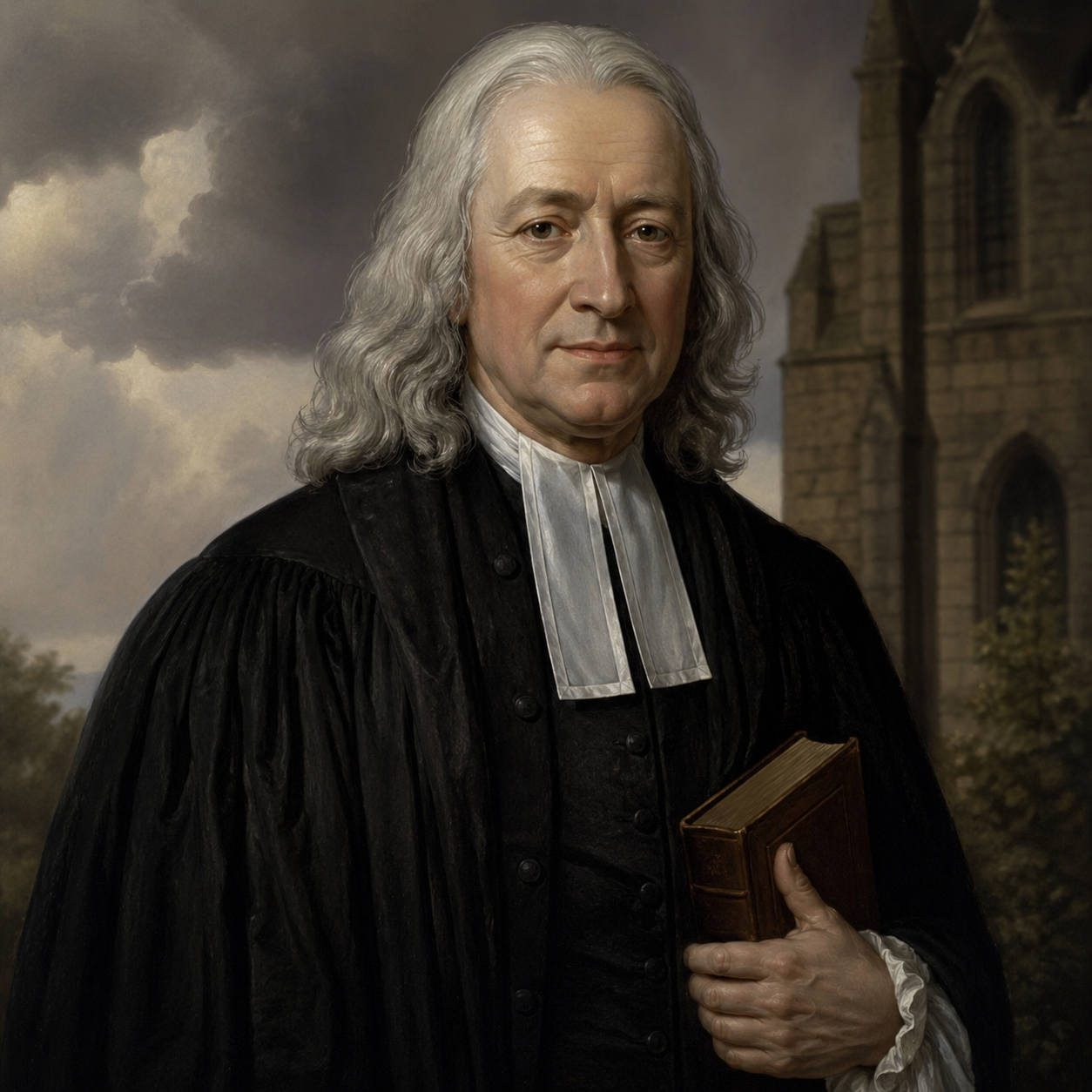
John Wesley — "I am never solitary, for I am never alone."
I am never solitary, for I am never alone.
I am never solitary, for I am never alone.
Click any product to generate a realistic preview. Up to 3 at a time.
* Initial load can take up to 90 seconds — revising the preview in another color is nearly instant.
"I am a creature of a day, passing through life as an arrow through the air. I am a spirit come from God, and returning to God; just hovering a few moments over a great gulf, till, on a sudden, I drop …"
"I have but one point in view, to promote, as far as I am able, vital, practical religion."
"I am not an enemy to pleasure; but I am an enemy to sin."
"I have been accounted a madman, a fool, a knave, a liar, a deceiver, and a devil."
"I have been writing a sermon on the use of money. Oh, what a flat, unprofitable subject it is!"
English Anglican cleric and founder of Methodism, whose open-air preaching and class-meeting structure created the largest 18th-century evangelical revival. Closely associated with Charles Wesley (his hymn-writing brother) and George Whitefield (early co-revivalist, later doctrinal opponent). For an intellectual contrast, see George Whitefield, Calvinist evangelical revivalist — Whitefield's predestinarian Calvinism vs Wesley's free-grace Arminian theology split the early Methodist movement permanently in the 1739-41 break. The founding evangelical Calvinist-Arminian schism — the two parallel evangelical traditions American Christianity descends from.
Found in 1 providers: grok
1 source checked
Even in physical solitude, one is never truly alone because of a constant spiritual presence—God or divine companionship. The speaker finds completeness within themselves and their faith, suggesting that loneliness is a state of disconnection from the divine rather than mere physical isolation. True company comes from inner spiritual communion, making external human presence unnecessary for wholeness or peace.
Wesley traveled over 250,000 miles on horseback across Britain, often riding alone through desolate countryside. Yet he maintained relentless energy and purpose, sustained by his Methodist conviction of a personal, immediate relationship with God. His doctrine of assurance—knowing God's presence directly in one's heart—made this statement a lived reality, not merely theological theory.
In 18th-century Britain, religious life was often formal and institutional, with God perceived as distant. Wesley's Methodist revival emphasized personal salvation and direct divine relationship during a period of industrial upheaval and social dislocation. Ordinary people felt abandoned by church and state; Wesley's message that God's presence was intimate and constant offered radical comfort to the displaced poor.
AI-generated insights based on extensive research and information for context. Factual errors? Email [email protected].
Your cart is empty