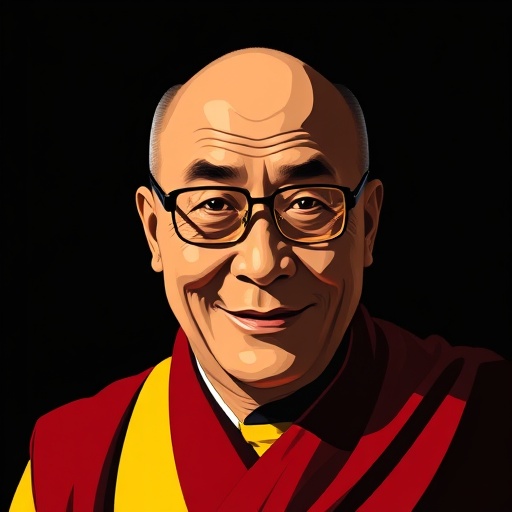
Dalai Lama (14th) — "I am not afraid of death. I believe that death is just a transition to a new lif…"
I am not afraid of death. I believe that death is just a transition to a new life.
I am not afraid of death. I believe that death is just a transition to a new life.
Click any product to generate a realistic preview. Up to 3 at a time.
* Initial load can take up to 90 seconds — revising the preview in another color is nearly instant.
"I am a vegetarian. I used to eat meat, but then I had a dream that I was eating a dog. So I stopped."
"I think the purpose of life is to be happy."
"The greatest happiness is to know the source of unhappiness."
"We need to combine modern education with ancient Indian knowledge."
"I think the most important thing is to find inner peace. If you have inner peace, you can face any challenge."
Found in 1 providers: grok
1 source checked
Death is not an ending to fear but a doorway into another form of existence. The speaker treats mortality with calm rather than dread, viewing consciousness as something that continues beyond the physical body. This is a rejection of death as annihilation — it reframes dying as a natural transition, much like moving between chapters, and invites others to release the existential terror that most people attach to the idea of dying.
Tenzin Gyatso was identified as the reincarnation of the 13th Dalai Lama at age two, making rebirth literally the foundation of his authority and identity. Tibetan Buddhism teaches that consciousness transmigrates across countless lives, and he is regarded as a living embodiment of Avalokiteshvara, bodhisattva of compassion. Forced into exile after China's 1959 invasion of Tibet, he has confronted political erasure and personal mortality for decades, giving this statement biographical weight beyond doctrine.
Born in 1935, the 14th Dalai Lama came of age during the Cold War's nuclear anxiety, witnessed the Tibetan genocide under Chinese occupation, and later addressed global audiences during AIDS, 9/11, and COVID-19 — each era amplifying collective death fear. As Western secular culture increasingly treated death as final and medically defeatable, his Buddhist perspective on rebirth offered a counter-narrative that resonated deeply with millions seeking meaning beyond materialist frameworks.
AI-generated insights based on extensive research and information for context. Factual errors? Email [email protected].
Your cart is empty