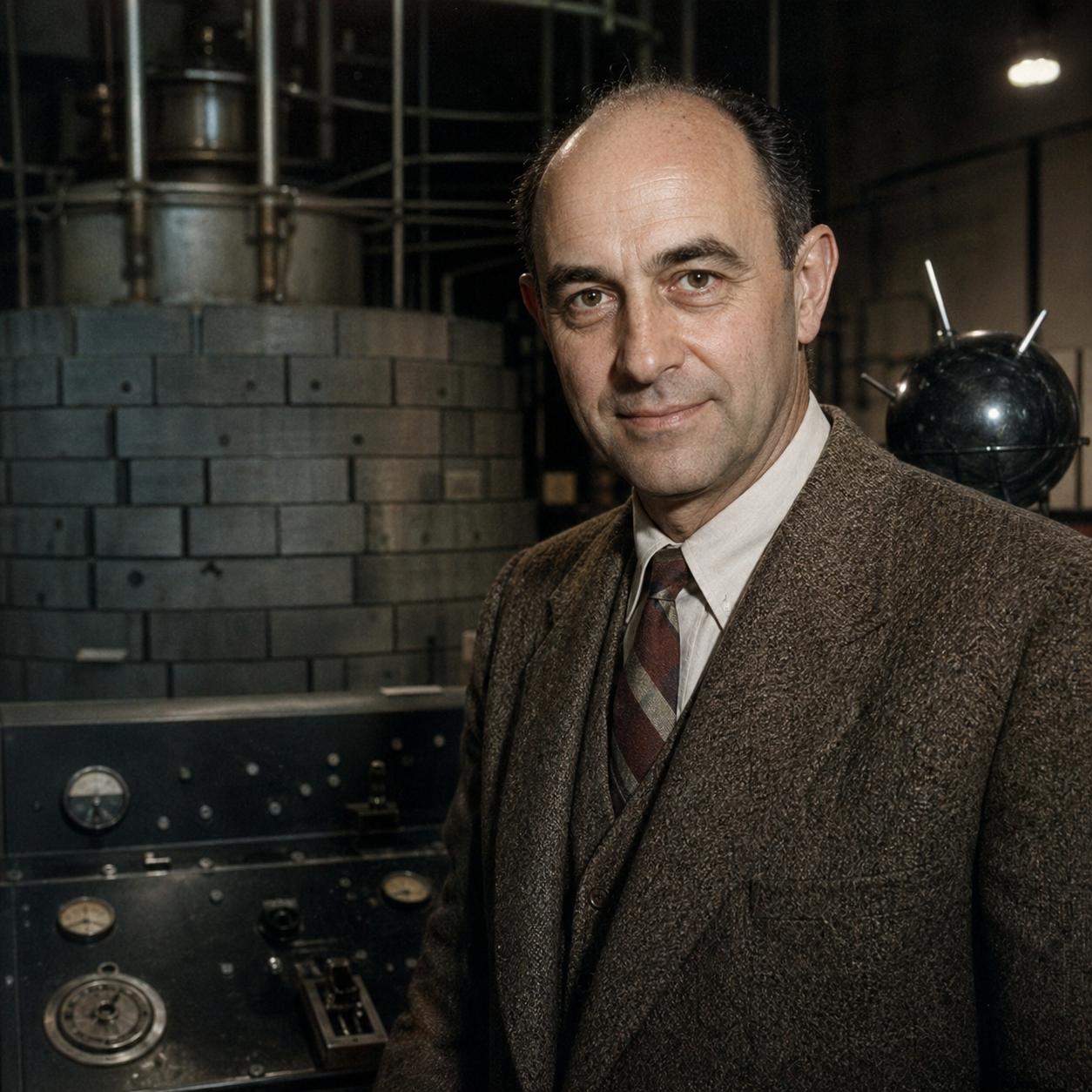
Enrico Fermi — "I am not afraid of death, because I know that I have lived a full life."
I am not afraid of death, because I know that I have lived a full life.
I am not afraid of death, because I know that I have lived a full life.
Click any product to generate a realistic preview. Up to 3 at a time.
* Initial load can take up to 90 seconds — revising the preview in another color is nearly instant.
"Where is everybody?"
"The atomic bomb is a terrible weapon, but it is also a powerful tool for peace."
"The pursuit of knowledge is an endless journey."
"The best way to understand something is to try to explain it to someone else."
"I am a simple man, and I like simple explanations."
Found in 1 providers: grok
1 source checked
When someone has pursued their passions deeply and contributed meaningfully, mortality loses its power to terrify. This quote says that a full, engaged life — one of genuine purpose and accomplishment — is its own answer to death's inevitability. It is not resignation but satisfaction: the sense that one has truly shown up for life. Fear of death comes from feeling unlived; a life completely inhabited dissolves that fear naturally.
Fermi died at 53 of stomach cancer, likely from radiation exposure during his nuclear research — yet he had won the Nobel Prize, built the world's first nuclear reactor, and shaped the Manhattan Project. An Italian immigrant who fled fascism, he rebuilt his career in America and fundamentally altered physics. His scientific output was staggering for 53 years. The quote reflects a man whose life, though brief, was extraordinarily dense with discovery and irreversible meaning.
Fermi worked during an era when physicists held civilization's fate in their hands. The 1940s–50s brought nuclear weapons, the Holocaust's shadow, and Cold War terror — death was not abstract but omnipresent and mass-scale. Scientists of his generation grappled with enormous moral weight. In that context, personal equanimity toward death carried extra resonance: a generation that witnessed unprecedented destruction found philosophical acceptance of mortality particularly hard-won and deeply significant.
AI-generated insights based on extensive research and information for context. Factual errors? Email [email protected].
Your cart is empty