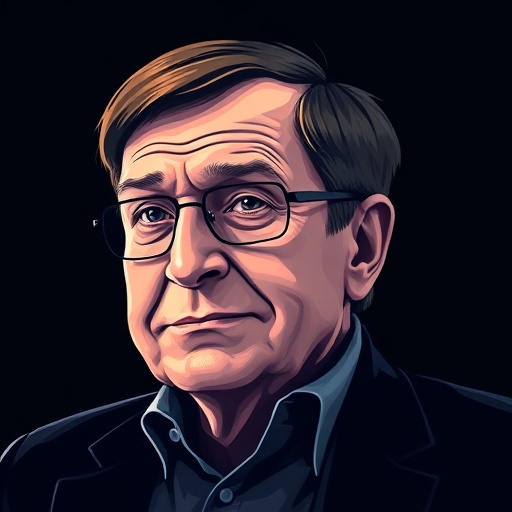
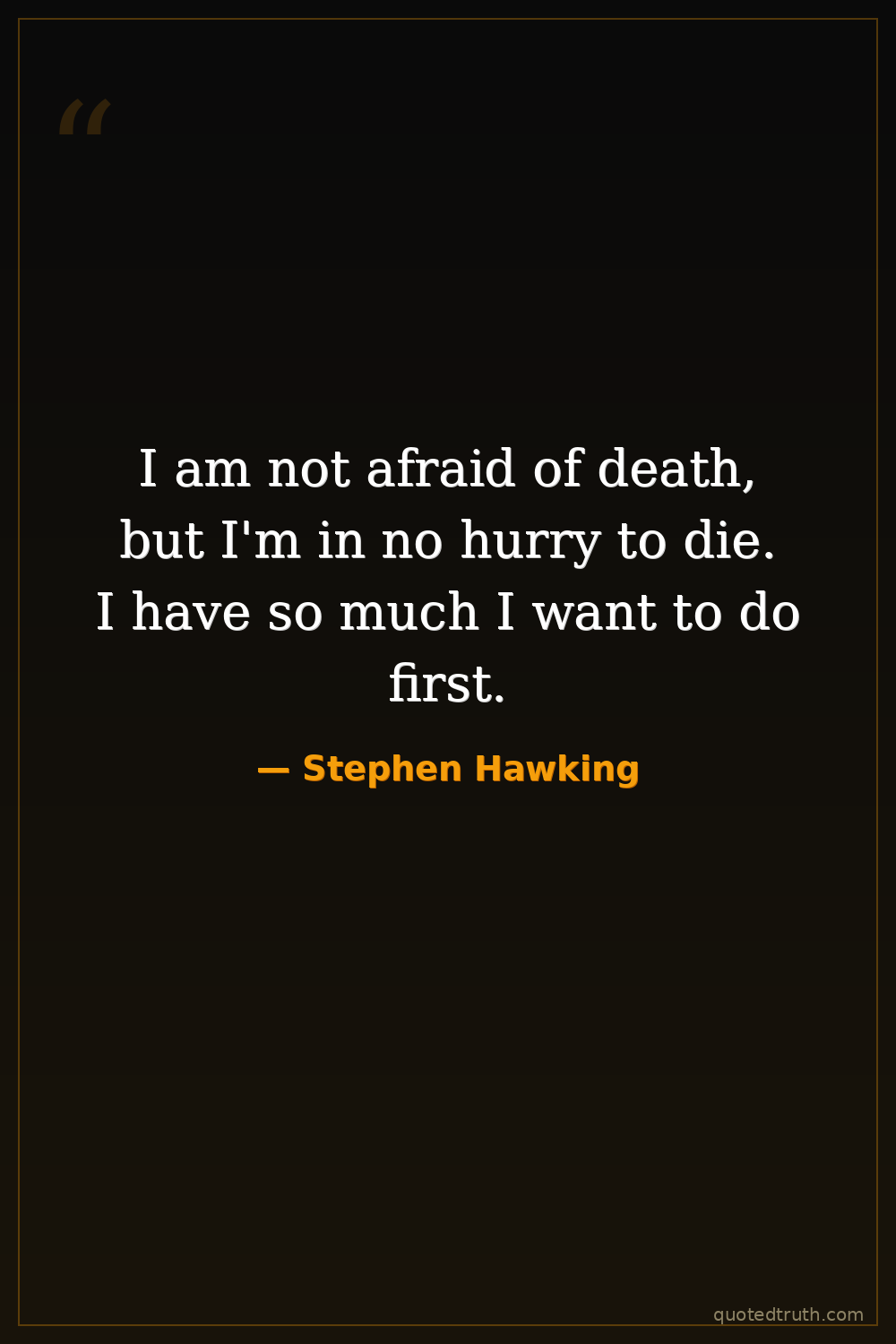
Stephen Hawking — "I am not afraid of death, but I'm in no hurry to die. I have so much I want to d…"
I am not afraid of death, but I'm in no hurry to die. I have so much I want to do first.
I am not afraid of death, but I'm in no hurry to die. I have so much I want to do first.
Click any product to generate a realistic preview. Up to 3 at a time.
* Initial load can take up to 90 seconds — revising the preview in another color is nearly instant.
"The human failing I would most like to correct is aggression. It may have had survival advantage in caveman days, to get more food, territory or partner with whom to reproduce, but now it threatens to…"
"I have no idea. People who boast about their IQ are losers."
"Slapstick is always funny. Oh yeah? How about now?"
"Yes. And also a universe where you're funny."
"The universe is a cruel, uncaring void. The key to being happy isn't to search for meaning. It's to just keep yourself busy with unimportant nonsense, and eventually, you'll be dead."
British theoretical physicist whose Hawking radiation work and A Brief History of Time (1988) brought black-hole physics to a mass audience while he lived with ALS for 55 years. Closely associated with Roger Penrose (his collaborator on singularity theorems) and Carl Sagan (fellow popularizer who wrote Brief History's foreword). For an intellectual contrast, see William Lane Craig, American philosopher of religion — Craig's Kalam cosmological argument depends on the Big Bang requiring a divine first cause; Hawking's no-boundary proposal was specifically designed to remove the moment that would require one — the cleanest cosmology-vs-natural-theology contrast in modern thought.
Found in 1 providers: grok
1 source checked
Death is accepted as inevitable, but it holds no power to paralyze or rush. The focus is entirely on what remains to be done — work, discovery, contribution. This is a stance of purposeful urgency rather than fear: mortality becomes irrelevant background noise when life is full of meaningful goals. It reframes the question from 'how long do I have?' to 'how much can I accomplish?'
Diagnosed with ALS at 21 and given two years to live, Hawking spent 55 more years producing landmark work on black hole radiation, the Big Bang's origins, and the nature of time. His body became almost entirely paralyzed yet his output accelerated. He publicly joked about death while privately racing against it — completing A Brief History of Time, founding entire research programs, and contributing to physics until his final weeks.
Hawking worked through the Cold War's nuclear dread, the AIDS crisis, and growing public debate over physician-assisted dying — all eras saturated with mortality anxiety. His voice carried particular weight: a disabled scientist surviving a terminal diagnosis while the world worried about collective annihilation. His secular, purpose-driven indifference to death offered a counter-narrative to both religious consolation and existential despair that resonated broadly across a generation questioning traditional answers.
AI-generated insights based on extensive research and information for context. Factual errors? Email [email protected].
Your cart is empty