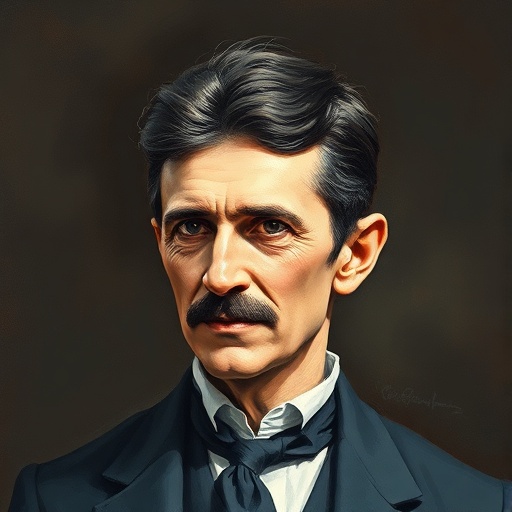
Nikola Tesla — "I am not an inventor, I am a discoverer."
I am not an inventor, I am a discoverer.
I am not an inventor, I am a discoverer.
Click any product to generate a realistic preview. Up to 3 at a time.
* Initial load can take up to 90 seconds — revising the preview in another color is nearly instant.
"This gives you vigor and vitality."
"I have toiled ceaselessly for a quarter of a century for the love of science, to benefit humanity."
"The ideal of a true man is to lead a life of self-sacrifice and devotion to the welfare of others."
"There are three possible solutions to the problem of increase of human energy: nutrition, peace, work."
"I felt that I could not touch the hair of other people, except with gloves."
Serbian-American inventor and electrical engineer whose alternating-current designs powered the modern electrical grid; died poor and largely forgotten. Closely associated with George Westinghouse (his AC-power business partner) and Mihajlo Pupin (fellow Serbian-American physicist at Columbia). For an intellectual contrast, see Thomas Edison, American inventor and direct-current advocate — Edison's direct-current power-distribution scheme was displaced by Tesla-Westinghouse AC in the 1890s 'War of Currents'. Edison ran a public-relations campaign electrocuting animals to discredit AC — the most famous engineering-ethics rivalry in American history. Tesla's AC won and powers nearly every electrical grid on Earth.
Attributed, reflecting his view that he was uncovering existing principles.
Date: Early 20th Century
EducationalFound in 1 providers: grok
1 source checked
The quote draws a sharp line between creating something from scratch and uncovering what nature already contains. Tesla argued that forces like electricity, magnetism, and resonance existed long before any human touched them. His role was to find them, not fabricate them. He saw himself as a reader of the universe's hidden code, not an author writing new rules. Discovery implies humility; invention implies personal credit.
Tesla's greatest contributions — alternating current, the rotating magnetic field, radio transmission — were rooted in electromagnetic principles he believed he was exposing, not creating. He famously visualized complete machines before building them, as if reading blueprints nature had already written. His rivalry with Edison, a self-styled inventor who prized credit and patents, deepened this philosophical gap. Tesla genuinely considered himself nature's instrument, not its master.
The late 19th century was the Second Industrial Revolution, when electricity reshaped civilization almost overnight. Edison had made 'inventor' a cultural hero — someone who creates progress and claims it. Patent battles were fierce and financially decisive. Tesla's reframing challenged the era's worship of invention-as-ownership. Scientists were also debating legally what discovery versus invention meant, since patents required human novelty. Tesla's stance placed him closer to pure science than commercial entrepreneurship.
AI-generated insights based on extensive research and information for context. Factual errors? Email [email protected].
Your cart is empty