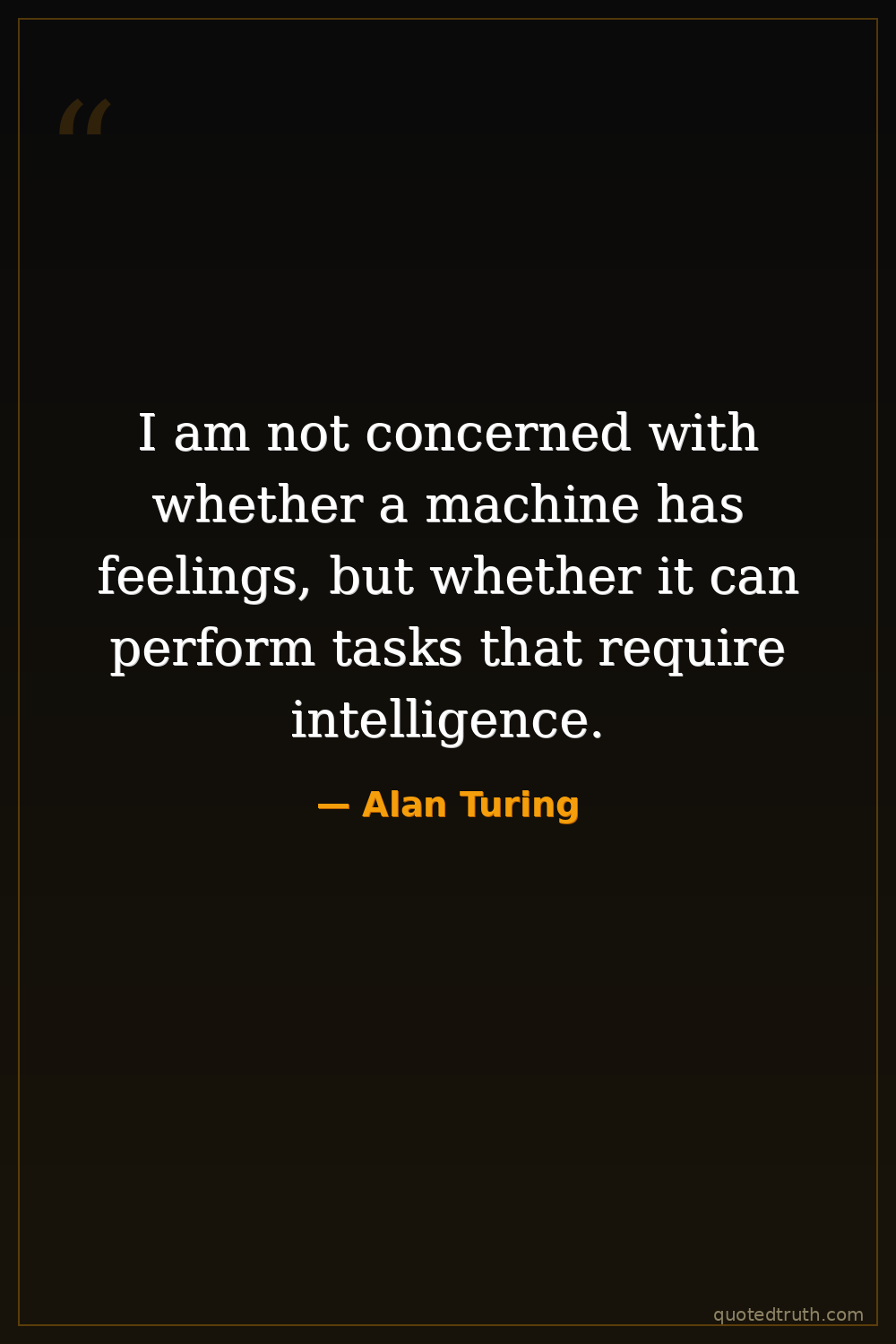
Alan Turing — "I am not concerned with whether a machine has feelings, but whether it can perfo…"
I am not concerned with whether a machine has feelings, but whether it can perform tasks that require intelligence.
I am not concerned with whether a machine has feelings, but whether it can perform tasks that require intelligence.
Click any product to generate a realistic preview. Up to 3 at a time.
* Initial load can take up to 90 seconds — revising the preview in another color is nearly instant.
"We are building a brain."
"The question of whether machines can think is a philosophical one, not a scientific one."
"If you cannot explain it simply, you do not understand it well enough."
"The question, 'Can machines think?' should be replaced by 'Are there imaginable digital computers which would do well in the imitation game?'"
"The computer is the most powerful tool ever invented by man."
Attributed, general implication from his writings, but exact quote is elusive.
Date: Approx. 1950
ShockingFound in 1 providers: grok
1 source checked
Intelligence isn't about inner experience or emotion — it's about what you can actually do. The quote argues for judging minds by observable performance, not unknowable internal states. If a machine solves problems, reasons through complexity, and produces intelligent outputs, it qualifies as intelligent regardless of whether anything feels like something inside it. This is behavioral functionalism: capability, not consciousness, defines intelligence.
Turing formalized this exact idea in his 1950 paper 'Computing Machinery and Intelligence,' introducing the Imitation Game — now called the Turing Test — which evaluates machine intelligence through conversation, not introspection. A mathematician and codebreaker who cracked Nazi Enigma through logical rigor, Turing valued testable definitions over philosophical speculation. Tragically prosecuted for his sexuality, he knew firsthand how inner experience was dismissed; capability was the only fair measure.
In the late 1940s and 1950s, the first electronic computers — ENIAC, Manchester Mark 1 — were just emerging, and society had no framework for thinking about machine minds. Philosophy was dominated by Cartesian dualism separating mind from matter. Turing's era witnessed the birth of cybernetics and information theory. His pragmatic stance cut through metaphysical fog at the exact moment humanity needed a workable definition of intelligence to guide the computing revolution.
AI-generated insights based on extensive research and information for context. Factual errors? Email [email protected].
Your cart is empty