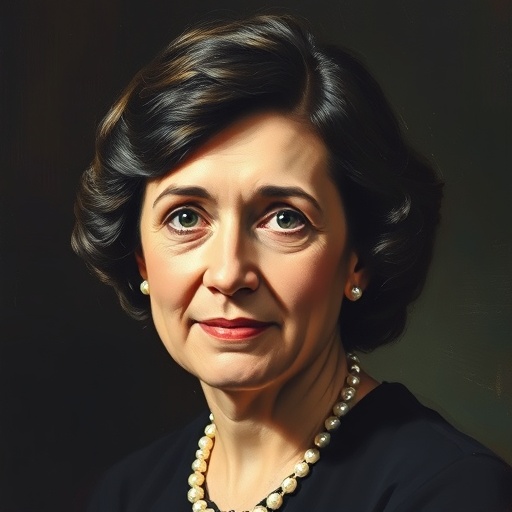
Rosalind Franklin — "I am not interested in building models. I am interested in finding out the truth…"
I am not interested in building models. I am interested in finding out the truth.
I am not interested in building models. I am interested in finding out the truth.
Click any product to generate a realistic preview. Up to 3 at a time.
* Initial load can take up to 90 seconds — revising the preview in another color is nearly instant.
"It's frustrating when others jump to conclusions without sufficient data."
"The atmosphere at King's College is not always conducive to collaborative research."
"The more I work on this, the more complex it seems to become."
"Science and everyday life cannot and should not be separated."
"I often feel that women in science have to work twice as hard to prove themselves."
Quoted by James Watson in 'The Double Helix' (though possibly a biased recollection, still reflects her approach)
Date: c. 1952
WisdomFound in 1 providers: grok
1 source checked
Franklin draws a sharp line between speculation and verified knowledge. Building models means proposing how something might work based on intuition, partial evidence, or guesswork. Finding the truth means letting rigorous experimental data determine the answer, even slowly. She prioritizes hard evidence over clever theorizing, refusing to commit to a picture of reality until measurements actually support it. The statement is a declaration of scientific discipline: conclusions follow from data, not the other way around.
This captures Franklin's exacting crystallographic method at King's College London. While Watson and Crick raced to assemble physical DNA models, she meticulously analyzed X-ray diffraction patterns, including Photo 51, to derive structure mathematically. Trained in physical chemistry at Cambridge, she distrusted speculative leaps and insisted on quantitative proof. Her caution was later framed as a flaw, but it reflected genuine scientific integrity. Watson himself recorded this remark in The Double Helix, intending criticism though it reads as principle.
In 1950s molecular biology, two cultures collided: model-builders like Pauling, Watson, and Crick who guessed structures and tested fit, and crystallographers who extracted structures from diffraction data. Postwar physics was flooding into biology, and the race to decode the gene attracted intense competition. Franklin worked in a male-dominated King's College where women were barred from the senior common room. The model-versus-data tension she names defined the 1953 DNA discovery and the credit dispute that followed.
AI-generated insights based on extensive research and information for context. Factual errors? Email [email protected].
Your cart is empty