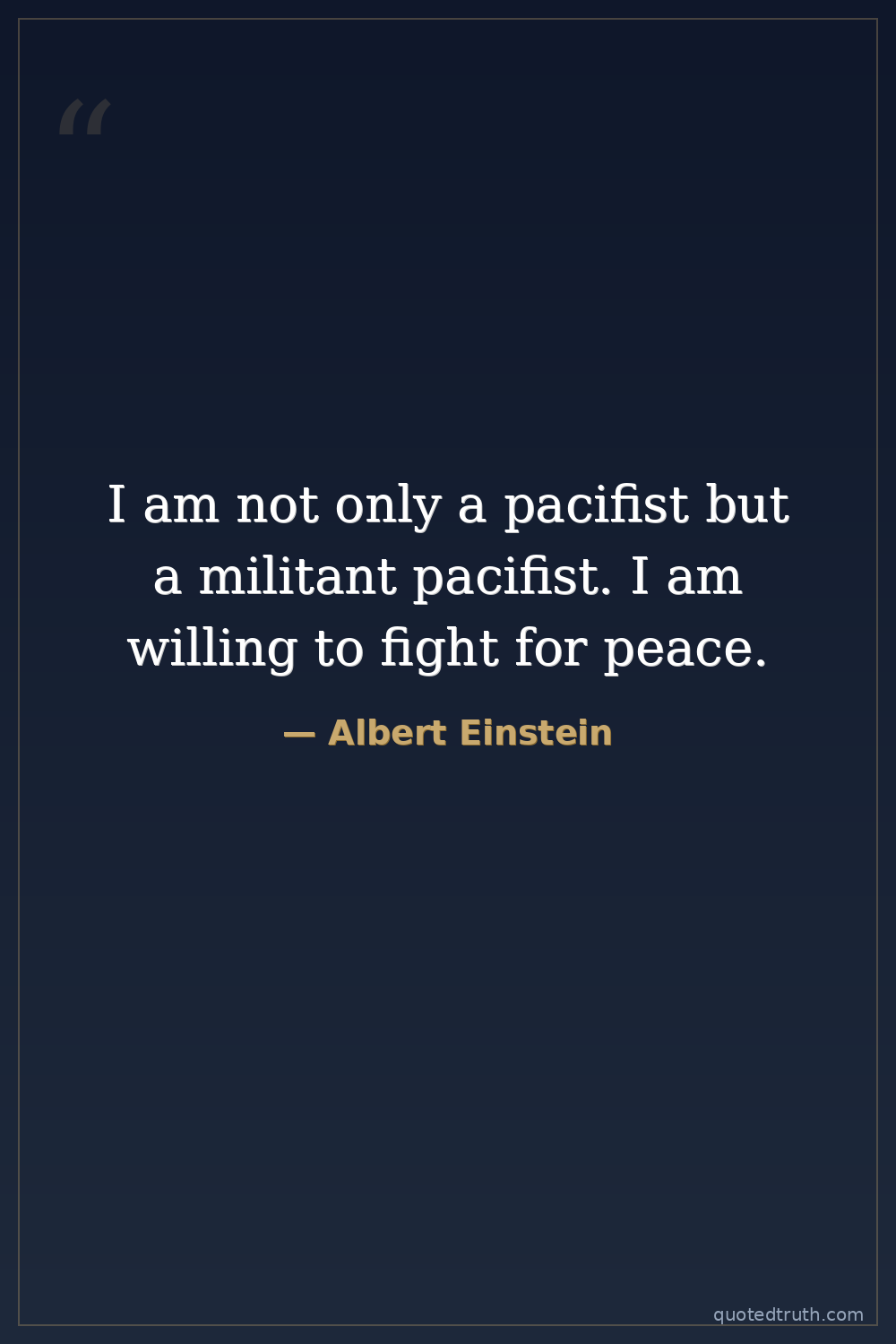
Albert Einstein — "I am not only a pacifist but a militant pacifist. I am willing to fight for peac…"
I am not only a pacifist but a militant pacifist. I am willing to fight for peace.
I am not only a pacifist but a militant pacifist. I am willing to fight for peace.
Click any product to generate a realistic preview. Up to 3 at a time.
* Initial load can take up to 90 seconds — revising the preview in another color is nearly instant.
"My passion for social justice has often brought me into conflict with people, as has my aversion to all kinds of authority."
"The pursuit of truth and beauty is a sphere of activity in which we are permitted to remain children all our lives."
"I am against any form of violence, for I know that violence only leads to more violence."
"Marriage is the unsuccessful attempt to make something lasting out of an incident."
"The only reason for time is so that everything doesn't happen at once."
Found in 1 providers: deepseek
1 source checked
Being peaceful isn't passive — it requires active commitment and courage. True peace demands you stand up, speak out, and confront forces that threaten it. Pacifism isn't cowardice or withdrawal; it's a deliberate, determined struggle against war and violence, pursued with the same intensity and willingness to sacrifice that soldiers bring to combat, but directed toward preventing conflict rather than waging it.
Einstein witnessed both World Wars firsthand, fleeing Nazi Germany in 1933. Despite devoting his life to pure physics, he signed the Russell-Einstein Manifesto warning against nuclear weapons and publicly opposed militarism throughout his career. The man whose E=mc² enabled the atomic bomb carried profound guilt over Hiroshima, making militant pacifism his personal moral reckoning — science's power demanded an equally forceful ethical response.
Einstein spoke these words amid rising European fascism in the 1930s, when pacifist movements faced the brutal paradox of Hitler's expansion. Traditional pacifism seemed naive against totalitarian aggression. The post-WWI disillusionment had energized peace movements globally, yet the League of Nations was collapsing. Einstein's formulation addressed this tension directly — acknowledging that preserving peace in that climate required confrontational advocacy, not quiet withdrawal.
AI-generated insights based on extensive research and information for context. Factual errors? Email [email protected].
Your cart is empty