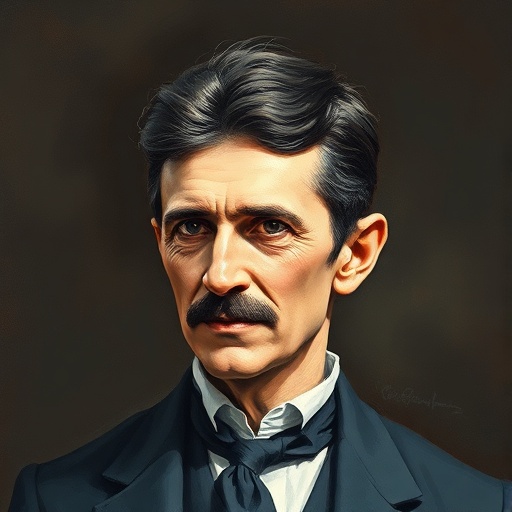
Nikola Tesla — "I am unwilling to submit to any procedure for the determination of my mental con…"
I am unwilling to submit to any procedure for the determination of my mental condition.
I am unwilling to submit to any procedure for the determination of my mental condition.
Click any product to generate a realistic preview. Up to 3 at a time.
* Initial load can take up to 90 seconds — revising the preview in another color is nearly instant.
"Even matter which is called inorganic, deemed dead, responds to the disbelievers and gives irrefutable proof of the living principle within itself. Everything that exists, organic or inorganic, living…"
"Restraint has not always been according to my taste, but my pleasurable experiences are a huge reward."
"Of all things, I liked books best."
"In the twenty-first century, the robot will take the place which slave labor occupied in ancient civilization."
"I have been so misunderstood, so misrepresented, so abused, by my enemies, that it is a wonder I am still alive."
Serbian-American inventor and electrical engineer whose alternating-current designs powered the modern electrical grid; died poor and largely forgotten. Closely associated with George Westinghouse (his AC-power business partner) and Mihajlo Pupin (fellow Serbian-American physicist at Columbia). For an intellectual contrast, see Thomas Edison, American inventor and direct-current advocate — Edison's direct-current power-distribution scheme was displaced by Tesla-Westinghouse AC in the 1890s 'War of Currents'. Edison ran a public-relations campaign electrocuting animals to discredit AC — the most famous engineering-ethics rivalry in American history. Tesla's AC won and powers nearly every electrical grid on Earth.
Statement made in court during a legal dispute.
Date: 1916 (during the Marconi lawsuit)
GeneralFound in 1 providers: grok
1 source checked
A firm refusal to undergo psychological or psychiatric evaluation. The speaker asserts that no external authority holds the right to judge their mental competence. It is a declaration of intellectual autonomy — a rejection of being categorized, pathologized, or diminished by professional assessment. In modern terms, it captures the defiance of someone fiercely protective of their independence and deeply resistant to having their mind scrutinized or second-guessed by any institution or individual.
Tesla was notorious for behavior others deemed strange — obsessive counting rituals, mysophobia, intense attachment to pigeons, and solitary hotel living in his final years. As his finances collapsed and grand projects went unfunded, rivals and creditors sometimes questioned his sanity. Yet he remained intellectually sharp, filing patents into his eighties. This statement mirrors his lifelong contempt for anyone who would reduce his unconventional genius to a clinical diagnosis or use psychiatry to undermine his credibility.
In Tesla's era, psychiatry wielded enormous social power with little oversight. Commitment laws allowed courts to strip individuals of legal rights based on minimal evidence, and the eugenics movement framed eccentricity as hereditary defect. Brilliant figures who defied social convention risked being labeled delusional. Sanatorium commitment was a real institutional threat. For a man who envisioned wireless global energy transmission and claimed to receive signals from other planets, psychiatric judgment represented a genuine existential danger to his freedom and legacy.
AI-generated insights based on extensive research and information for context. Factual errors? Email [email protected].
Your cart is empty