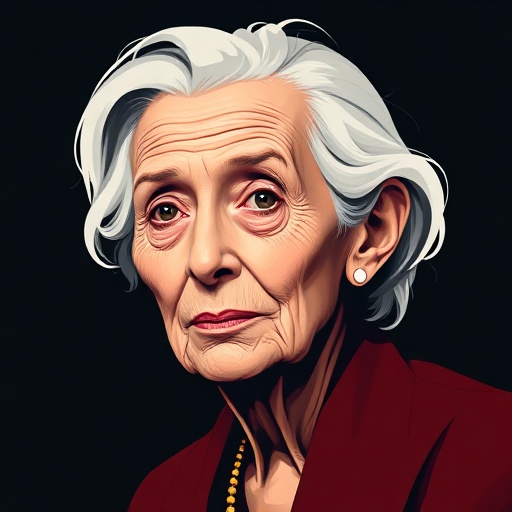
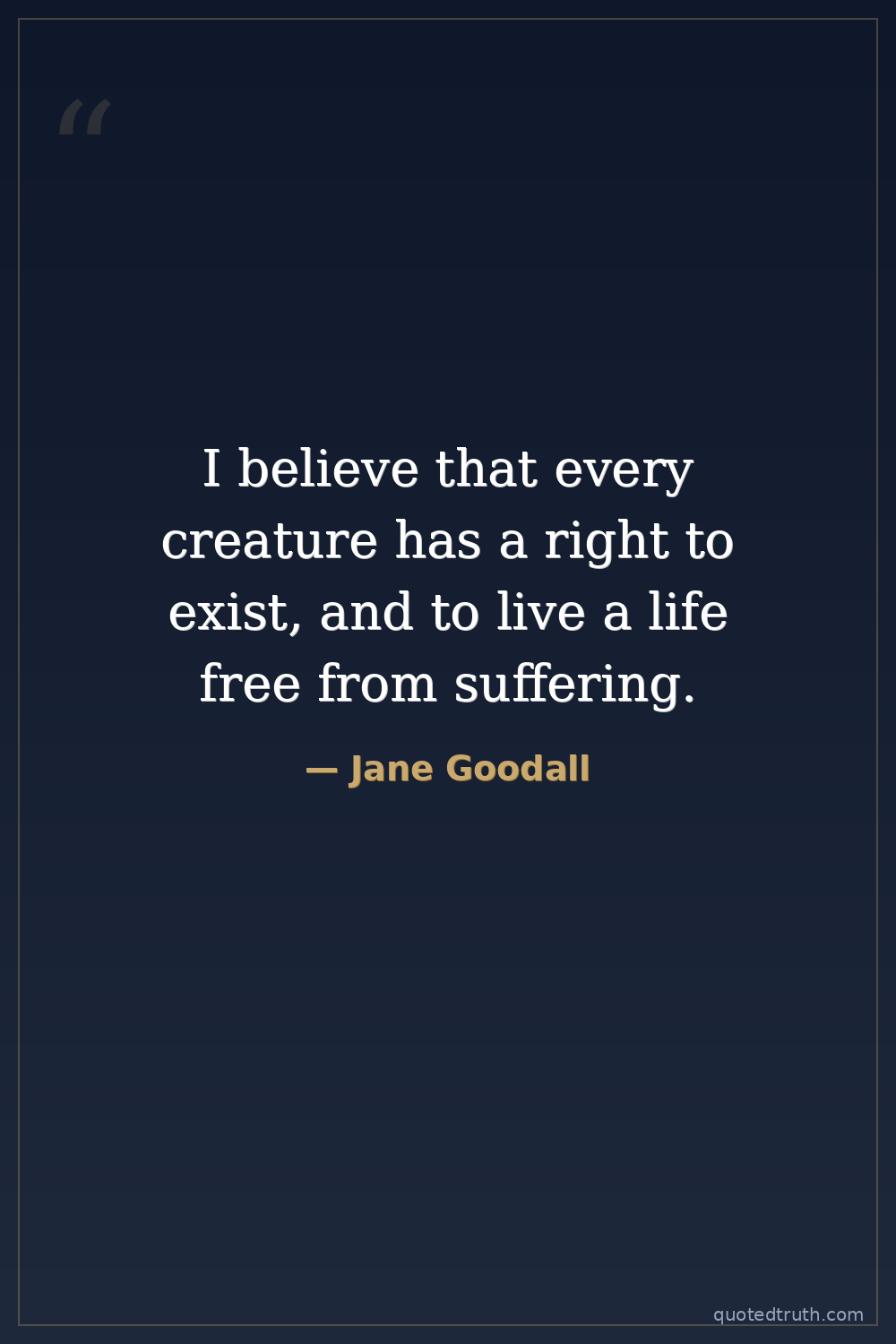
Jane Goodall — "I believe that every creature has a right to exist, and to live a life free from…"
I believe that every creature has a right to exist, and to live a life free from suffering.
I believe that every creature has a right to exist, and to live a life free from suffering.
Click any product to generate a realistic preview. Up to 3 at a time.
* Initial load can take up to 90 seconds — revising the preview in another color is nearly instant.
"Every individual matters. Every individual has a role to play. Every individual makes a difference."
"Every single one of us can make a difference, and we should never forget that."
"We have so much to learn from the animals, if we would only listen."
"My message is one of hope, but it's also a call to action."
"We can't save the world if we don't save the animals."
British primatologist who in 1960 began the longest-running wild primate study at Gombe Stream, transforming our understanding of chimpanzees. Closely associated with Dian Fossey (mountain-gorilla researcher) and Birutė Galdikas (orangutan researcher; together with Goodall and Fossey one of Louis Leakey's 'Trimates'). For an intellectual contrast, see Walter Palmer, American dentist who killed Cecil the Lion in Zimbabwe in 2015 — Palmer represents the trophy-hunting tradition Goodall's life's work has been organized against — the colonial-era hunter-naturalist worldview that treated primates and big game as specimens or trophies, which Goodall's Roots & Shoots and Jane Goodall Institute exist specifically to displace.
Found in 1 providers: grok
1 source checked
Every living creature has an inherent right to exist and to be spared unnecessary pain. This is a core animal ethics principle: animals are not resources or tools but beings with intrinsic worth deserving moral consideration. It challenges systems that treat non-human life as disposable — factory farming, invasive testing, habitat destruction — insisting that ethical responsibility must extend beyond humanity to all sentient creatures sharing this planet.
Goodall's six decades studying chimpanzees at Gombe revealed their grief, joy, tool use, and complex social bonds — proving animals have rich inner lives. That scientific witness transformed her from researcher into activist. She founded the Jane Goodall Institute and Roots & Shoots program, campaigned against invasive lab testing, and became a leading voice for wildlife conservation. This quote distills her conviction that knowledge of animal minds creates an unambiguous moral obligation to protect them.
Goodall's career spans an era of profound tension between industrial expansion and ecological awareness. Peter Singer's Animal Liberation (1975) challenged speciesism philosophically; factory farming scaled massively through the 1970s–80s; species extinction accelerated alongside deforestation and climate change. Animal testing controversies sparked public protests. By the 1990s–2000s, biodiversity loss reached crisis levels. Goodall's scientific credibility gave this ethical position unusual weight precisely when governments and corporations resisted extending rights to non-human life.
AI-generated insights based on extensive research and information for context. Factual errors? Email [email protected].
Your cart is empty