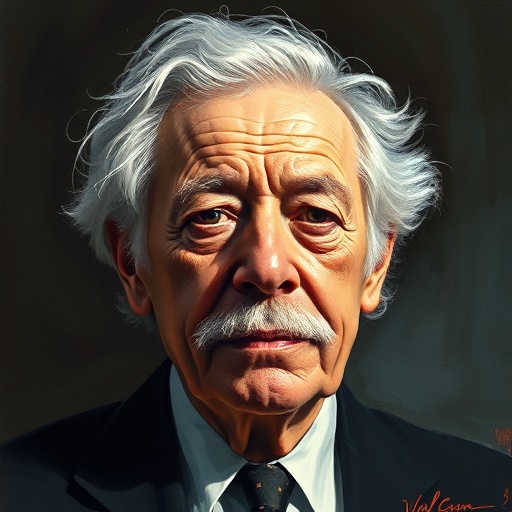
Linus Pauling — "I believe that every problem has a solution, and that we should never give up on…"
I believe that every problem has a solution, and that we should never give up on finding it.
I believe that every problem has a solution, and that we should never give up on finding it.
Click any product to generate a realistic preview. Up to 3 at a time.
* Initial load can take up to 90 seconds — revising the preview in another color is nearly instant.
"I believe that the future of humanity depends on our ability to cooperate and to solve the problems that confront us."
"I have spent a good deal of my life trying to get people to eat more vitamin C."
"I have always been interested in the nature of things, and especially in the nature of life."
"A good scientist thinks logically and accurately when conditions call for logical and accurate thinking—but so does any other good worker when he has a sufficient number of well-founded facts to serve…"
"I think that the vitamin C story is a very important story, and it's a story that has not yet been told in its entirety."
Found in 1 providers: grok
1 source checked
Every challenge, no matter how intractable it appears, has an answer waiting to be discovered. Persistence is not optional — abandoning the search for a solution is itself a failure. This is a commitment to optimism grounded in effort: the world is fundamentally solvable, and the only real defeat is stopping the inquiry before the answer emerges.
Pauling embodied this belief across two Nobel Prizes — Chemistry in 1954 for chemical bonding theory, and Peace in 1962 for anti-nuclear activism. When the scientific establishment dismissed his campaign against nuclear testing, he persisted for over a decade. His vitamin C megadose research continued despite medical skepticism. He treated both molecular structure and geopolitical catastrophe as problems demanding rigorous, tireless solutions.
Pauling's career spanned the Cold War nuclear arms race, when humanity faced genuine existential threats. Scientists were newly confronted with the consequences of their discoveries — atomic weapons, chemical warfare, environmental contamination. His era demanded that researchers ask not just 'can we?' but 'should we, and how do we fix what we've broken?' The solvability of problems was both a scientific and moral necessity.
AI-generated insights based on extensive research and information for context. Factual errors? Email [email protected].
Your cart is empty