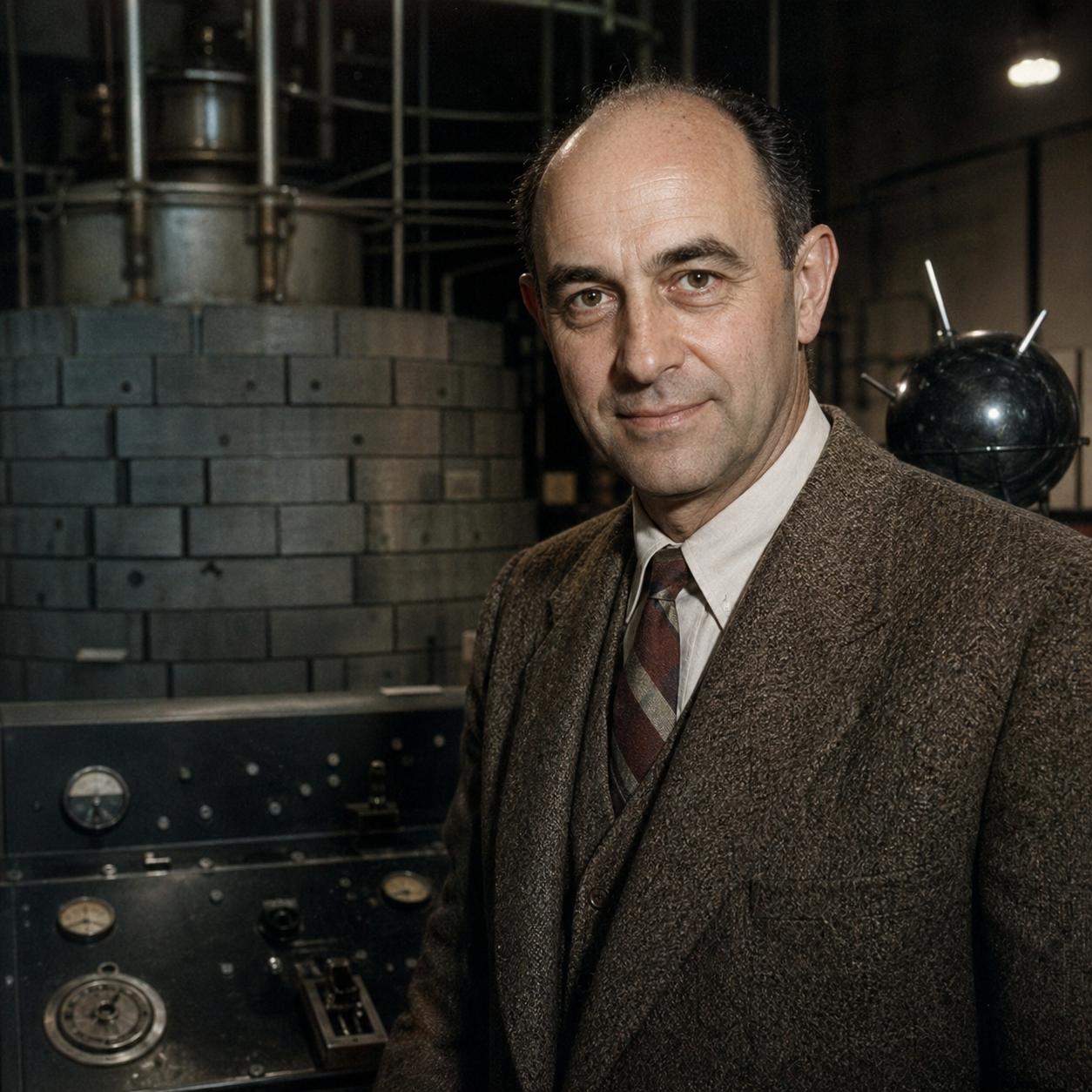
Enrico Fermi — "I believe that the future of humanity depends on our ability to control the forc…"
I believe that the future of humanity depends on our ability to control the forces that we have unleashed.
I believe that the future of humanity depends on our ability to control the forces that we have unleashed.
Click any product to generate a realistic preview. Up to 3 at a time.
* Initial load can take up to 90 seconds — revising the preview in another color is nearly instant.
"I hope it works."
"Don't ever tell anybody anything, or you'll never get anything done."
"I am not an optimist. I am a realist. I believe that we must be prepared for the worst, and hope for the best."
"The greatest discovery yet to be made is the discovery of what we do not know."
"The only constant in life is change."
Found in 1 providers: grok
1 source checked
Humanity's continued existence depends on responsible stewardship of the powerful technologies it invents. Discovery alone isn't enough — the ability to govern, limit, and wisely direct those discoveries determines survival. Once a force is released into the world, whether nuclear energy, genetic engineering, or artificial intelligence, the challenge shifts from creation to control. Progress becomes dangerous without the wisdom and institutions to manage what science makes possible.
Fermi built Chicago Pile-1, the world's first nuclear reactor, in 1942 beneath a University of Chicago squash court — physically realizing the chain reaction he theorized. As a Manhattan Project architect, he helped create weapons that leveled two cities. That firsthand experience of unleashing nuclear fission and watching its consequences made this not abstract philosophy but personal reckoning. Fermi spent his later career advocating for civilian nuclear energy and arms control.
Fermi worked through the 1940s and early 1950s, when nuclear fission transformed from laboratory curiosity to civilization-scale threat. The Trinity test in 1945, followed by Hiroshima and Nagasaki, proved physics could end cities in seconds. The Cold War immediately accelerated the arms race — by 1949 the Soviet Union had its own bomb. Scientists faced a question humanity had never confronted: what responsibility does a creator bear for a weapon that cannot be un-invented?
AI-generated insights based on extensive research and information for context. Factual errors? Email [email protected].
Your cart is empty