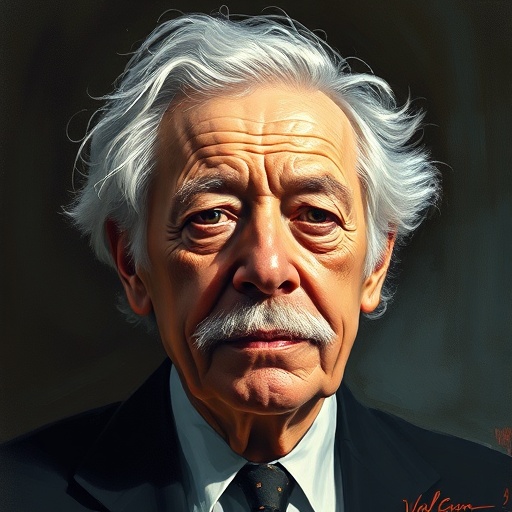
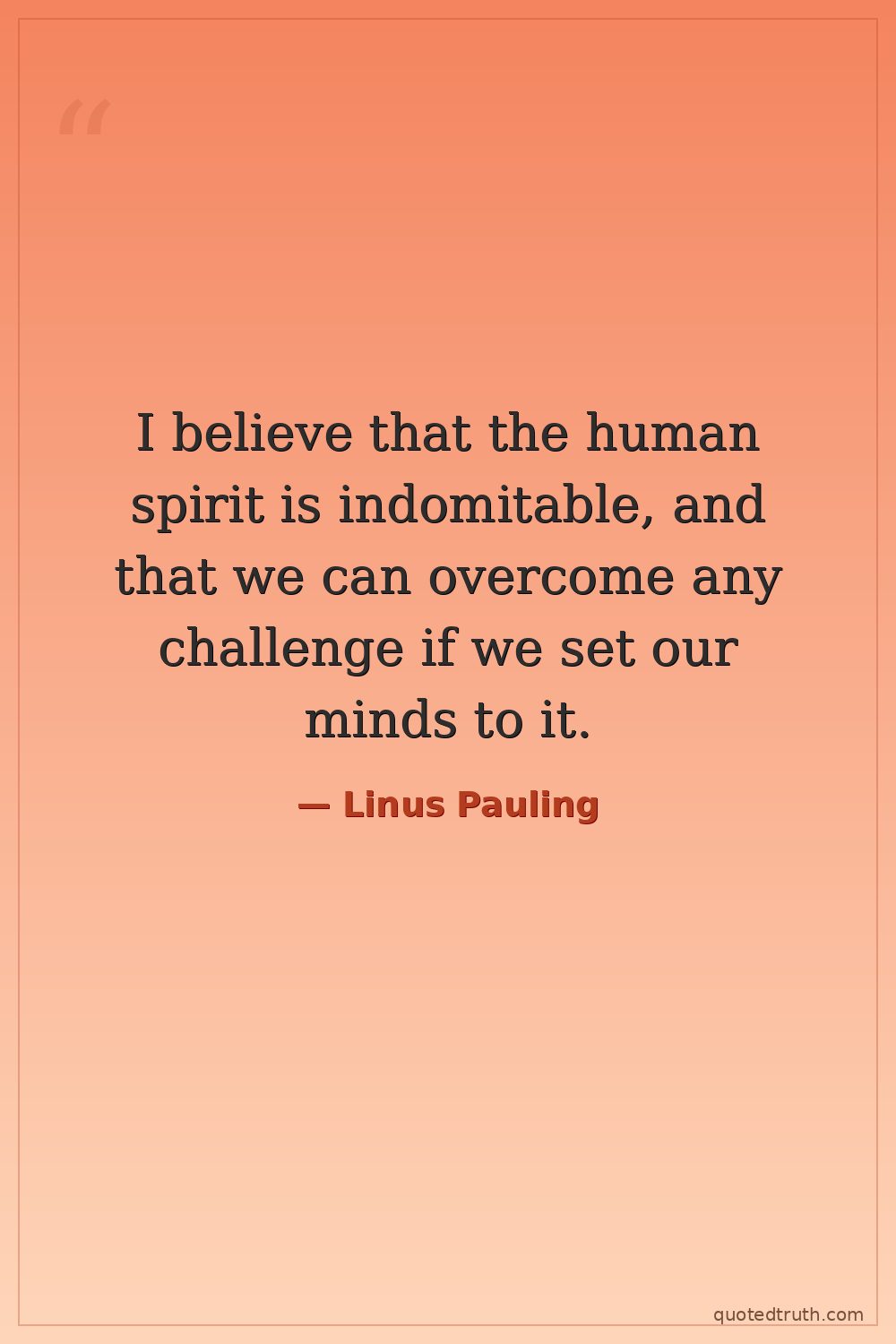
Linus Pauling — "I believe that the human spirit is indomitable, and that we can overcome any cha…"
I believe that the human spirit is indomitable, and that we can overcome any challenge if we set our minds to it.
I believe that the human spirit is indomitable, and that we can overcome any challenge if we set our minds to it.
Click any product to generate a realistic preview. Up to 3 at a time.
* Initial load can take up to 90 seconds — revising the preview in another color is nearly instant.
"I might well have become egotistical as a result [of the Langmuir Prize].... But... I think that I just said I shouldn't let this go to my head. I shouldn't think I'm really better than other people e…"
"I believe that the pursuit of knowledge is one of the most noble endeavors of humanity."
"The only difference between a good idea and a bad idea is that a good idea works."
"Orthomolecular medicine is the preservation of good health and the treatment of disease by varying the concentrations of substances normally present in the body."
"The greatest discoveries of science have always been made by those who were not afraid to challenge the existing paradigms."
Found in 1 providers: grok
1 source checked
Human willpower and determination can conquer any obstacle. When people commit their full mental and emotional energy toward a goal, even the largest barriers become surmountable. The quote rejects fatalism and defeatism, asserting that the human mind's capacity for focus, creativity, and persistence is the deciding factor in success. Belief in oneself and collective human potential unlocks solutions that seem impossible from the outside.
Pauling embodied this conviction through extraordinary personal perseverance. He revolutionized chemistry by applying quantum mechanics to molecular bonding, winning the 1954 Nobel Prize in Chemistry. Then, defying McCarthyism-era persecution — his passport was revoked for anti-nuclear activism — he campaigned relentlessly against nuclear weapons, winning the 1962 Nobel Peace Prize, remaining the only person to win two unshared Nobel Prizes.
Pauling's active decades spanned the Cold War, when nuclear weapons threatened civilization's existence. The McCarthy era silenced dissidents through fear and blacklisting. Yet grassroots movements — anti-nuclear campaigns, civil rights, peace activism — proved ordinary people could challenge superpower governments. Pauling's advocacy helped produce the 1963 Partial Nuclear Test Ban Treaty, a real-world example of human determination reshaping policy against enormous institutional opposition.
AI-generated insights based on extensive research and information for context. Factual errors? Email [email protected].
Your cart is empty