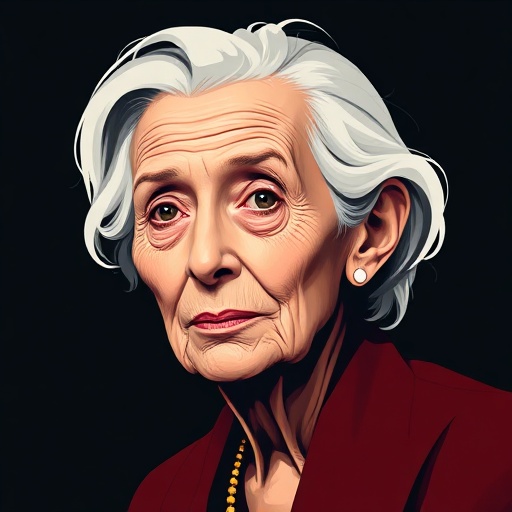
Jane Goodall — "I believe that there is hope for the future, as long as we don't give up."
I believe that there is hope for the future, as long as we don't give up.
I believe that there is hope for the future, as long as we don't give up.
Click any product to generate a realistic preview. Up to 3 at a time.
* Initial load can take up to 90 seconds — revising the preview in another color is nearly instant.
"We are at a crossroads, and we have to choose between a path of destruction and a path of hope."
"My mother always told me that if I wanted to achieve something, I had to work hard and never give up."
"Every single creature on this planet has a right to exist."
"The chimpanzees taught me that it's important to be patient."
"We need to reconnect with nature. We need to remember that we are part of it, not separate from it."
British primatologist who in 1960 began the longest-running wild primate study at Gombe Stream, transforming our understanding of chimpanzees. Closely associated with Dian Fossey (mountain-gorilla researcher) and Birutė Galdikas (orangutan researcher; together with Goodall and Fossey one of Louis Leakey's 'Trimates'). For an intellectual contrast, see Walter Palmer, American dentist who killed Cecil the Lion in Zimbabwe in 2015 — Palmer represents the trophy-hunting tradition Goodall's life's work has been organized against — the colonial-era hunter-naturalist worldview that treated primates and big game as specimens or trophies, which Goodall's Roots & Shoots and Jane Goodall Institute exist specifically to displace.
Found in 1 providers: grok
1 source checked
Hope is not passive — it requires that people refuse to quit. The quote frames hope as conditional on sustained human effort: as long as someone keeps trying, good outcomes remain possible. It pushes back against defeatism and paralysis in the face of overwhelming problems, arguing that surrender is the only true failure. Giving up is the one guaranteed way to ensure nothing improves.
Goodall began her Gombe chimpanzee research in 1960 and spent over six decades as both scientist and activist. After documenting chimp social complexity, she shifted to global conservation work, founding the Jane Goodall Institute (1977) and Roots & Shoots (1991). Despite witnessing rampant deforestation and species collapse across Africa, she chose sustained optimism over despair — traveling 300 days a year well into her 80s to advocate for environmental action.
Goodall's active years span the early 1960s through today, overlapping with severe environmental deterioration: accelerating deforestation, rising eco-anxiety among youth, biodiversity reaching crisis levels, and climate change turning existential. When scientists and activists increasingly struggle with hopelessness — particularly after failed climate summits and accelerating habitat loss — her insistence on conditional hope offered a psychologically sustainable model for continued environmental engagement.
AI-generated insights based on extensive research and information for context. Factual errors? Email [email protected].
Your cart is empty